

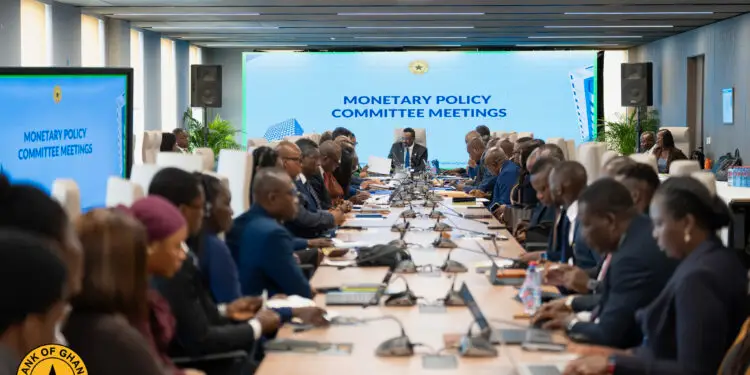
The Bank of Ghana’s Monetary Policy Committee (MPC) has unanimously maintained the Monetary Policy Rate (MPR) at 14.0 percent, citing a broadly balanced outlook for inflation and economic growth despite emerging global and domestic price pressures.
Announcing the decision after the MPC meeting, Governor Dr. Johnson Asiama said the committee judged that current monetary conditions remain appropriate, with inflation expectations easing even as headline inflation edged up in August.
The decision comes against a backdrop of heightened geopolitical tensions, elevated crude oil prices and tightening monetary policy by major central banks, developments that have increased uncertainty for emerging and frontier economies.
“Based on these considerations, the Monetary Policy Committee viewed the balance of risks to inflation and growth as broadly balanced, and the committee voted by a unanimous decision to maintain the monetary policy rate at 14.0 percent,” the Governor stated.

The MPC noted that headline inflation rose to 5.0 percent in August 2026, from 4.6 percent in July, driven mainly by higher non-food inflation following utility tariff adjustments and increased crude oil prices.
However, underlying inflationary pressures continued to moderate. The Bank’s core inflation measure, which excludes energy and utility prices, eased slightly to 4.2 percent from 4.3 percent in July.
In addition, inflation expectations among consumers, businesses and the banking sector declined during the review period.
According to the Governor, headline inflation remains below the lower band of the Bank’s medium-term target range of 8 percent, plus or minus 2 percentage points, but is expected to gradually move back into the target band over the coming quarters.
The committee’s decision was also influenced by continued resilience in economic activity.
Real GDP growth stood at 6.0 percent in the second quarter of 2026, supported by strong performances in the services and industrial sectors.
The Bank’s Composite Index of Economic Activity recorded annual growth of 14.9 percent in July 2026, compared with 6.1 percent a year earlier.
The MPC said easing credit conditions, stronger private sector lending and improving business and consumer confidence continue to support economic expansion.
Private sector credit growth rebounded sharply to 35.5 percent in August 2026, up from 13.3 percent a year earlier, reflecting improved access to financing amid lower lending rates.
Despite the improving domestic picture, the committee expressed concern about increasing global inflationary pressures linked to higher energy costs and persistent supply chain disruptions.
Crude oil prices have climbed above US$100 per barrel, while expectations of a strong El Niño weather pattern raise concerns about food supply and global commodity prices.
At the same time, leading central banks, including the U.S. Federal Reserve, European Central Bank and Bank of Japan, have resumed policy tightening in response to persistent inflation, a development that could tighten global financing conditions and strengthen the U.S. dollar.
The MPC identified several upside risks to inflation, including further increases in utility tariffs, higher petroleum prices, associated transport fare adjustments and potential imported inflation from a stronger dollar.
However, the committee also pointed to factors likely to moderate inflation, including continued fiscal consolidation, stable exchange rate conditions and improved domestic food supply.
With these competing forces broadly offsetting each other, policymakers opted to leave rates unchanged while monitoring developments.
Source: businesspostonline