

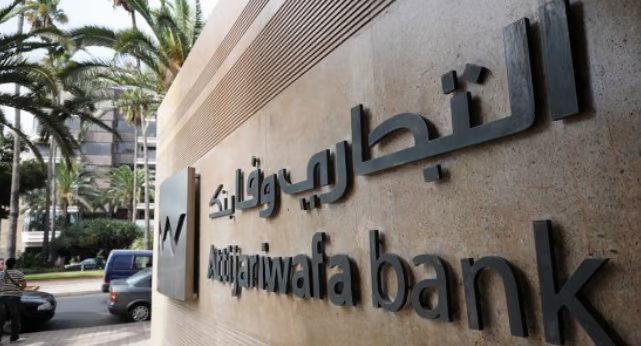
The announced agreement for the takeover of Société Générale Ghana by Morocco’s Attijariwafa Bank, as agreed by both parties, will bring one of Africa’s largest banking groups into Ghana, replacing a French multinational that has been reducing its African footprint with a Moroccan institution whose strategy has been built around expanding across the continent.
Under the agreement announced on October 1, 2026, Société Générale Group will sell its entire 60.22 percent holding in Société Générale Ghana. Attijariwafa Bank will acquire 55.22 percent, while Ghana’s Social Security and National Insurance Trust (SSNIT) will acquire 5 percent. Attijariwafa is also expected to take over the Ghanaian bank’s activities, customer portfolios and employees. Completion remains conditional on regulatory approvals.
A substantial Moroccan financial group
Attijariwafa Bank was created in 2004 through the merger of Banque Commerciale du Maroc, founded in 1911, and Wafabank, founded in 1904. Its reference shareholder is Al Mada, which held 46.5 percent of its capital at December 31, 2025. The bank is listed on the Casablanca Stock Exchange.

Its issued share capital at the end of 2025 was equivalent to roughly US$220 million at exchange rates around the period, its shareholders’ equity was much larger at the equivalent of about.US$8,232 million. The distinction is important: share capital represents the nominal paid-in capital, whereas shareholders’ equity incorporates retained earnings and other capital components.
On a consolidated basis, Attijariwafa ended 2025 with about the equivalent of US$79 billion in assets, (converted at current exchange rates between the US dollar and the Moroccan Dirham) close to US$8 billion in shareholders equity and over US$52 billion in customers’ deposits. Customer loans amounted to approximately US$44.7 billion
Its 2025 net banking income, the banking-sector equivalent most closely corresponding to gross operating revenue, was about US$3.5 billion – using current exchange rates – roughly the same as the bank made in 2024. Consolidated net profit reached about US$ 1.2 billion, while profit attributable to the group was about US$1 billion.
The group had more than 12 million customers and 22,052 employees at year-end and operated in 27 countries.
A genuinely pan-African network
Africa is central to Attijariwafa’s business model rather than a peripheral international operation. Its subsidiaries span North, West and Central Africa.
In North Africa, the group owns Attijari bank Tunisia, acquired in 2005, and Attijariwafa bank Egypt, created through its 2017 acquisition of 100 percent of Barclays Bank Egypt. Its West African operations include CBAO in Senegal, BIM in Mali, Société Ivoirienne de Banque in Côte d’Ivoire, Attijari bank Mauritania, BIA-Togo and operations in Burkina Faso, Niger and Benin. In Central Africa it has subsidiaries including SCB Cameroon, Union Gabonaise de Banque, Crédit du Congo and Attijari bank Chad.
The group also operates through Attijariwafa bank Europe, based in France and serving France, Belgium, Germany, Italy, Spain, Britain and Switzerland through 60 branches. Outside its banking subsidiaries, it maintains representative offices in Dubai, Riyadh, Abu Dhabi, London, Montreal, Beijing and Doha.
This gives the Ghana transaction a potentially important regional dimension. Attijariwafa says its international retail banking operations contributed 32.8 percent of group net banking income and 27.3 percent of group net profit in 2025.
What kind of bank is it?
Attijariwafa operates essentially as a universal financial-services group rather than simply a conventional deposit-taking bank. Its activities cover retail and corporate banking, investment banking, asset management, insurance, consumer finance, leasing, factoring, securities intermediation and financial advisory services.
That model is particularly relevant to Ghana because Société Générale Ghana already has a strong corporate and institutional orientation, alongside retail banking. The incoming shareholder therefore has an existing continental model through which corporate clients can potentially access trade, investment, treasury and cross-border financial services.
The regulatory road to completion
The October 1 agreement does not itself transfer control. Because the transaction involves a change in control of a Ghanaian bank, regulatory approval from the Bank of Ghana is central.
Under Ghana’s Banks and Specialised Deposit-Taking Institutions Act, a person cannot acquire a significant shareholding in a bank without prior written Bank of Ghana approval. The supervisory thresholds include 5 percent, 10 percent, 20 percent, 30 percent, 50 percent and 75 percent. The Act also requires approval of arrangements involving the sale or transfer of the whole or part of a bank’s business.
For a sale of a bank, Bank of Ghana is required to communicate its decision within six months from receipt of complete information. Its assessment covers the financial and managerial resources of the acquiring institution, future prospects, competition, community needs, financial-system stability and anti-money-laundering controls. Where a foreign bank is involved, its home supervisor must also indicate that it has no objection.
The BoG’s merger-and-acquisition directive requires substantial documentation, including the acquisition agreement, audited financial statements, valuation and due-diligence reports, a capital plan and details and CVs of proposed directors and key management personnel.
Consequently, a completion during 2027 is a reasonable working expectation if the application is promptly lodged with complete documentation, but the agreement does not establish a fixed completion date. The statutory six-month period runs from receipt of complete information, not simply from the October 1 announcement.
Because Société Générale Ghana is listed on the Ghana Stock Exchange, the transaction will also have securities-market implications. The GSE has already published the transaction announcement, while the remaining conditions include the applicable regulatory and takeover requirements.
What may change after completion?
Attijariwafa’s previous acquisitions provide useful, though not definitive, clues.
Its acquisition of Barclays Bank Egypt is particularly instructive. The deal was completed in May 2017 after all regulatory approvals; the bank was rebranded Attijariwafa bank Egypt in November. Attijariwafa subsequently implemented a five-year strategic plan, with an emphasis on expanding the customer base, developing products and exploiting group synergies.
The group had already planned, before the Egyptian integration, to change the brand within six months and transfer IT assets and internal processes to its target systems during the first 12 months.
This suggests that Ghana could see a phased transition rather than an abrupt operational overhaul: new ownership and board arrangements first, followed by rebranding, systems integration, product development and greater connection to Attijariwafa’s African network.
Its earlier acquisitions across Senegal, Côte d’Ivoire, Gabon, Congo, Cameroon, Mauritania and Togo similarly show a strategy of acquiring established local banking franchises and progressively incorporating them into a broader regional network.
For Société Générale Ghana’s employees and customers, therefore, the most observable changes are likely to involve ownership, branding, governance, technology, product development and cross-border commercial linkages, while the transaction announcement itself indicates that employees and existing client portfolios are to transfer with the business. The precise management structure, senior appointments, rebranding timetable and product changes will only become clear once regulatory approval and completion arrangements are finalized.
By: Toma Imirhe / businesspostonline