

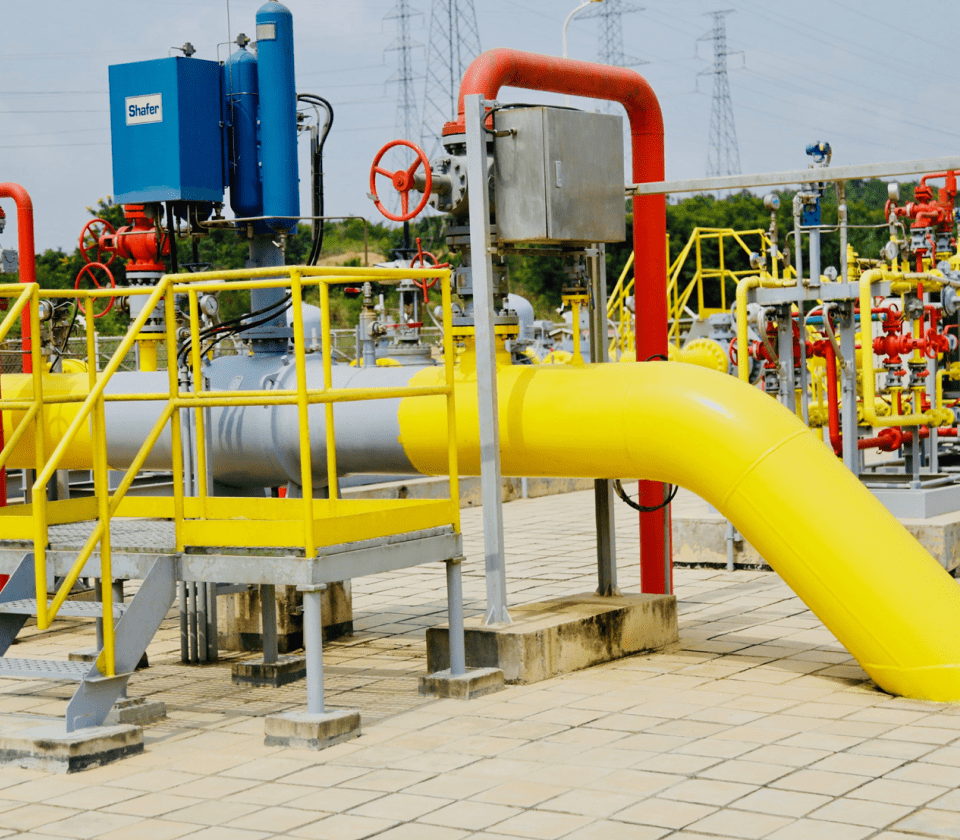
Under a new agreement formalized earlier this month, Yinson Production, the operator of the FPSO John Agyekum Kufuor will add new gas compression and treatment modules to the Sankofa FPSO John Agyekum Kufuor, offshore Ghana, increasing gas export capacity by more than 60% while extending the vessel’s lease period to 2036. The project, to be executed at a cost of US$600 million is scheduled for completion by the first quarter of 2028 by which time full installation and integration of the new gas turbine-driven compressors and treatment modules are expected to be completed and operational.
The FPSO operates at the Sankofa Field development in Ghana’s Offshore Cape Three Points field run by Italian multinational, Eni.
Under the terms off a contract amendment agreement with Eni, the programme for the Non-Associated Gas (NAG) project involves installing gas compression facilities to counter declining reservoir pressure, and raising the vessel’s gas export capacity from the current 210-220 million cubic feet per day (MMcf/d) to 355 MMcf/d.
In addition, Yinson’s firm lease period for the FPSO will be lengthened by four years until 2036.

This timeline follows a formal contract amendment signed on October 2, 2026, between Eni Ghana and Yinson Production.
The new development will directly impact both utility tariffs and power generation costs by altering the Weighted Average Cost of Gas (WACOG), a metric utilized by the Public Utilities Regulatory Commission (PURC) to set end-user electricity rates. The net impact on Ghanaian consumers will balance a reduction in high-cost emergency fuel with the structural pricing realities of non-associated gas.
The most immediate benefit to domestic consumers will be tariff stability, rather than a drastic price drop as expensive liquid fuels are displaced. When domestic gas faces shortfalls, Ghana’s thermal plants are forced to run on expensive alternatives like Light Crude Oil (LCO) or Distillate Fuel Oil (DFO). Because liquid fuel generation costs are substantially higher than gas, the injection of an absolute 135 to 145 MMscf/d would protect the PURC from triggering steep emergency upward quarterly tariff adjustments. By replacing volatile liquid fuel imports, the state will save considerable revenue and also slow down the accumulation of circular energy debt between the Volta River Authority (VRA) and Independent Power Producers (IPPs), lowering the long-term risk of structural tariff hikes designed to recover sector losses.
However, while the upgrade will increases gas volumes, it will shift the overall generation mix heavily toward Sankofa gas, which has historically been the costliest domestic source since, unlike Jubilee field gas which historically featured low commodity charges because it was associated gas (a byproduct of oil extraction), Sankofa’s gas is non-associated, requiring deep offshore infrastructure factored into its base cost to recover capital expenditures.
Currently, the PURC maintains the national WACOG by blending cheaper Jubilee gas, imported Nigerian gas via the West African Gas Pipeline, and Sankofa gas. Expanding Sankofa’s market dominance to over 60% of total national supply means its underlying commodity price heavily anchors the formula.
The US$600 million cost of the project will be absorbed into the vessel’s operational day rate from 2028 to 2036. However, because this optimization maximizes existing wells and avoids the multibillion-dollar expense of drilling an entirely new field, it represents a cost-efficient extraction strategy that prevents the WACOG from spiking into double digits
Ultimately for the domestic consumer, electricity tariffs will not drop significantly, but they will become vastly more predictable. The massive influx of domestic gas will act as a buffer against inflation and cedi depreciation by limiting the need to purchase foreign oil to keep the national grid online.
However for Ghana to enjoy these benefits it will have to win a race against time – set in motion by the Sankofa gas upgrade – to increase its domestic gas processing capacity.
The current facility, Atuabo Gas Processing Plant (GPP Train 1), does not possess the capacity to handle the expected surge in gas throughput from the Sankofa FPSO upgrade. It will require an extensive infrastructure upgrade, which fortunately is already structurally underway
The existing Atuabo plant was designed with a peak capacity of 150 MMscf/d, but it generally operates at an optimal baseline of 120 MMscf/d. The current plant is already operating near capacity just by processing associated gas from the Jubilee and TEN fields. It physically cannot ingest the extra 135 to 145 MMscf/d being unlocked by Eni’s US$600 million Sankofa FPSO modification. Without an expansion, Ghana would face catastrophic gas flaring bottlenecks offshore.
To handle the incremental volumes, the Ghana National Gas Company (Ghana Gas) is building a second facility, Gas Processing Plant Train 2 (GPP II), adjacent to the existing facility in Atuabo. GPP Train 2 will introduce a new nominal processing capacity of 150 MMscf/d, which is scalable up to 300 MMscf/d. Once integrated with the existing Train 1, Ghana’s total midstream processing capacity will expand to 450 MMscf/d.
The project is valued between US$700 million and US$812 million, financed via public-private partnerships, including backing from the Africa Finance Corporation.
It will come on stream with important technical advantages. Unlike the first train, which only extracts 40 percent to 50 percent of Natural Gas Liquids (NGLs), Train 2 will use advanced turbo-expander technology to achieve 80 percent liquid extraction. This will allow Ghana to recover propane, butane, and condensates locally—saving the country over US$151 million annually in NGL losses and drastically cutting LPG (cooking gas) imports.
The midstream expansion has been tightly aligned with the offshore upstream timeline to ensure the plant is fully commissioned by the time the Sankofa FPSO upgrade goes live but any delays in completing the second gas processing plant would force the country to resume large scale flaring of the increased gas the Sankofa FPSO upgrade project will produce.
However, the project has been kept more or less on schedule so far. Front-End Engineering Design (FEED) studies and formal Project Implementation Agreements with the CMILT Consortium have been executed. Land was secured in the Ellembelle district, and Environmental/Construction permits under LI 1652 were cleared.
The Government established the GPP II Implementation Committee to drive the technical design, funding mechanics, and operational delivery schedules. Simultaneously, Ghana Gas is rolling out the Atuabo Mainline Compressor Station addition to withstand the physical pressure changes of the incoming gas.
Final mechanical completion, tie-ins to the existing onshore export lines, and testing loops are scheduled to finish ahead of the first quarter of 2028, creating a synchronized hand-off when Eni begins pushing the expanded 355 MMscf/d stream ashore.
By: Toma Imirhe / businesspostonline