

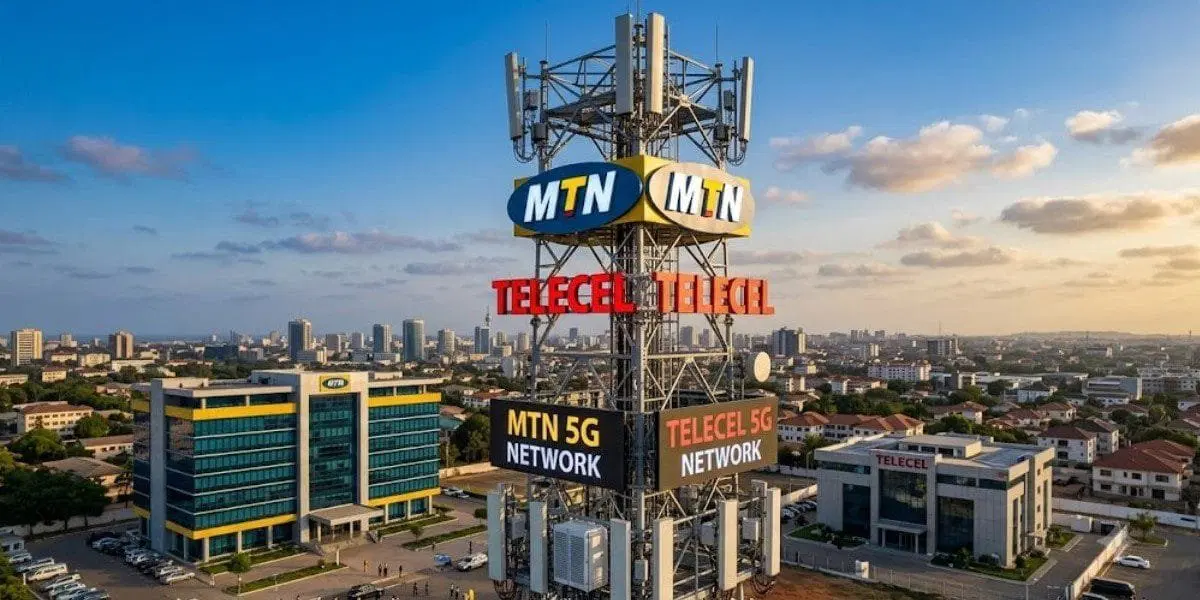
The allocation of new 5G spectrum to MTN Ghana, announced on October 5, is set to transform the country’s emerging fifth-generation mobile market into a two-way contest, with the market leader now facing a direct challenge from Telecel Ghana, which has already announced plans to commercially launch its own 5G service in December 2026.
The development follows MTN Ghana’s confirmation that it has received spectrum in the 700 MHz and 3 GHz bands, licenses that will run for 15 years. The company is expected to invest about US$202 million in the new spectrum, comprising US$100.9 million for two 20 MHz lots in the 700 MHz band and US$101.1 million for 150 MHz in the 3 GHz band.
The allocations give MTN a substantial additional spectrum resource with which to expand its existing high-speed network, while Telecel has secured three lots in the 2.3 GHz band as the foundation for its planned 5G rollout. Telecel said the allocation would strengthen its network expansion and improve customer experience.
The competition is particularly significant because the National Communications Authority (NCA) this year removed the wholesale 5G exclusivity arrangement that had restricted competition in high-speed mobile broadband. The regulator subsequently opened the 700 MHz, 2.3 GHz and 3 GHz bands to competing operators. MTN, Telecel and Goal Telecommunications qualified for the licensing process.

.Telecom analysts point out that it would be commercially risky for Ghana’s largest mobile operator , MTN, to allow Telecel several uninterrupted months to market itself as the country’s new 5G leader. MTN has already said the new spectrum will accelerate its 5G and home-connectivity expansion, while the company is undertaking a major network investment programme. Government says MTN has committed more than US$1.1 billion over three years, including approximately US$380 million in 2026 and plans for 800 new cell sites this year.
MTN can consequently be expected to accelerate commercial deployment of the newly awarded spectrum rather than deliberately wait for Telecel’s December launch. Its objective would be to establish a strong 5G presence before Telecel begins commercial operations, locking existing customers into its ecosystem and making customer migration less attractive.
The likely consequence is that December may no longer represent simply Telecel’s launch date. It could instead become the point at which Ghana’s 5G market moves into a much more aggressive competitive phase—with MTN and Telecel fighting simultaneously over speed, coverage, reliability, price, data value and customer experience.
The first battleground will be network performance.
MTN enters the contest with an important advantage: scale, an established nationwide network and existing 5G-related infrastructure. Its newly acquired spectrum is expected to be deployed alongside its existing holdings to increase capacity, improve network quality and accelerate both mobile and home broadband services.
The combination of low-band 700 MHz spectrum and higher-capacity 3 GHz spectrum could give MTN flexibility to balance coverage with capacity. The 700 MHz allocation should be particularly useful for wider geographic coverage and indoor penetration, while the 3 GHz spectrum can provide substantial capacity in high-traffic urban areas.
Telecel’s 2.3 GHz allocation, meanwhile, gives it a sizeable mid-band resource with which to build a competitive high-speed service. Its challenge will be to translate that spectrum into sufficiently broad coverage and consistent speeds before customers conclude that 5G is available only in selected pockets of the major cities.
Consequently, the contest will not simply be about headline maximum speeds. Customers are likely to judge the networks by average speeds at busy times, latency, reliability, indoor coverage and the consistency of connections while moving around the country.
The second major front will be pricing.
5G spectrum represents a substantial capital investment, and both operators will need to recover the cost of spectrum, network equipment, fibre backhaul and customer acquisition. Yet neither can afford to price 5G so aggressively that the service becomes financially unattractive to provide.
Telecel could nevertheless use pricing and promotional data allowances to attack MTN’s established market position. A December launch would provide the company with an opportunity to position itself as the challenger offering more data or better value for money to customers willing to switch networks.
MTN, for its part, has demonstrated willingness to adjust tariffs and bundle benefits. In January 2026, for example, it reduced tariffs following the government’s VAT reforms and increased the volumes attached to its data bundles.
The likely result is therefore not necessarily a simple price war, but competition around data volumes, validity periods, introductory 5G packages, home broadband offers, device financing and bundled services.
The third battleground will be customer experience.
With 5G reducing the technological differentiation between networks in terms of basic connectivity, customers are likely to become more sensitive to how easily they can activate packages, resolve faults, obtain refunds and communicate with their network provider.
Telecel, as the challenger, has an opportunity to differentiate itself through responsiveness and customer-friendly packages. MTN, meanwhile, has the advantage of a large established customer base and extensive digital and physical service channels.
But its sheer scale could also make customer-service responsiveness particularly important. A technically superior network will not necessarily retain customers if complaints about failed transactions, congestion or billing take too long to resolve.
Implications for consumers
For Ghanaian telecom users, the emergence of two serious 5G competitors should ultimately be positive.
Competition should encourage faster network investment, better coverage, more reliable connections and potentially lower prices per gigabyte. It could also accelerate the availability of fixed-wireless 5G broadband as an alternative to fibre, particularly for homes and businesses outside areas with convenient fibre infrastructure.
The wider economic implications could also be significant. The Communications Minister, Samuel Nartey George, has indicated that government is targeting 70 per cent 5G population coverage by March 2027, while emphasizing that the technology should support genuine digital access rather than simply provide a stronger signal.
By: Toma Imirhe / businesspostonline