

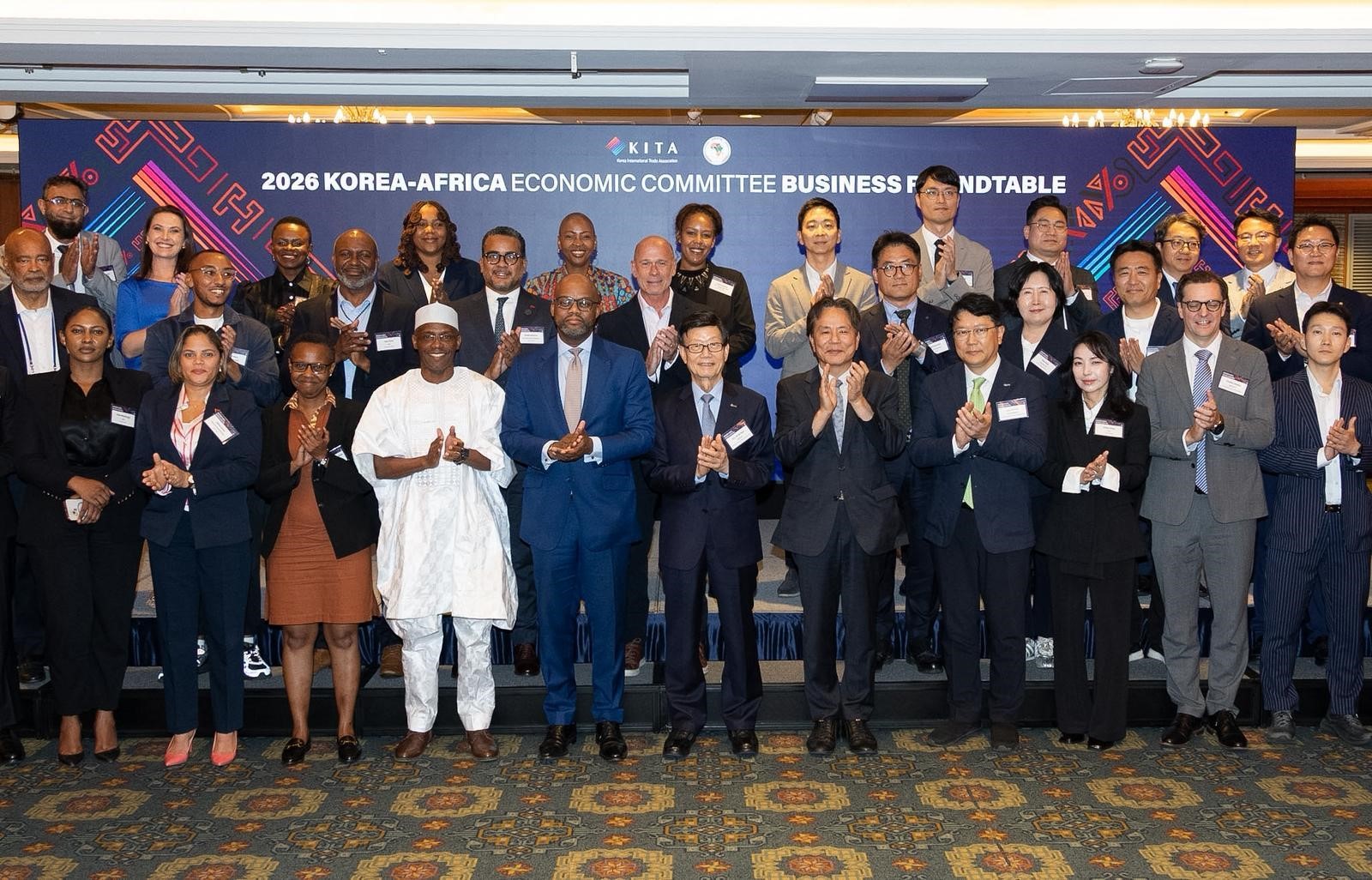
The Korea International Trade Association (KITA) and the African Continental Free Trade Area (AfCFTA) Secretariat have held the inaugural business roundtable under the newly established Korea–Africa Economic Committee (KAEC), marking a significant step toward strengthening commercial relations between the two regions.
The meeting, hosted in Seoul, brought together 35 companies and institutions from Africa and South Korea, including global industrial leaders such as Hyundai Motor Group, POSCO International, and Samsung Electronics.
African representation featured organisations like the Pan-African Chamber of Commerce and Industry (PACCI), South African power utility Eskom, and investment group OPAIA.
The roundtable is the first formal engagement under the KAEC framework, which was created following a Memorandum of Understanding signed during the Korea–Africa Business Summit in June 2024.

The platform is designed to facilitate sustained dialogue and collaboration between private sector actors and institutions across both regions.
Discussions at the event centred on tangible cooperation opportunities across key sectors, including manufacturing, infrastructure, energy, digital trade, and industrial development.
Participants explored ways to align Africa’s industrialisation drive with South Korea’s advanced technological and manufacturing expertise.
Chairman of KITA, H.E. Jin Sik Yoon, emphasised the strategic value of the partnership, highlighting the potential for mutual growth.
“If Korea’s industrial competitiveness is combined with Africa’s growth potential, we will be able to create a future-oriented model of cooperation that draws global attention,” he said.
Yoon added that KITA would continue to support exchanges between business communities and promote joint projects aimed at unlocking investment opportunities.
Similarly, the Secretary-General of the AfCFTA Secretariat, H.E. Wamkele Mene, underscored the significance of the new platform in advancing Africa’s trade agenda.
“The establishment of the KAEC reflects our shared commitment to building practical and mutually beneficial partnerships between Africa and the Republic of Korea,” Mene said.
“As Africa advances implementation of the AfCFTA, we welcome deeper cooperation in trade, investment, industrialisation, technology and infrastructure.”
A key highlight of the session was a presentation by Dr Mun Su Kang, a research fellow at the Korea Institute for International Economic Policy (KIEP).
His presentation outlined strategic priorities for Korea–Africa economic cooperation, identifying manufacturing, infrastructure, decarbonisation, and digital commerce as priority sectors.
Dr Kang also stressed the need to develop reciprocal supply chains that leverage Africa’s resource base and Korea’s industrial capacity.
Such partnerships, he noted, could enhance resilience and support sustainable development goals across both regions.
The emphasis on decarbonisation and energy transition reflects a growing global trend, with African and Korean stakeholders increasingly aligning around green growth strategies and climate-conscious investments.
Looking ahead, both KITA and the AfCFTA Secretariat signalled their intention to institutionalise the KAEC platform through regular engagements.
Future roundtables are expected to be hosted on a rotational basis between Africa and South Korea, further deepening business-to-business collaboration.
The initiative comes at a time when Africa is accelerating implementation of the AfCFTA agreement—widely seen as one of the world’s largest free trade areas, covering 54 countries and a market of over 1.3 billion people.
Since trading under the agreement began in January 2021, attention has shifted toward translating policy frameworks into real economic activity.
For South Korea, the engagement aligns with broader efforts to diversify trade partnerships and expand its footprint in emerging markets.
Background
The AfCFTA, a flagship project of the African Union’s Agenda 2063, aims to boost intra-African trade, promote industrialisation, and enhance economic integration. The Secretariat, headquartered in Accra, coordinates implementation of the agreement.
KITA, established in 1946, is one of South Korea’s largest business organisations, representing over 80,000 companies. It plays a key role in promoting trade, supporting businesses, and shaping the country’s commercial strategy globally.
The launch of the KAEC business roundtable signals a renewed push toward structured and practical engagement between Africa and South Korea. With both regions seeking to strengthen supply chains, promote industrial growth, and accelerate digital transformation, the initiative is expected to open new channels for investment and trade.
As discussions evolve into concrete projects, stakeholders on both sides will be watching closely to assess how this partnership translates into measurable economic outcomes.
Source: businesspostonline