

Ghana’s gross international reserves declined to US$12.9 billion at the end of June 2026, down from US$13.8 billion in December 2025, as rising energy-related payments linked to renewed tensions in the Middle East placed pressure on the country’s external sector position.
Despite the decline, the Bank of Ghana (BoG) insists that reserve levels remain strong enough to cushion the economy against external shocks and support exchange rate stability.
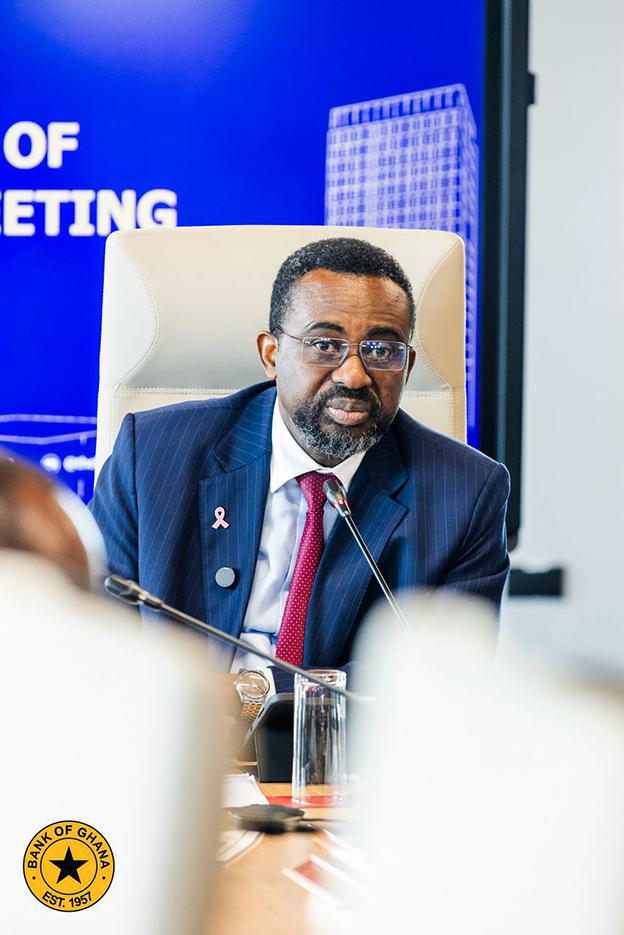
Addressing journalists after the 131st Monetary Policy Committee (MPC) meeting, Governor Dr. Johnson Asiama attributed the reduction largely to higher import costs triggered by escalating geopolitical tensions and rising crude oil prices.
The reserve stock currently provides approximately five months of import cover, compared to 5.7 months at the end of 2025.

“The decline in reserves reflected elevated energy-related payments arising from the Middle East crisis,” the Governor said.
The renewed conflict in the Middle East has rattled global energy markets in recent weeks, pushing crude oil prices above US$85 per barrel and increasing import bills for energy-dependent economies.
The decline in reserves comes at a time when Ghana’s external sector continues to post strong performance, supported by robust export earnings from gold and cocoa.
According to the MPC, the country’s trade surplus improved significantly during the first half of 2026, aided by strong growth in export proceeds despite the sharp increase in the import bill.
The current account surplus also expanded to US$5.1 billion, up from US$4.1 billion during the corresponding period last year.
The stronger current account position, together with improvements in the capital account, helped strengthen the overall balance of payments position and provided support for the reserve stock. Dr. Asiama noted that the reserve drawdown should not be interpreted as a sign of weakness in Ghana’s external finances.
“I don’t think I want to call it a reserves depletion at this point,” he told journalists. “These were legitimate expenditures that had to be covered. There were debt service payments, government-related external obligations, imports that had to be funded and the greater oil bills that also had to be settled.”
The Governor sought to reassure markets that the reserve position remains resilient despite recent pressures.
Questions over the sustainability of the reserve stock have emerged following the sharp increase in energy costs and continued uncertainty surrounding the geopolitical situation in the Middle East.
However, Dr. Asiama argued that Ghana’s strong trade and current account position provide important support for reserve accumulation going forward. He emphasised that authorities are closely monitoring developments, particularly the disruption of shipping routes and energy supplies associated with instability around the Strait of Hormuz.
“From where we are now, we are reviewing these developments going forward, whether the Strait of Hormuz problem is now going to be a permanent one or not, and the appropriate strategy will be adopted,” he said.
The Governor added that the reserve-building strategy implemented in recent years has helped strengthen Ghana’s capacity to absorb external shocks.
“What it confirms is that the strategy we introduced to build reserves was a good one. Imagine if we didn’t build all these reserves,” he stated.
The MPC identified rising energy prices as one of the key external risks facing the economy.
The committee warned that a prolonged conflict in the Middle East could further increase oil prices, raise Ghana’s import bill and exert additional pressure on foreign exchange reserves.
Higher energy costs could also feed into domestic inflation through transport and utility prices.
For this reason, the MPC cited geopolitical tensions among the major factors influencing its decision to maintain the policy rate at 14 percent.
The committee noted that while global financing conditions remain relatively favourable, prolonged instability could tighten financial conditions and create additional challenges for emerging and developing economies.
Despite the reserve decline, the central bank remains optimistic about the outlook for the external sector.
Strong gold and cocoa export earnings, coupled with continued surpluses in trade and the current account, are expected to support foreign exchange inflows in the months ahead.
Dr. Asiama said the Bank of Ghana would continue to monitor external developments and adjust its strategy where necessary to preserve macroeconomic stability.
“Rest assured, our reserves will not get depleted,” he said.
“Our trade balance is still in surplus, the capital account is still in surplus, and we will continue to look at other ways of earning foreign exchange to ensure that our reserves remain at comfortable levels.”
With global energy markets remaining volatile, analysts say the trajectory of reserves in the second half of the year will largely depend on developments in the Middle East and Ghana’s ability to sustain strong export growth while managing import costs.
By: Christian Akorlie / businesspostonline