

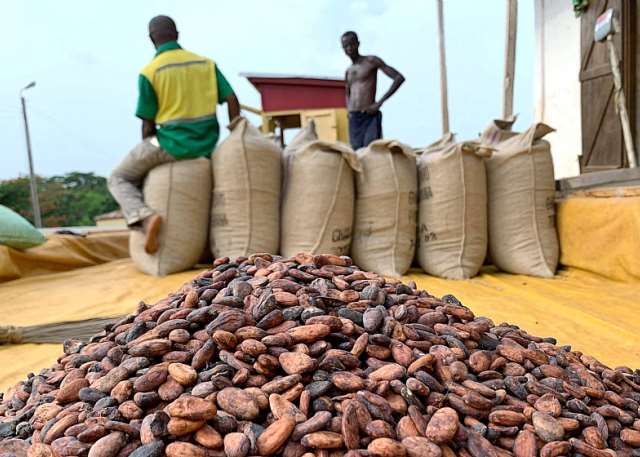
Executives of both COCOBOD and its special purpose vehicle subsidiary Cocoa Capital PLC are currently engaged in intense closed door meetings as they deliberate on how to navigate the 15 percent shortfall financing it targeted through its issuance of GH¢4 billion in commercial paper last week, but which only yielded GH¢3.39 billion, this amounting to a GH¢610 million shortfall.
This is because the money raised from the first tranche of a total of GH¢14 billion being targeted though three tranches is insufficient for the purposes it is meant for under the current circumstances.
While securing 84.8 percent of the target provides a substantial injection of short-term liquidity, the resulting GH¢610 million funding gap creates tight operational constraints across two main areas.
For the 2026/27 season, COCOBOD increased the cocoa producer price to GH¢42,400 per tonne (equivalent to GH¢2,650 per 64kg bag). This front-loaded price hike means that Licensed Buying Companies (LBCs) require a significantly higher volume of cash upfront to purchase beans directly from farmers at the start of the harvest cycle. A shortfall at this critical juncture risks slowing down the speed of crop aggregation

Furthermore, Ghana’s private cocoa buyers entered the new crop year claiming that COCOBOD still owed them roughly GH¢4 billion in unpaid arrears from the previous season. Because these LBCs rely on those funds as working capital to jumpstart their operations, the combination of past debts and the first tranche shortfall leaves a deficit that requires temporary external buffers.
COCOBOD can temporarily offset this shortfall through its recycling strategy. Rather than waiting for the entire GH¢14 billion to be raised, COCOBOD is collateralizing less than 60 percent of the crop at a time, allowing it to use early export revenues from immediate forward-sales contracts to continuously replenish domestic liquidity before the second tranche launches.
But COCOBOD and its new special purpose subsidiary need a more front-loaded financing at the start of the season and this is what the ongoing crunch meetings are all about. Industry sources say that three alternatives are under consideration.
One is reopening the first tranche by extending or initiating a follow-up window to capture leftover domestic liquidity. But because the first tranche was structured to cover the initial two months of cocoa aggregation (October and November), any decision to re-open the tranche to bridge the GH¢610 million shortfall must happen almost immediately – over the next fortnight at the longest – to be operationally viable.
If transaction advisors choose to re-open the tranche, they would likely launch a rapid “tap issuance” or a supplementary 5-to-10-day subscription window. This would keep the paper aligned with the original 266-day tenor maturity schedule without resetting the broader seasonal funding clock.
An alternative also now under consideration is simply absorbing the deficit into the upcoming second (GH¢4 billion) and third (GH¢6 billion) tranches of the broader GH¢14 billion purchase facility. An exact calendar date for the opening of the second tranche has not yet been publicly released by COCOBOD or its transaction advisors.
The first tranche was designed to cover the initial two months of crop aggregation. The second tranche will open to finance the subsequent three months of the 2026/27 crop season, although COCOBOD has stated that the precise launch date and final amount of the second tranche will depend dynamically on immediate funding requirements and prevailing domestic market conditions. This flexibility allows them to evaluate investor sentiments following the first tranche’s subscription miss before opening the next window.
Importantly though whether a re-opening of the first tranche or a roll-over of the shortfall into the second tranche is adopted, the coupon rate on offer may need to be reviewed upwards, adding to COCOBOD’s costs and squeezing its margins further.
Institutional investors – pension funds, insurance companies and commercial banks) – left the first tranche 15.2 percent undersubscribed because they view COCOBOD as carrying lingering credit risk following the 2023 cocoa bill restructurings. Simply re-offering the exact same 11 percent yield for the same risk profile will not magically unlock the GH¢610 million shortfall from hesitant fund managers.
To guarantee a full subscription, transaction advisors would likely need to sweeten the annual interest rate above 11 percent to meet investors’ demands for a higher risk premium. If COCOBOD is fiercely resistant to raising the 11 percent pricing—which would drive up its borrowing costs and squeeze its cash margins—it can re-open the first tranche or issue an enlarged second one without changing the yield only if it changes the structure by reducing the maturity from 266 days to a 90-day or 180-day paper. Investors are far more willing to accept an 11 percent yield for a much shorter duration, as it minimizes their holding risk.
The third alternative is to turn to local commercial banks for short-term bridge financing to ensure bean purchases for the 2026/27 season remain unhindered.
Indeed, there is a high possibility that COCOBOD will turn to domestic commercial banks to bridge the shortfall since under the Domestic Cocoa Notes Programme local commercial banks have already been positioned as primary stakeholders, transaction liquidity providers, and eligible market participants.
But this would come with critical caveats since local banks are still highly cautious. During the recent Domestic Debt Exchange Programme (DDEP), banks had their short-term Cocoa Bills forcibly restructured into five year bonds. Furthermore, many banks are already heavily exposed to private LBCs who owe massive interest on loans because COCOBOD has delayed paying them GH¢4 billion in outstanding arrears from past crops.
The funding structure would therefore have to be heavily insulated with repayments explicitly backed by assigned cocoa export receivables generated via select forward sales contracts managed through locked, escrow accounts, this structure giving local banks high repayment confidence.
Expectedly banks would extend the bridge loan, but they would not do it cheaply. Banks will likely price a short-term corporate loan closer to the prevailing Ghana Reference Rate of 10 percent or the central bank policy rate, currently at 14 percent than to the 11 percent offered on the first tranche of the commercial paper, meaning COCOBOD could face a steep pricing structure about 15 percent.
Besides, banks may refuse another long 266-day commitment. They would prefer a 30- to 90-day rolling bridge facility, intended strictly to keep farm gate purchases active until the second official commercial paper tranche opens to pay off the bank balance.
An upward adjustment of the borrowing rate would severely squeeze COCOBOD’s finances. However, it is highly unlikely to trigger a reduction in the newly announced GH¢42,400 per tonne producer price for the 2026/27 season.
Instead, a higher risk premium would directly impact COCOBOD’s structural operational capacity, cash-flow margins, and future pricing frameworks through several mechanisms.
For one thing, when COCOBOD and the Ministry of Finance set the producer price at GH¢42,400 per tonne, they explicitly pegged it to exactly 71.18 percent of the realized gross Free-on-Board (FOB) value of Ghana’s cocoa. This leaves exactly 28.82 percent of cocoa export revenue for COCOBOD to manage its own operations. This 28.82 percent must cover all internal costs, including disease control (swollen shoot campaigns), fertilizer subsidies, administrative overhead, and interest payments on its debt. If COCOBOD is forced to raise its commercial paper yield significantly above 11 percent to attract investors, or taken more expensive bridge finance from local banks, debt-servicing costs would eat up a massive portion of that 28.82 percent buffer. COCOBOD would have less money left to manage the sector, putting strain on farm inputs and crop sustainability.
Besides, a higher interest rate could inadvertently trigger operational delays in how farmers get paid. If COCOBOD stalls its borrowing because it is haggling over high risk premiums with domestic institutional investors or local banks, it would face a cash crunch. This means COCOBOD would take longer to release funds to the LBCs and in turn, LBCs would lack the immediate cash to buy cocoa at the farm gate, forcing farmers to wait weeks for their money despite the officially high “guaranteed” price.
Little wonder the ongoing meetings are so intense.
By: Toma Imirhe / businesspostonline