

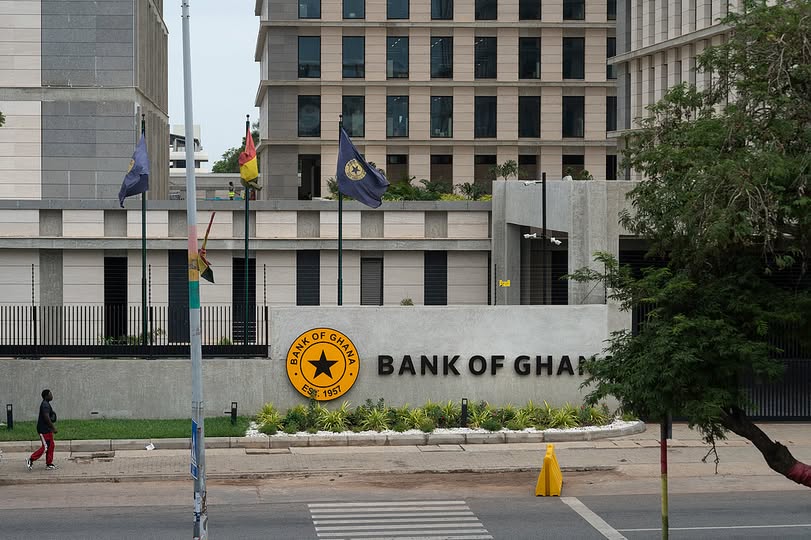
The Bank of Ghana (BoG) has dramatically reduced both the yield and maturity profile of the central bank bills it uses for liquidity management, signalling a fundamental shift in monetary conditions and financial market dynamics after the extraordinary tightening measures deployed in 2024 and 2025.
Data from the central bank show that BoG Bill yields, which reached as high as 28 percent in 2025 for some sterilization operations, have fallen to around 12-14 percent in recent auctions. At the same time, the BoG has largely abandoned the 56-day and 273-day instruments that dominated its liquidity management toolkit in 2025, reverting to the 14-day bill as its principal open market operations instrument.
The shift reflects a combination of sharply lower inflation, declining benchmark interest rates, improved banking sector liquidity conditions, and reduced pressure on the central bank to absorb excess cash from the financial system.
From crisis-era sterilization to normalization

Throughout the first half of 2025, the BoG faced a difficult balancing act. Inflation remained elevated, the monetary policy rate stood at 28 percent after a surprise tightening in March 2025, and the central bank was forced to conduct aggressive liquidity mop-up operations to prevent excess liquidity from fuelling further inflation and exchange rate instability.
The cost of these operations was substantial. According to BoG disclosures, the central bank spent approximately GH¢17 billion in 2025 on liquidity management operations, double the GH¢8.6 billion incurred in 2024.
During that period, 56-day and 273-day BoG Bills became major instruments for sterilizing liquidity from commercial banks. Indeed, the 273-day instrument was targeted exclusively at banks and interbank market participants rather than retail investors.
However, the macroeconomic environment changed dramatically during the second half of 2025 and into 2026.
Inflation fell sharply into single digits, the cedi stabilized, international reserves strengthened, and economic growth remained resilient. These developments enabled the Monetary Policy Committee to embark on a cumulative easing cycle that reduced the policy rate from 28% in March 2025 to 18 percent by November 2025 and further to 15.5 percent by January 2026 and 14 percent since March.
As monetary policy eased, there was less need for expensive long-dated sterilization operations.
“The return to the 14-day bill as the main tool for open market operations reflects the normalization of monetary conditions,” Governor Johnson Asiama indicated while explaining adjustments to monetary policy in late 2025.
Current BoG data show 14-day bill rates hovering around 14 percent compared with nearly 18 percent on the 56-day bill in late 2025 and considerably higher effective rates during the peak tightening phase.
According to the BoG, in reply to an enquiry from Business Post: “The shift reflects improved liquidity conditions, changing government financing patterns, and stronger FX liquidity, while allowing for more flexible and responsive liquidity management. Open Market Operations rates, which ranged between 18 and 28 percent during the 2025 tightening cycle, have declined significantly following the cumulative 1,400 basis points reduction in the Monetary Policy Rate to 14 percent. Lower rates are helping to reduce the Bank’s sterilisation costs while maintaining effective liquidity management.”
Reduced competition for bank liquidity
The implications for Ghana’s banking sector are significant.
BoG Bills effectively compete with Government of Ghana Treasury Bills for the liquid resources of commercial banks. When central bank bills offer relatively high yields with virtually zero credit risk, banks have strong incentives to allocate liquidity into those instruments rather than government securities or private sector lending.
The reduction in BoG Bill yields therefore changes the relative attractiveness of available investment options.
A treasury executive at a leading Ghanaian bank noted that the spread between BoG Bills and Treasury Bills has narrowed considerably.
With 91-day Treasury Bills currently yielding around 4.9 percent and 364-day Treasury Bills around 10 percent, the premium offered by BoG Bills remains attractive but is no longer large enough to dominate banks’ liquidity allocation decisions.
The shortening of maturities is equally important.
A 14-day bill allows banks to recycle liquidity much more frequently than a 56-day or 273-day instrument. This improves liquidity management flexibility and reduces duration risk on bank balance sheets.
Financial market analysts argue that the shorter tenor structure should support greater activity in the interbank market because funds are no longer tied up for extended periods in sterilization instruments.
Implications for financial intermediation
Perhaps the most important consequence is for credit creation.
When central banks offer very attractive sterilization instruments, commercial banks often prefer the certainty of risk-free returns to the challenges of lending to businesses and households.
With yields on BoG Bills now substantially lower, banks may find private sector lending increasingly attractive, especially as economic activity strengthens and inflation declines.
BoG officials have repeatedly pointed to early signs of recovery in private sector credit growth as monetary conditions normalize.
Lower sterilization costs also help the central bank itself.
The heavy losses incurred through liquidity management operations were one of the major contributors to the erosion of BoG’s capital position. Lower bill yields mean lower interest expenses for the central bank and therefore less pressure on its income statement.
Wider economic benefits
For the broader economy, the transition signals increasing confidence that inflation expectations have become anchored.
Analysts note that central banks typically rely on longer-dated and higher-yield sterilization instruments only when they need to lock up liquidity for extended periods. The move back to short-term 14-day operations suggests BoG believes excess liquidity can now be managed with much lighter interventions.
The likely result is a more efficient allocation of financial resources across the economy, lower financial sector distortions, improved credit transmission, and reduced quasi-fiscal costs for the central bank.
The challenge, however, will be maintaining the delicate balance between supporting economic growth and preventing a resurgence of inflationary pressures.
For now, the sharp fall in BoG Bill yields and the return to short-term liquidity management instruments represent one of the clearest signs that Ghana’s monetary stabilization programme has moved from crisis management to normalization.
By: Toma Imirhe / businesspostonline