

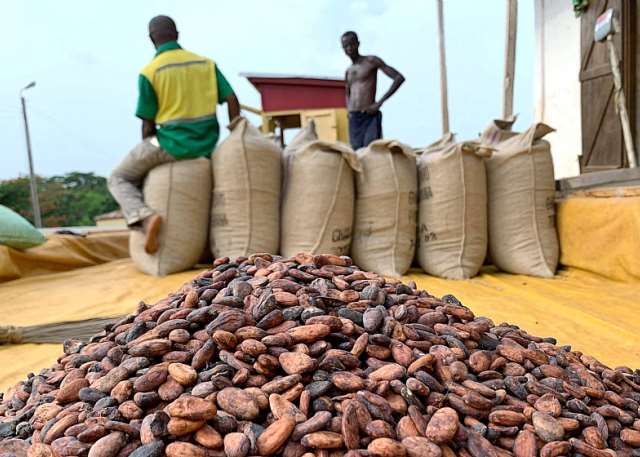
Government is preparing a major overhaul of Ghana’s cocoa sector governance framework, with a proposed new law set to guarantee cocoa farmers not less than 70 percent of the gross Free-on-Board (FOB) price while introducing a market-based pricing mechanism and new financing arrangements for the industry.
The reforms were announced by Finance Minister Dr. Cassiel Ato Forson during the presentation of the 2026 Mid-Year Fiscal Policy Review to Parliament, where he outlined measures intended to improve farmer incomes, strengthen value addition and restore the long-term financial sustainability of the cocoa sector.
The proposed legislation will repeal and replace the existing Ghana Cocoa Board Act, 1984 (PNDCL 81), which has governed the sector for more than four decades.
Government argues that the industry has undergone significant transformation over the years and now requires a modern legislative framework to address emerging challenges and opportunities.

“Government will submit a new COCOBOD Bill to Parliament to repeal and replace the Ghana Cocoa Board Act, 1984,” the Finance Minister stated.
At the centre of the proposed reforms is a new producer pricing mechanism designed to align cocoa prices more closely with developments in international markets.
Under the new framework, producer prices will reflect movements in global cocoa prices, exchange rate developments and other relevant market conditions, replacing a system that has often been criticised for not adequately responding to changing market realities.
Most significantly, government has pledged to guarantee cocoa farmers not less than 70 percent of the gross FOB price.
The commitment is expected to be welcomed by cocoa farmers and industry stakeholders who have long advocated a larger share of export earnings for producers amid rising production costs and growing competition from other cocoa-producing countries.
Officials believe the measure will improve farmer welfare, strengthen incentives for cocoa production and help sustain the sector’s contribution to export earnings and rural livelihoods.
The proposed legislation also seeks to deepen local value addition within Ghana’s cocoa industry.
According to the Finance Minister, the new law will require that not less than 50 percent of cocoa beans produced in Ghana be processed locally.
The measure forms part of government’s broader industrialisation agenda and is aimed at reducing the country’s dependence on raw bean exports while expanding opportunities in cocoa processing, manufacturing and exports of higher-value finished products.
Industry analysts have long argued that increasing domestic processing could create additional jobs, generate more foreign exchange and strengthen Ghana’s position within the global cocoa value chain.
Government believes the policy will encourage investment in processing capacity while unlocking greater economic benefits from one of the country’s most important export commodities.
Beyond farmer pricing and value addition, the proposed bill is expected to introduce a new financing framework for cocoa purchases and related operations.
The Finance Minister said the reforms are intended to restore the long-term financial sustainability and operational efficiency of the Ghana Cocoa Board (COCOBOD), which has faced increasing financial pressures in recent years.
Government views the restructuring as necessary to strengthen the institution’s ability to support farmers, manage cocoa marketing operations and maintain stability within the sector.
The proposed financing arrangements are also expected to improve transparency and strengthen governance across the cocoa value chain.
The reforms come at a time when government is seeking to revitalise strategic sectors capable of driving export growth, generating foreign exchange and supporting employment.
Describing cocoa as a cornerstone of Ghana’s economy, Dr. Forson noted that the sector remains a major source of export earnings and livelihoods for millions of Ghanaians, particularly those living in rural communities.
Government argues that modernising the legal, pricing and financing structures of the cocoa industry is essential to ensuring its competitiveness and sustainability in a rapidly evolving global market.
“These reforms will place Ghana’s cocoa sector on a stronger financial footing, improve returns to cocoa farmers, ensure value addition, and position the industry for sustainable long-term growth,” the Finance Minister said.
If approved by Parliament, the new COCOBOD law would represent one of the most significant policy changes in Ghana’s cocoa industry in decades, reshaping how farmers are paid, how cocoa revenues are distributed and how the country captures value from one of its most important agricultural exports.
By: Christian Akorlie / businesspostonline