

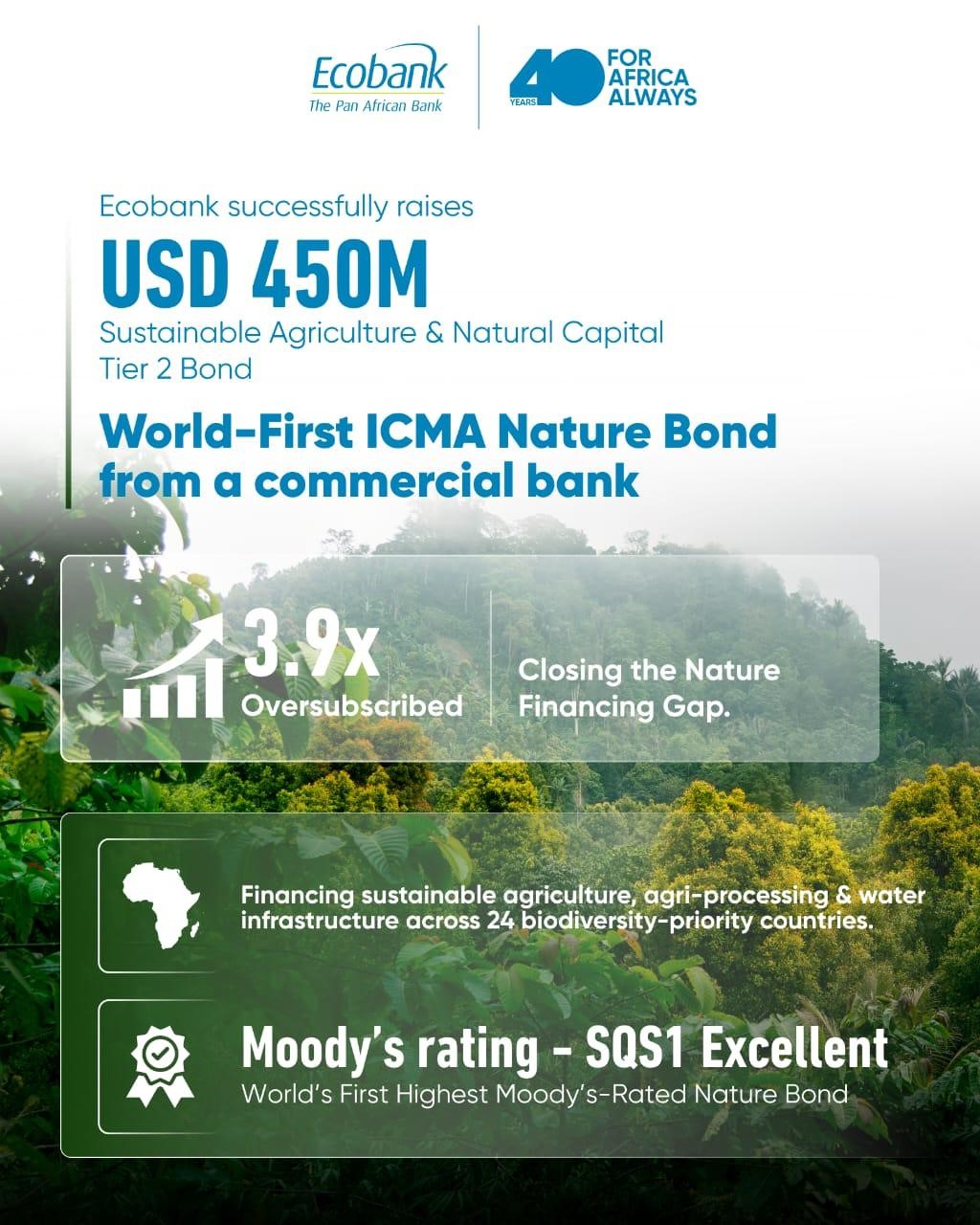
Ecobank Group has launched what it describes as the world’s first International Capital Market Association (ICMA) commercial bank-issued Nature Bond, raising US$450 million on the London Stock Exchange to finance sustainable agriculture, biodiversity protection and water infrastructure across Africa.
The transaction, awarded Moody’s highest sustainability quality score of SQS1 (Excellent), was nearly four times oversubscribed, with an order book exceeding US$1.36 billion.
Strong demand enabled the pan-African lender to increase the deal size by US$100 million and tighten pricing by 50 basis points, signalling growing investor appetite for nature-focused finance linked to emerging markets.
The issuance is positioned as a response to a significant imbalance in global nature financing. Despite hosting around a quarter of the world’s biodiversity, Africa attracts less than 3 percent of total nature-related capital flows.

Ecobank says the proceeds will be channelled into its lending operations across 24 African markets, targeting smallholder farmers, agri-processing firms and water infrastructure providers.
The focus is on practical, real-economy activities such as sustainable farming practices, deforestation-free supply chains and freshwater ecosystem protection.
Notably, more than 80 percent of the eligible lending pool is allocated to countries where agricultural land-use change is the primary driver of biodiversity loss, including Côte d’Ivoire, Burkina Faso and Ghana.
Unlike traditional conservation financing tools, which often support protected areas or NGO-led projects, Ecobank’s Nature Bond is structured to direct capital through the continent’s commercial ecosystem.
Under ICMA guidelines, a Nature Bond must demonstrate that proceeds support measurable nature-positive outcomes, including reducing environmental degradation and promoting sustainable land use.
Ecobank’s framework includes independent monitoring measures, such as deforestation screening, supply chain traceability and seven sustainability conditions attached to each eligible loan.
The scale of investor interest reflects increasing recognition of biodiversity loss as a financial risk, alongside climate change.
The bond attracted participation from both international and African institutional investors, underscoring Ecobank’s ability to mobilise capital across markets.
Jeremy Awori, Group Chief Executive Officer of Ecobank Transnational Incorporated, described the transaction as a “defining moment” for sustainable finance on the continent.
“Investors did not just support this bond — they demanded more of it, allowing us to increase the size and tighten pricing,” he said.
“We have spent four years building the systems, governance and accountability needed to make nature finance credible and scalable in Africa.”
Market analysts view the deal as a potential template for future issuances, particularly as governments and financial institutions face mounting pressure to mobilise private capital for environmental protection.
Rachael Antwi, Ecobank’s Group Head of Sustainability and Environmental & Social Risk Management, emphasised that scalability depends on linking finance to everyday economic activity.
“Nature finance will only scale in Africa if it is practical, measurable and connected to the real economy,” she said.
“This bond reflects the systems and standards we have built to ensure environmental resilience while supporting livelihoods.”
The success of Ecobank’s debut Nature Bond may accelerate the development of biodiversity-linked financial instruments, an area that has lagged behind the rapid growth of green and climate bonds globally.
By anchoring the structure in agriculture and water systems — sectors central to both economic development and environmental sustainability — the bank is attempting to bridge the gap between conservation goals and commercial viability.
With increasing global focus on nature loss following international biodiversity commitments, instruments such as this could play a larger role in directing capital towards ecosystems critical to food security, climate resilience and economic stability across Africa.
Source: businesspostonline