

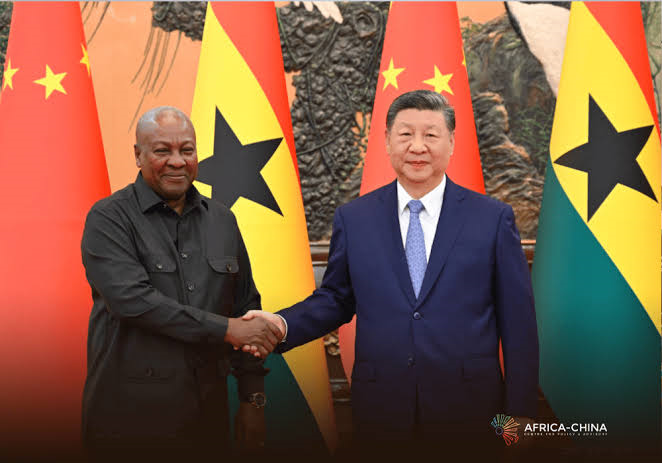
Ghana’s merchandise trade surplus has contracted sharply in 2026 as rising imports, including manufactured goods and vehicles from China, outpace export growth, prompting renewed efforts to expand access for Ghanaian products in the Asian market.
Data from the Ghana Statistical Service (GSS) cited in recent trade analysis show that the country’s trade surplus declined from US$4.3 billion in the first quarter of 2026 to US$1.3 billion in the second quarter, representing a reduction of about 70 percent.
The deterioration reflects a widening gap between import spending and export earnings. Between the first and second quarters, Ghana’s aggregate import bill increased 47.5 percent to GH¢94.7 billion, equivalent to approximately US$8.3 billion, while export revenue fell marginally by 1.6 percent to GH¢108.5 billion, or about US$9.6 billion.
The trend has heightened concerns about the sustainability of Ghana’s external trade position, particularly as imports from China continue to expand.

Bilateral trade between Ghana and China reached a record US$14.12 billion in 2025. However, the relationship remained heavily tilted towards China, with Ghana importing US$11.45 billion worth of goods and exporting US$2.67 billion.
This meant Ghana imported nearly US$5 for every US$1 it exported to China.
Recent bilateral figures compiled through UN Comtrade and the Observatory of Economic Complexity indicate that Chinese exports to Ghana surged during parts of 2026, while Ghanaian exports to China declined sharply in certain monthly periods, deepening the imbalance.
Against this backdrop, the government is looking to China’s zero-tariff initiative, introduced on May 1, 2026, to improve Ghanaian exporters’ competitiveness and increase foreign-exchange earnings.
The policy removes import duties across eligible tariff lines for African exports, creating opportunities for products such as cocoa derivatives, cashew nuts, shea butter, tropical fruits and cosmetics.
Authorities believe the opportunity lies particularly in processed goods, which generate greater domestic value than unprocessed agricultural commodities. Ghanaian businesses could expand exports of cocoa powder, cocoa butter, confectionery and packaged shea-based products to Chinese consumers.
However, tariff-free access alone will not resolve the trade imbalance. Exporters must overcome production constraints, high logistics costs, inadequate cold-chain facilities and stringent Chinese sanitary, phytosanitary and labelling requirements.
To address these challenges, a proposed Ghana-China Market Access Council was introduced at a forum at the African Continental Free Trade Area Secretariat in Accra on October 15.
The platform, introduced by Eric Nii Amu Okotokata Dodoo-Amoo, Head of the China Desk at the Ministry of Finance, would coordinate export agencies, financial institutions, logistics providers and business associations to help local producers meet Chinese market requirements.
A proposed Ghana-China Zero-Tariff Fund would complement the initiative by providing financing, equipment leasing and liquidity for small-scale processors.
Meanwhile, Ghana’s integration into China’s Cross-Border Interbank Payment System is expected to facilitate direct cedi-to-yuan settlements, potentially reducing currency-conversion costs for businesses trading with China.
The government’s challenge is to ensure that improved market access and payment arrangements translate into sustained export growth, greater local processing and reduced dependence on imported goods.
Without a corresponding rise in exports, the benefits of the new trade opportunities may prove insufficient to reverse the growing imbalance in Ghana-China commerce.
By: Toma Imirhe / businesspostonline