

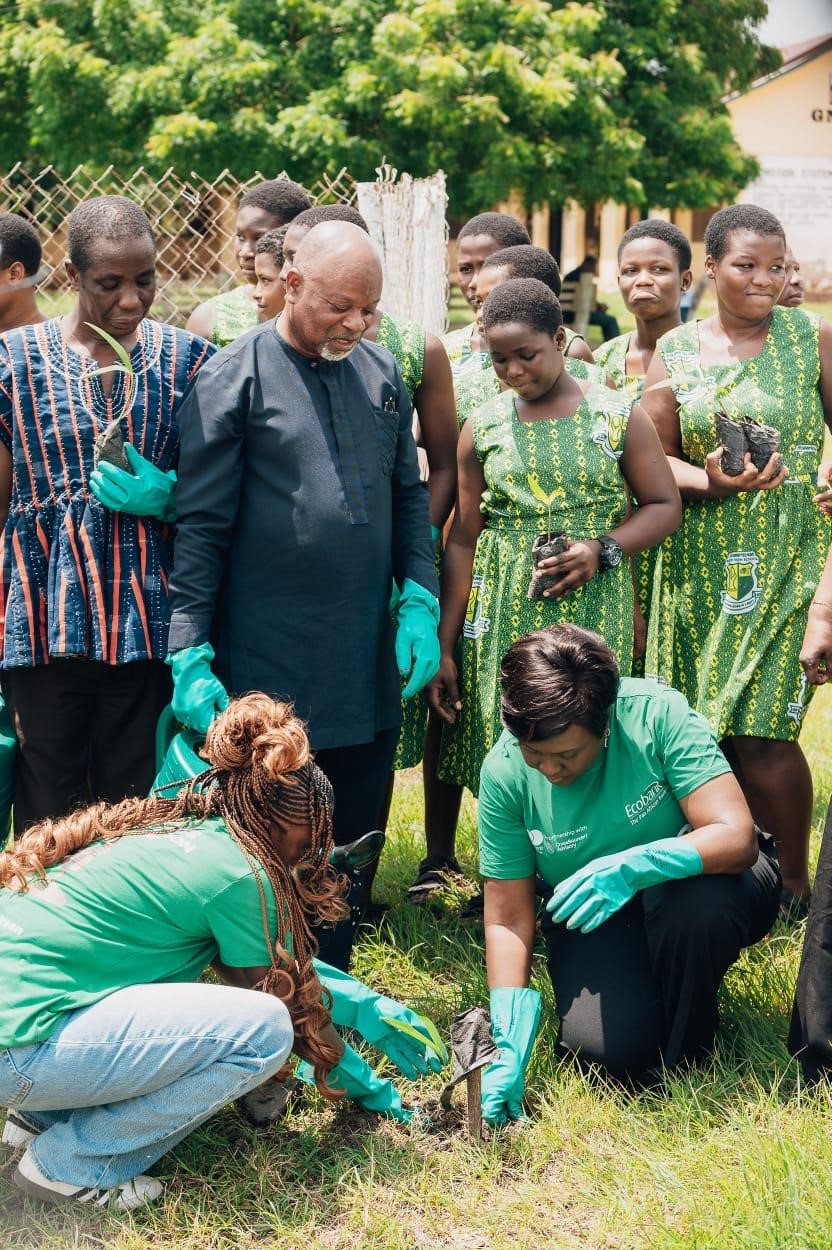
Ecobank Ghana has reinforced its commitment to environmental sustainability with a renewed tree-planting exercise at Prampram Senior High School (SHS), as part of activities marking World Environment Day 2026.
The initiative forms part of a nationwide, month-long environmental programme and saw the bank plant 200 additional trees on the campus—building on a legacy project launched in 2012 that introduced more than 1,200 seedlings to the school.
Speaking at the event, Charlotte Amanquah, Regional Head Commercial Banking at Ecobank Ghana, described the return to Prampram SHS as both symbolic and strategic, noting that the intervention reflects the bank’s long-term approach to sustainability.
“In June 2012, Ecobank Ghana undertook one of its earliest World Environment Day interventions here at Prampram, where over 1,200 seedlings were planted to support the development of this school’s new site,” she said. “Fourteen years later, we are proud to return not just to plant more trees, but to reinforce a legacy project.”

Ms. Amanquah emphasised that sustainability efforts required consistency and long-term commitment rather than one-off actions.
“Sustainability is not built in a day. It is the result of deliberate, consistent action over time,” she stated. “The trees that have grown on this campus are clear evidence that even small initiatives, when sustained, can yield lasting impact.”
She revealed that similar activities were being carried out simultaneously across key locations, including Accra, Kumasi, Tamale, Takoradi and Sunyani, bringing the national total for this year’s campaign to over 4,000 trees.
At Prampram SHS alone, Ecobank’s interventions have resulted in the planting of roughly 1,400 trees since 2012.
Ms. Amanquah noted that Ecobank’s environmental efforts have evolved beyond tree-planting into a comprehensive sustainability framework that integrates environmental, social and governance (ESG) principles.
“Our interventions today go beyond planting trees. We are supporting ecosystem restoration, including reforestation of degraded lands, advancing sustainable financing—particularly in renewable energy—and promoting digital banking solutions that help reduce paper usage,” she said.
She added that the bank’s operational practices increasingly prioritised reducing environmental impact while supporting inclusive and responsible growth.
Ms. Amanquah encouraged students to see themselves as custodians of the future.
“The trees we plant today are not just for us—they are for you and for generations yet to come. Protecting the environment ultimately rests in your hands,” she said.
Headmaster of Prampram SHS, Mr. Peter Djan, welcomed the initiative and commended Ecobank Ghana for maintaining a consistent partnership with the school.
“The impact of the 2012 intervention is still evident across our campus today,” he noted. “The trees we see are a testament to the value of partnerships that go beyond one-time support to deliver sustained benefits.”
Mr. Djan described the latest tree-planting exercise as both “refreshing and encouraging,” stressing that the school remains committed to nurturing and maintaining the planted trees.
“The success of this initiative will depend on how well we care for what has been established. We will take full ownership to ensure these trees thrive,” he assured.
He also charged students to take responsibility for environmental stewardship.
“This exercise is more than just an event. It is a call for us to protect and sustain our environment for future generations,” he said.
Madam Grace Taylor, the Tema-Ada District Range Manager of the Forestry Commission, underscored the urgency of environmental conservation, linking the exercise to Ghana’s broader “Tree for Life” initiative, launched in March 2025 to restore degraded landscapes and combat climate change.
“Without trees, there is no life,” she said, highlighting the role of trees in providing oxygen, regulating climate, preventing soil erosion and supporting biodiversity.
She warned of the consequences of unchecked deforestation, including rising temperatures, erratic rainfall, water shortages and loss of biodiversity.
“Planting is only half the job. Proper aftercare—watering, weeding and protection—is essential if we are to grow forests and not just plant trees,” she emphasised.
Source: businesspostonline