

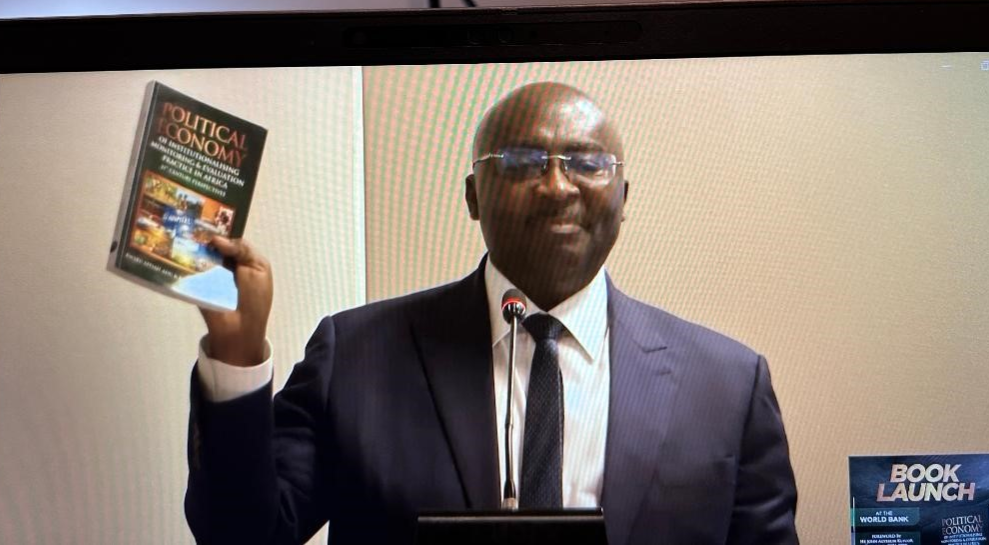
Former Vice President, Dr Mahamudu Bawumia has called for stronger institutionalisation of monitoring and evaluation (M&E) systems across Africa, stressing that sustainable development depends on governments’ ability to translate policies and public spending into measurable improvements in citizens’ lives.
Speaking at the launch of the book ‘Political Economy of Institutionalizing Monitoring & Evaluation Practice in Africa – 21st Century Perspectives’, on Wednesday June 10, 2026, at the World Bank Country Office in Accra, Ghana, Dr. Bawumia described the publication as a timely contribution to one of Africa’s most pressing governance challenges: ensuring that public programmes deliver tangible results rather than simply generating activity and expenditure.
According to him, effective governance requires countries to continually assess whether public resources are being used efficiently, whether policies are reaching intended beneficiaries, and whether institutions are learning from evidence to improve outcomes.
“A serious nation must constantly ask whether it is spending wisely, implementing faithfully, reaching its intended beneficiaries, and learning quickly enough to improve,” he stated.

Dr. Bawumia argued that the true measure of governance is not found in policy documents or official reports, but in the everyday experiences of citizens. He noted that meaningful accountability is demonstrated through improved education, healthcare delivery, agricultural productivity, and enhanced living conditions.
He observed that although many African countries have made progress in developing planning frameworks and evaluation systems, a significant gap remains between data collection and decision-making.
“While data collection and evaluation systems have improved, the evidence generated too often fails to sufficiently influence policy choices, budget priorities and institutional behaviour,” he said.
The former Vice President emphasized that evidence-based governance has become even more critical at a time of fiscal constraints, when governments must ensure every public resource generates maximum value.
He noted that robust monitoring and evaluation systems help reduce inefficiencies, improve programme targeting, protect vulnerable populations and enhance development outcomes.
Dr. Bawumia further highlighted the importance of strong institutions in sustaining development progress beyond political transitions. He cautioned against allowing successful programmes and policies to be abandoned simply because of changes in political leadership or administrative personnel.
“Strong institutions preserve national memory and ensure that what works is not discarded because a new administration takes office,” he remarked.
He also underscored the need to strengthen monitoring and evaluation capacities at the local level, arguing that development challenges are best understood and addressed within communities where policies are implemented.
Touching on technology and governance, Dr. Bawumia said Africa is uniquely positioned to leverage digital transformation, artificial intelligence and open data systems to improve transparency, accountability and decision-making.
Drawing from his public service experience, he noted that digital systems can generate valuable real-time information that enables governments to respond more effectively to citizens’ needs. However, he stressed that data alone is insufficient unless it informs action.
“Data, no matter how abundant, must be acted upon. It is the action that drives transformation,” he stated.
He called on universities and training institutions across Africa to give monitoring and evaluation greater prominence within their curricula, arguing that future public servants, economists, planners and development professionals must be equipped with the skills needed to make evidence-based decisions.
Dr. Bawumia described the book as a call to elevate governance standards across the continent by making evidence central to budgeting, policymaking and programme implementation.

L-R, Andrew O. Asibey, Co-author, Patrick G. Awuah Jr, President, Ashesi University, Dr. Mahamudu Bawumia, Vice President, Ghana (2017-2025), Prof Kwaku Appiah-Adu, Co-author, GIMPA, Mrs. Nana Kegya Appiah-Adu Esq., Publisher, Hon Osei Kyei-Mensah-Bonsu, former Majority Leader, Emerita Prof Isabella Quakyi, President, Ghana Academy of Arts & Sciences, Mr Djabanor Narh, Alumnus Partner, EY and Prof E.H. Amonoo-Neizer, Vice Chancellor Emeritus, KNUST
The former Vice President commended the authors, Professor Kwaku Appiah-Adu and Andrew Osei Asibey, for their contribution to public policy and development discourse, expressing hope that the publication would serve as a valuable resource for policymakers, researchers, public servants and citizens committed to advancing accountable and results-driven governance across Africa.
He subsequently declared the book officially launched, describing it as an important contribution to knowledge, governance and development practice on the continent.
Review of the book
The event was chaired by Mr. Patrick Awuah, founder of Ashesi University and a respected educationist and leadership advocate. He observed that technological advancement alone cannot guarantee development without effective governance and capable institutions. Describing the book as relevant to policymakers, practitioners and citizens alike, he called for a shift from compliance to learning, from reporting to impact and from data collection to informed decision-making. He stressed that the launch should not be seen as the end of a process but the beginning of an important conversation on strengthening governance systems, improving service delivery and enhancing the well-being of African citizens. He also commended the authors for their dedication, intellectual rigour and contribution to governance and development discourse.
Representing the World Bank, Mr. Smile Kwawukume emphasised that monitoring and evaluation has become a central pillar of effective governance and development planning. He added that governments, development agencies and civil society organisations increasingly depend on robust M&E systems to monitor performance, measure impact and ensure accountability in the use of public resources. Moreover, he noted that the lessons presented in the publication would be valuable to development partners and policymakers seeking to strengthen institutions and improve development outcomes across the continent.
Mr. Djabanor Narh, an Alumnus Partner of Ernst & Young (EY), provided a comprehensive review of the book. He described it as a timely contribution to Africa’s governance landscape. He explained that the publication outlines the political and institutional realities influencing the success of M&E reforms, while providing practical guidance on embedding evidence-based decision-making within public institutions. In his view, the book offers policymakers and practitioners fresh perspectives for strengthening governance and achieving better development results.
The closing address was delivered by Emerita Professor Isabella Quakyi, President of the Ghana Academy of Arts and Sciences. She urged participants to continue the conversation on monitoring and evaluation beyond the event and to apply its lessons within their organisations and professional responsibilities. She emphasised that accountability, continuous improvement and results-oriented governance should become integral to planning and decision-making if African countries are to achieve sustainable development and meaningful transformation.
The 14-chapter book explores five broad themes, including the conceptual foundations of M&E, Ghana’s institutional experience, global and African perspectives, the process of institutionalizing M&E, and future reforms driven by technology and innovation. Through case studies from Ghana, South Africa and Uganda, the authors demonstrate how political leadership, institutional culture, incentives and governance structures influence the effectiveness of M&E systems.
The review concluded that the book serves as both a practical guide and a call to action for governments, public servants, researchers and development practitioners. It urges leaders to make evidence central to decision-making, improve accountability and ensure that public resources deliver measurable improvements in citizens’ lives.
Source: businesspostonline