

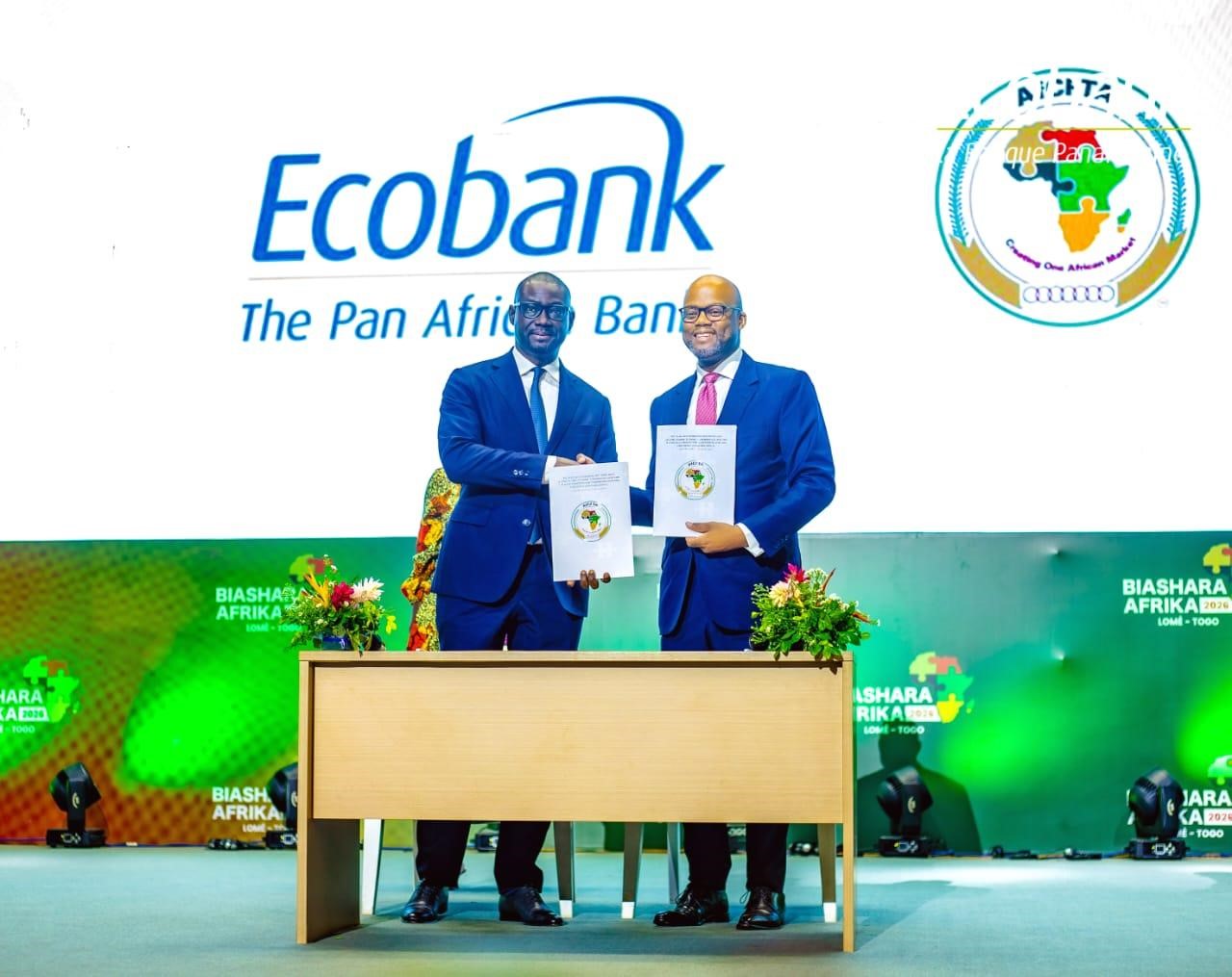
The African Continental Free Trade Area (AfCFTA) Secretariat and Ecobank Group have signed a landmark Memorandum of Understanding (MoU) to accelerate intra-African trade and expand access to finance, particularly for small and medium-sized enterprises (SMEs), women-led businesses and youth entrepreneurs.
The agreement, announced in Lomé, establishes a strategic framework to support the implementation of the AfCFTA—Africa’s flagship trade pact aimed at creating a single market of more than 1.3 billion people with a combined GDP of about US$3.4 trillion.
The partnership is anchored on Ecobank’s recently unveiled US$3 billion trade finance commitment, which the pan-African bank plans to deploy over the next three years in collaboration with development finance institutions (DFIs) to support trade across the continent.
Both institutions said the initiative seeks to address one of the biggest constraints to intra-African trade—limited access to affordable finance—while enhancing the capacity of African businesses to participate in regional value chains.

AfCFTA Secretary-General, Wamkele Mene, described the partnership as a critical step toward unlocking the full potential of the free trade area.
“Access to trade and affordable finance remains critical to unlocking the full potential of the AfCFTA. Through this partnership with Ecobank, we are strengthening the support available to African businesses, particularly SMEs, women-led enterprises and young entrepreneurs,” he said.
Ecobank’s Group Executive for Corporate and Investment Banking, Michael Larbie, said the lender’s extensive footprint across 34 African countries positioned it as a key enabler of the AfCFTA.
“With our unmatched presence across Africa and our digital capabilities, we are uniquely positioned to serve as a catalyst for the AfCFTA. This MoU formalises our commitment to connecting African businesses to markets, finance, and knowledge,” he said.
The agreement follows Ecobank’s announcement at the Africa-Forward Summit in Nairobi, where it committed up to US$3 billion in trade finance to support cross-border commerce and industrialisation.
The bank said the new partnership with the AfCFTA Secretariat would provide a platform to deploy the funding more effectively, ensuring businesses of all sizes can benefit from opportunities arising under the continental free trade regime.
Under the MoU, both parties will collaborate across several strategic areas such as SME capacity building by providing training, tools, and networks to help businesses leverage AfCFTA opportunities and closing the trade finance gap by Promoting Ecobank’s Ellevate programme, aimed at supporting women entrepreneurs through tailored financial and non-financial solutions.
Others are single market trade hub by leveraging Ecobank’s digital trade platform to reduce information gaps among traders and connect them globally, linking buyers and sellers through AfCFTA databases and Ecobank’s continental network as well as engaging regulators to reduce non-tariff barriers and improve cross-border payment systems, among others.
The agreement comes at a critical phase in the AfCFTA rollout, as African governments intensify efforts to dismantle trade barriers, harmonise regulations, and strengthen regional supply chains.
Experts note that while the AfCFTA has the potential to boost intra-African trade significantly, success depends heavily on financing, infrastructure, and private sector participation.
By combining the AfCFTA Secretariat’s policy mandate with Ecobank’s banking network and capital commitment, the partnership is expected to deepen trade integration and support inclusive growth across the continent.
The AfCFTA, which entered into force in May 2019 with trading commencing in January 2021, is projected to increase intra-African trade by more than 50 percent through tariff reductions and trade facilitation measures.
Stakeholders say the collaboration signals a growing alignment between policy institutions and financial players in driving Africa’s economic integration agenda.
With SMEs accounting for the majority of businesses on the continent, the success of such initiatives could determine how widely the benefits of the AfCFTA are shared.
For Ecobank, the deal reinforces its role as a key financial intermediary in pan-African trade, while for the AfCFTA Secretariat, it provides a practical mechanism to translate policy ambition into tangible economic outcomes.
Source: businesspostonline