

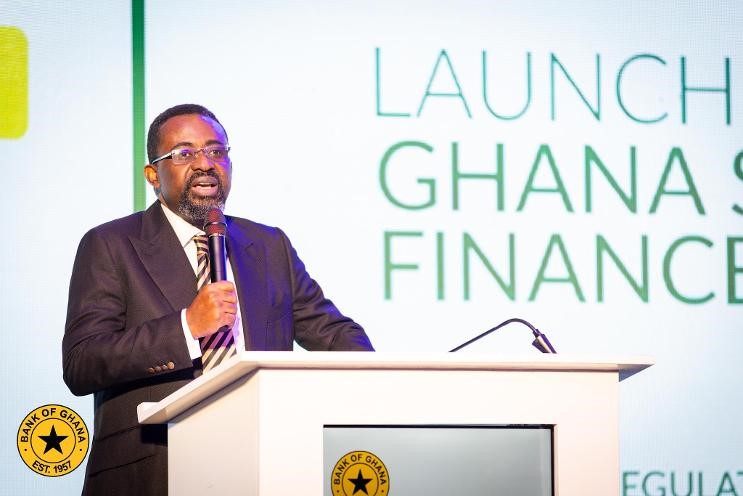
The Bank of Ghana (BoG) has launched a Sustainable Finance Roadmap aimed at embedding environmental, social and governance (ESG) considerations across Ghana’s financial sector.
It is also to help strengthen resilience to climate-related risks and position the country as a leading destination for sustainable investment in the region.
Speaking at the launch ceremony held in Accra, Governor of the Bank of Ghana, Dr. Johnson Pandit Asiama, described the initiative as a decisive step towards building a more resilient and sustainable financial system capable of supporting long-term economic growth.
“Sustainable finance is increasingly central to financial stability, to long-term investment, and to economic resilience,” Dr. Asiama said. “It is reshaping where global capital flows and what investors expect of financial systems.”

The Governor stressed that climate change and sustainability challenges were no longer distant concerns but had become material risks for economies and financial systems worldwide.
He pointed to recent flooding incidents across Ghana as evidence of how environmental risks increasingly affect asset values, lending security and insurance claims.
According to him, such risks require regulators and financial institutions to rethink traditional approaches to supervision, risk pricing and long-term planning.
“Ignoring these evolving risks would leave our financial system vulnerable. So, we have chosen a different path – one of foresight, innovation and collaboration,” he noted.
Dr. Asiama underscored the need for greater cooperation among Ghana’s financial sector regulators, including the Bank of Ghana, the National Insurance Commission (NIC), the Securities and Exchange Commission (SEC) and the National Pensions Regulatory Authority (NPRA).
While each institution oversees a distinct segment of the financial system, he said sustainability-related risks cut across regulatory boundaries and therefore require a coordinated response.
“Achieving a truly sustainable financial ecosystem goes beyond individual mandates. It calls for coordinated, long-term collaboration among all relevant regulators, aligned around a shared goal,” he stated.
The Governor highlighted the significant groundwork undertaken by the central bank over the past decade to advance sustainable finance.
He noted that the Bank of Ghana established a multi-stakeholder committee in 2015 that evolved into the Sustainable Banking Principles Steering Committee, bringing together the central bank, the Ghana Association of Banks and the Environmental Protection Agency.
This effort culminated in the introduction of the Sustainable Banking Principles and accompanying sector guidance notes in 2019.
All 23 commercial bank chief executives endorsed the principles, committing their institutions to integrating sustainability considerations into governance structures, risk management frameworks and business operations.
With support from the International Finance Corporation (IFC) and the Swiss Secretariat for Economic Affairs (SECO), the BoG subsequently developed a standardised compliance measurement framework in 2021.
Dr. Asiama revealed that industry-wide compliance with the Sustainable Banking Principles had risen steadily to 73 percent as of September 2025.
The central bank also introduced a four-year Strategic Plan on Sustainability and Climate-Related Risks covering the period 2024–2028 and issued a Climate-Related Financial Risk Directive aimed at strengthening financial institutions’ capacity to identify and manage climate-related risks.
The newly launched Sustainable Finance Roadmap provides, for the first time, a unified framework for regulators to coordinate sustainable finance initiatives across the financial sector.
The roadmap is structured around three strategic pillars environmental, social and governance (ESG) Integration, climate-related risk management and financing sustainability.
According to the Governor, the roadmap moves sustainable finance from isolated initiatives to a comprehensive system-wide framework with clearly defined responsibilities for regulators.
“These actions will strengthen our collective ability to anticipate emerging risks, respond proactively and unlock new opportunities that support inclusive and sustainable economic growth,” he said.
The financing sustainability pillar, in particular, seeks to mobilise private and institutional capital, encourage green and blended finance instruments and position Ghana as a regional hub for sustainable finance.
Beyond managing risk, Dr. Asiama said the framework is designed to help Ghana attract new pools of international capital increasingly directed toward sustainable investments.
He argued that a credible regulatory framework for sustainable finance would improve access to climate and development finance, support critical infrastructure financing, facilitate the energy transition and deepen domestic financial markets.
“Done well, this is not a cost we carry. It is a market we open,” he said, adding that Ghana has the opportunity to establish itself as a regional leader in sustainable finance.
The Governor praised members of the Sustainable Finance Roadmap Committee, which included representatives from the Ministry of Finance, Bank of Ghana, NIC, NPRA, SEC, the Institute of Chartered Accountants, Ghana, and the Chartered Institute of Bankers.
He also acknowledged the support of the International Finance Corporation, the Swiss Secretariat for Economic Affairs and the Sustainable Banking and Finance Network for their technical expertise and longstanding partnership.
As the roadmap enters the implementation phase, Dr. Asiama urged stakeholders to maintain the spirit of collaboration that led to its development.
“The roadmap we launch today is an important milestone, but its success will be measured by what we do next,” he said. “Let us build a financial system that is more resilient, more competitive and better prepared for the future.”
Source: businesspostonline