

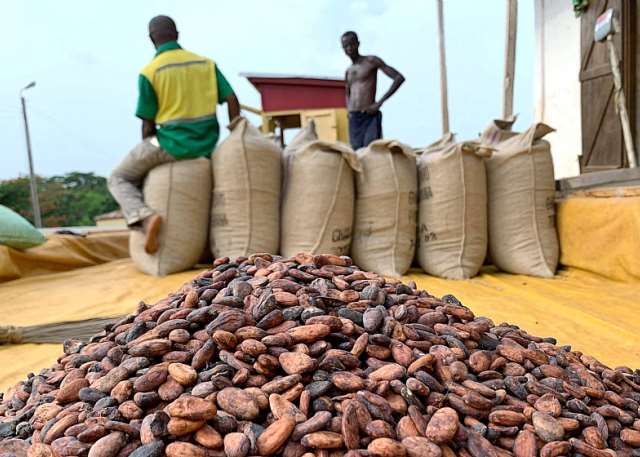
The Government of Ghana’s decision, announced on June 15, to maintain the producer price of cocoa despite a significant decline in global cocoa prices is a politically popular move among farmers, but it raises serious questions about the long-term financial sustainability of the country’s cocoa sector and the ability of the Ghana Cocoa Board (COCOBOD) to continue meeting its payment obligations without accumulating further debt.
Under the decision, the producer price remains unchanged at GH¢41,392 per tonne, or GH¢2,587 per 64-kilogram bag, even though international cocoa prices have fallen sharply from the record highs seen in 2024 and 2025. Since the government last slashed the farm gate price in February 2026, from GH¢58,000 per tonne (GH¢3,625 per bag) international cocoa prices have experienced continued downward pressure, sliding below US$4,000 per metric tonne at times before stabilizing. The global benchmark currently fluctuates between US$3,900 and US$4,500 per tonne.
According to COCOBOD’s Head of Public Affairs, Jerome Sam, maintaining the producer price was driven primarily by concern for farmers’ livelihoods rather than by prevailing market conditions. He acknowledged that if Ghana had followed international market trends, the producer price would likely have been reduced again.
Why Ghana has chosen stability

The government’s decision is understandable from both a political and developmental perspective.
Cocoa farmers have experienced several difficult seasons marked by disease outbreaks, illegal mining, weather-related production challenges and rising input costs. A further reduction in producer prices would almost certainly have generated political backlash and could have encouraged increased smuggling of cocoa beans into neighbouring countries if price differentials emerged.
Maintaining the price also aligns with the government’s broader objective of restoring confidence among cocoa farmers after years of declining production and concerns over farmer incomes.
For many cocoa-growing communities, producer prices are effectively the main determinant of household income. A stable price therefore provides income certainty and may encourage continued investment in farm maintenance and rehabilitation.
The financial challenge
The problem is that cocoa marketing economics are becoming less favourable.
Global cocoa prices have retreated substantially from the extraordinary highs reached in 2024 and early 2025 when global markets hit a speculative, historic record peak of over US$11,500 per tonne in mid-2024 due to severe crop shortages in West Africa. Market analysts attribute the decline since then largely to expectations of improved supply, particularly from Côte d’Ivoire, which is forecasting a significant recovery in production during the current season. Reuters reported in May that Ivorian cocoa output could rise by more than 10% this season, while other market analysts have highlighted improved crop prospects and increasing supply expectations.
Cocoa prices remain dramatically below year-ago levels despite occasional rebounds.
For COCOBOD, this creates a potentially dangerous mismatch between what it pays farmers and what it ultimately earns from cocoa exports.
Historically, Ghana has used forward sales and hedging arrangements to lock in export prices. However, if global prices continue to weaken while domestic producer prices remain fixed at relatively high levels, COCOBOD’s marketing margins will shrink. In extreme circumstances, losses may emerge.
Given COCOBOD’s already strained balance sheet and substantial debt burden accumulated over recent years, sustained losses would likely require additional government support or borrowing.
The contrast with neighbouring Côte d’Ivoire is striking.
While Ghana has prioritised income protection for farmers, Côte d’Ivoire has adopted a more market-responsive strategy. In February, Ivorian authorities moved to reduce farm-gate prices for the mid-crop season, with prices dropping sharply from the main-crop level as authorities adjusted to lower global market prices.
Lately, Côte d’Ivoire has cut producer prices and removed certain cocoa marketing premiums in order to restore competitiveness and align domestic pricing more closely with market realities.
From a financial management perspective, the Ivorian approach arguably carries lower fiscal risk because it transfers part of the market downturn to producers rather than to the state marketing system.
The Ghanaian approach does the opposite: it cushions farmers but increases financial pressure on COCOBOD and, ultimately, on government finances.
Cocoa farmers vs cocoa market analysts
Most Ghanaian cocoa farmers have welcomed the decision.
Farmer groups have consistently argued that producer prices should reflect not only international market conditions but also rising production costs, including fertilizers, labour and transportation. Many farmers believe they did not fully benefit from the period of exceptionally high international prices and therefore should not be asked to absorb the full impact of the current downturn.
For farmers, the unchanged producer price represents a degree of protection against volatile global commodity markets.
Many cocoa market analysts, however, see risks ahead.
Several analysts have warned that the global cocoa market is entering a correction phase after the unprecedented price spike of the past two years. Improving production prospects in Côte d’Ivoire and other producing countries are expected to place continued downward pressure on prices.
If those forecasts prove accurate, Ghana could face increasing difficulty maintaining current producer prices without either reducing COCOBOD’s profitability or increasing government support.
Some industry observers argue that Ghana’s current policy is viable as a temporary social protection measure but may not be sustainable over multiple seasons unless global prices recover.
What lies ahead
In the near term, Ghana can probably sustain the current producer price because much of its cocoa export programme is based on forward contracts and because the government appears willing to prioritize farmer welfare over immediate commercial considerations.
The bigger question is what happens in the 2026/27 main crop season.
If global cocoa prices stabilize or recover moderately, the decision to hold prices steady could prove politically astute and economically manageable. However, if the current downward trend continues and Côte d’Ivoire’s production recovery gathers momentum, Ghana may eventually be forced to choose between maintaining farmer incomes and protecting COCOBOD’s financial health.
For now, Ghana has chosen farmer protection over market adjustment, while Côte d’Ivoire has opted for market adjustment over farmer protection. The sustainability of Ghana’s strategy will depend largely on whether the global cocoa market stabilizes before COCOBOD’s finances come under renewed strain.
By: Toma Imirhe / businesspostonline