

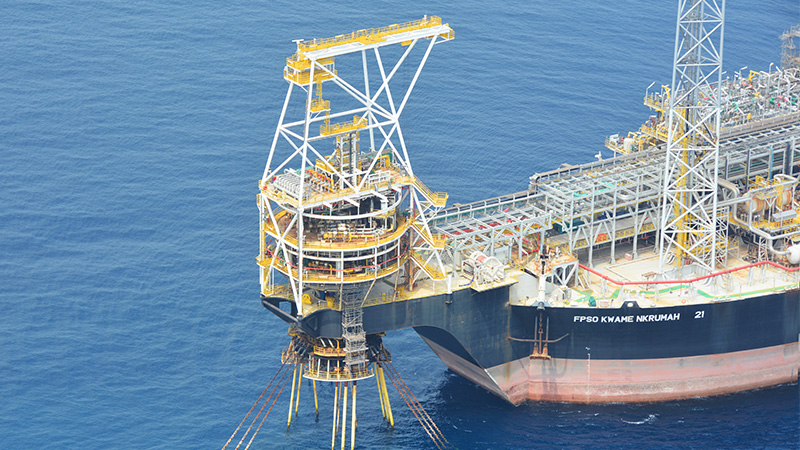
The government has revised its 2026 petroleum revenue projection upward to approximately US$1.5 billion, reflecting the impact of rising global crude oil prices and stronger-than-expected developments in the oil and gas sector.
Finance Minister Dr. Cassiel Ato Forson disclosed the revised outlook during an interview with Bloomberg in London, indicating that the new estimate significantly exceeds the US$985 million target contained in the 2026 Budget Statement.
According to the Minister, the revision follows sustained increases in international oil prices, driven largely by geopolitical tensions and supply concerns linked to developments in the Middle East.
He said the government will provide a detailed breakdown of the revised revenue projections when it presents the Mid-Year Budget Review in July 2026.

“We have seen significant developments in the oil and gas sector, and these are expected to positively impact both petroleum revenues and overall economic growth this year,” Dr. Forson noted.
Oil windfall boosts fiscal outlook
The original petroleum revenue estimate of US$985 million was based on a benchmark crude oil price of US$76.22 per barrel, slightly above the US$74.70 per barrel assumption used in the previous year’s budget.
Under the initial projections, royalties were expected to contribute US$162 million, while carried and participating interests were estimated at US$419 million. Corporate income tax from petroleum operations was projected at US$403.5 million, with surface rentals contributing a modest US$720,000.
Government had planned to allocate US$556.6 million of the projected revenue to the Annual Budget Funding Amount (ABFA), which supports national development expenditure.
Another US$238.6 million was earmarked for the Ghana Petroleum Funds, including US$167 million for the Ghana Stabilisation Fund and US$71.6 million for the Ghana Heritage Fund.
Additionally, about US$190.3 million was expected to be transferred to the Ghana National Petroleum Corporation (GNPC) to support equity financing costs and its share of carried and participating interests.
The revised revenue forecast could potentially provide government with additional fiscal space to support development priorities while strengthening petroleum-related savings and stabilization buffers.
Economic growth outlook improves
Beyond the stronger revenue outlook, the Finance Minister also signaled a possible upward revision to Ghana’s economic growth forecast for 2026.
The 2026 Budget projected real GDP growth of 4.8 percent. However, Dr. Forson indicated that current economic trends suggest the economy could perform significantly better than initially anticipated.
He expressed confidence that Ghana’s economy may expand by more than 6 percent this year, supported by increased activity in the oil and gas sector and improving macroeconomic conditions.
“We are optimistic that growth will exceed earlier projections. The recent developments in the petroleum sector are expected to have a positive impact on GDP performance by the end of the year,” he said.
Mid-year review expected to unveil new policies
The upcoming Mid-Year Budget Review is also expected to outline new economic policy measures aimed at sustaining growth, strengthening fiscal stability and maximizing the benefits of higher petroleum revenues.
The government has maintained that prudent management of oil revenues remains central to its fiscal strategy, balancing current development needs with long-term savings objectives.
The revised petroleum revenue forecast comes at a time when Ghana is benefiting from a combination of improved oil prices, stronger foreign exchange reserves and renewed investor confidence, providing additional support for the country’s ongoing economic recovery.
Source: businesspostonline