

Ghana has launched a US$3.5 billion AgriConnect Compact, positioning agriculture—particularly rice—at the centre of its strategy for job creation, food security and economic transformation, while setting the pace for West Africa’s broader push toward rice self-sufficiency.
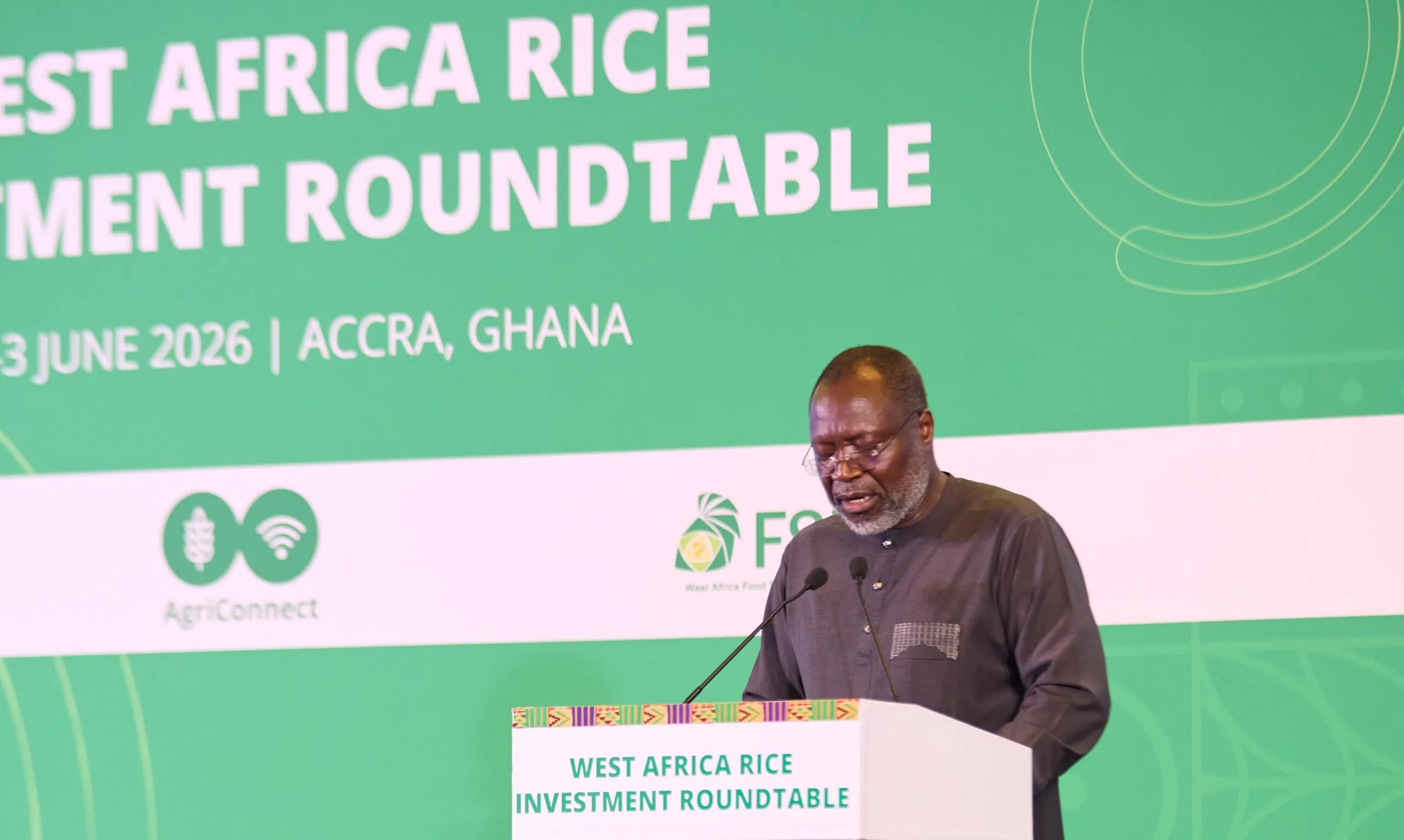
Unveiled on the sidelines of the West Africa Rice Investment Roundtable in Accra, the initiative aims to create over 2.6 million jobs, improve food and nutrition security for nearly 3 million people, and unlock large-scale public and private investment over the next five years.
Vice-President Prof. Jane Naana Opoku-Agyemang said the initiative reflects a shift from subsistence farming to a more commercial, integrated agricultural system.
“The challenge is not just about growing more rice, but mobilising capital to transform agriculture into integrated value chains. Rice must be seen as a strategic economic asset,” she said.

The Compact targets key value chains including rice, maize, cocoa, oil palm and poultry, supported by investments in irrigation, mechanisation, climate-smart agriculture and digital innovation.
Rice remains central, given rising demand and Ghana’s dependence on imports. Priority areas include irrigation expansion, improved seed systems, mechanisation for smallholders, modern milling, storage and logistics, and stronger market linkages.
The Accra roundtable—convened by ECOWAS, the World Bank Group and the African Development Bank—brought together regional leaders, investors and technical experts to accelerate financing for national rice strategies. A pipeline of investment-ready projects was presented, alongside calls for stronger public-private partnerships and risk-sharing tools.
World Bank Vice-President Guangzhe Chen described Ghana’s initiative as a model for the region, noting its potential to deliver jobs and inclusive growth at scale.
Regional leaders reaffirmed a shared goal of achieving rice self-sufficiency by 2035, with ECOWAS Commission President Dr. Omar Alieu Touray urging faster action to boost investor confidence and financing.
For Ghana, the Compact also places strong emphasis on youth employment and agribusiness development, with opportunities across mechanisation services, processing, logistics and digital agriculture.
By aligning national priorities with regional ambitions, Ghana is positioning itself as a hub for agricultural investment and a leader in reshaping West Africa’s rice economy.
The key challenge ahead will be translating the Compact’s ambitions into bankable projects and measurable outcomes, ensuring that increased investment leads to higher productivity, reduced imports and a more resilient food system.
Source: businesspostonline