

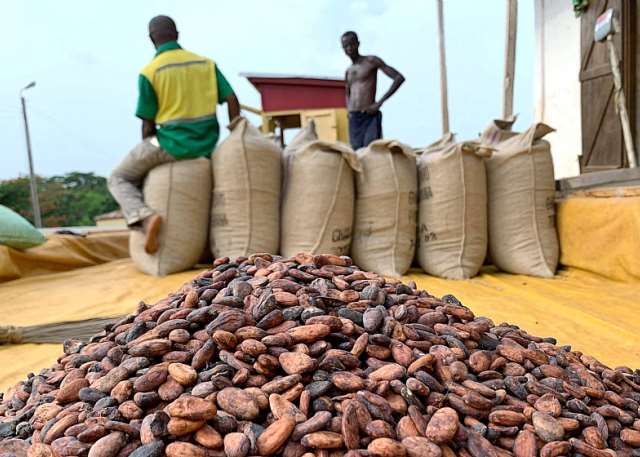
The Government of Ghana has begun disclosing details of an ambitious new domestic cocoa financing programme centred on a planned cedi-denominated bond issuance with a target size equivalent to US$1 billion, aimed at funding purchases of cocoa beans from local farmers ahead of the 2026/27 crop season.
The proposed “cocoa bond” programme represents one of the most significant changes to the financing structure of Ghana’s cocoa industry in decades, replacing the long-standing offshore syndicated loan arrangement that has historically funded annual cocoa purchases by the Ghana Cocoa Board, popularly known as COCOBOD.
What has emerged so far from statements by officials at the Ministry of Finance, the Bank of Ghana and COCOBOD itself indicates that government intends to mobilise domestic liquidity through local-currency debt instruments rather than rely on foreign commercial lenders. However, several crucial aspects of the programme remain either undecided or undisclosed.
Finance Minister Cassiel Ato Forson first publicly outlined the new financing model in February this year, describing it as a revolving domestic cocoa bond arrangement. According to the Ministry of Finance, funds raised through the bonds would be used by COCOBOD to purchase cocoa beans directly from farmers and licensed buying companies, with repayment expected to come from cocoa export proceeds generated within the same crop year.

“The new financing model will utilise domestic cocoa bonds to purchase cocoa and repay from cocoa proceeds within each crop year,” Dr Forson stated during a press briefing announcing wider cocoa sector reforms.
COCOBOD Chief Executive Officer Randy Abbey has since confirmed that the planned issuance is expected before the start of the next cocoa season, which traditionally begins around August.
While government officials have repeatedly referred to the programme as a US$1 billion issuance, they have clarified that the securities themselves will be denominated in Ghana cedis rather than dollars. This means the actual nominal issuance size will depend on prevailing exchange rates at the time of launch.
Authorities have also indicated that the bonds will primarily target domestic institutional investors. Market analysts expect likely buyers to include commercial banks, pension funds, insurance firms, asset managers and high-net-worth investors seeking relatively high-yield fixed income instruments. The Governor of the Bank of Ghana, Johnson Pandit Asiama, recently stated that the programme is also intended to deepen Ghana’s domestic bond market and broaden local investor participation in long-term securities.
However, government has not yet publicly specified whether the issuance will be conducted through a single benchmark bond, a programme of multiple tranches, or a combination of instruments including commercial paper and medium-term notes. The precise tenor structure also remains undisclosed, although statements by officials suggest the instruments may be relatively short-dated and self-liquidating, aligned to the annual cocoa crop cycle.
Neither the Ministry of Finance nor COCOBOD has yet announced whether the securities will carry explicit sovereign guarantees from the Government of Ghana or rely solely on cocoa export receivables and COCOBOD cash flows for repayment support. This issue is considered critical by investors given COCOBOD’s highly leveraged financial position, which would make an issuance on its own balance sheet – without a government guarantee – a considerably riskier proposition than a sovereign bond issuance
The cocoa regulator is currently burdened with debts estimated at over GH¢32 billion following years of declining production, financing strains and restructuring under the Domestic Debt Exchange Programme (DDEP).
Market participants are therefore closely watching whether government will provide formal repayment guarantees, liquidity backstops or partial credit enhancement mechanisms to improve investor confidence and lower borrowing costs.
Equally unclear is whether the bonds will receive international or domestic credit ratings. Analysts say a formal rating could become important if authorities hope to attract participation from pension funds and institutional investors with strict investment guidelines.
There is also no official confirmation yet on whether the securities will be listed on the Ghana Stock Exchange or traded over-the-counter among institutional investors. If listed, the bonds could become tradable instruments that investors may buy, sell or discount in the secondary market before maturity. Market dealers note that tradability would improve liquidity and investor appetite but could also expose the securities to volatility linked to cocoa prices, exchange rate expectations and broader sovereign risk perceptions.
Pricing considerations remain another unresolved area. Officials have acknowledged that the bonds will need to offer sufficiently attractive yields to compete with treasury bills and government bonds. However, no indicative coupon range has yet been announced.
Analysts expect pricing to balance the positive of improving macroeconomic conditions with the negatives of elevated sector-specific risks. Ghana’s declining inflation and falling interest rate environment may support lower borrowing costs compared to recent years. But at the same time, COCOBOD’s debt burden, operational challenges and recent liquidity problems are likely to persuade investors to demand a substantial risk premium.
Another major concern is currency mismatch risk. Although cocoa export earnings are received largely in dollars, the bonds will be serviced in cedis. Analysts warn that sharp depreciation of the cedi could complicate debt servicing if cocoa prices weaken simultaneously.
Government officials maintain that the proceeds will be ring-fenced specifically for cocoa purchases and payments to farmers and licensed buying companies rather than broader COCOBOD operations. Reuters recently reported that large arrears owed to cocoa farmers and licensed buying companies have strained the entire cocoa value chain, with buyers owing banks up to US$750 million.
The new financing arrangement is therefore being positioned as both a liquidity solution and a structural reform intended to reduce Ghana’s dependence on offshore syndicated loans, which became increasingly difficult and expensive to secure after the country’s sovereign debt crisis and DDEP restructuring.
Still, several critical details remain outstanding ahead of the expected launch later this year, including the final issuance structure, investor protections, and legal documentation, underwriting arrangements, listing status, coupon pricing, guarantee mechanisms and regulatory approvals.
Until those details are clarified, investors are likely to remain cautiously optimistic about what could become one of the largest and most consequential domestic commodity-backed bond issuances in Ghana’s financial history.
By: Toma Imirhe / businesspostonline