

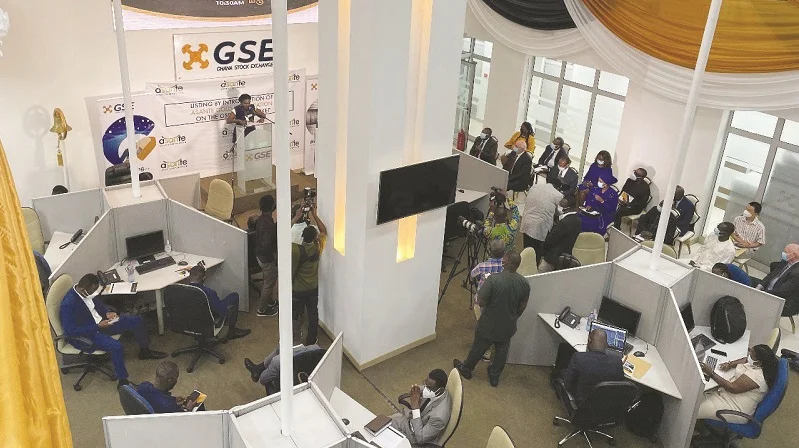
Profit-taking by investors after months of extraordinary capital gains failed to trigger a major price correction on the main board of the Ghana Stock Exchange during the trading week ended May 22, 2026, reinforcing growing market confidence that the current equities rally still has room to run.
Instead of the sharp sell-off that often follows rapid appreciation in frontier equity markets, trading activity over the past two weeks has pointed to a market that is flattening gradually while still retaining strong underlying support from both institutional and retail investors.
Market analysts say this resilience reflects two important developments in Ghana’s financial markets and wider economy: the dramatic fall in yields on fixed income securities over the past year and growing investor confidence that Ghana’s macroeconomic recovery is becoming entrenched.
The GSE Composite Index has delivered one of its strongest performances in recent history in 2026, after already returning nearly 49 percent in the first quarter alone, according to market data.

Although the market recorded some pullbacks earlier in May, including a steep weekly decline during the week ended May 8 when market capitalization shed about GH¢12.5 billion, subsequent trading sessions suggest investors have largely viewed that decline as the result of temporary profit-taking opportunities rather than a signal of a broader reversal.
“The market is clearly consolidating after a very aggressive rally,” said a senior Accra-based equities trader with one of Ghana’s leading brokerage houses. “But what is notable is that investors are not rushing for the exits. They are selectively taking profits while maintaining exposure to fundamentally strong equities.”
That pattern has become increasingly visible in heavily traded equities such as MTN Ghana, Ecobank Ghana, CalBank, SIC Insurance and some consumer goods and petroleum-related stocks, where trading volumes remain robust despite intermittent price declines.
Analysts say investors are reluctant to rotate aggressively back into treasury bills and government bonds because yields on those instruments have fallen sharply following Ghana’s improving macroeconomic conditions, easing inflation and tighter fiscal management.
Over the past year, yields on short-term government securities have compressed significantly as inflation slowed and the government’s domestic borrowing pressures eased. At the same time, the success of Ghana’s IMF-supported recovery programme and improving foreign exchange stability have boosted confidence in cedi-denominated assets generally.
This has strengthened the relative attractiveness of equities.
“With treasury bill yields declining steadily, investors are now more willing to assume measured equity risk in pursuit of higher real returns,” said an investment analyst at an asset management firm. “Equities are no longer being viewed merely as speculative assets but increasingly as viable long-term stores of value.”
The strong performance of several listed banks has reinforced that sentiment. Shares of some financial institutions have more than doubled since the start of the year, driven by stronger earnings expectations, balance sheet recovery after the Domestic Debt Exchange Programme, and renewed optimism about private sector credit growth.
Ecobank Ghana, for instance, has recorded a year-to-date share price gain of more than 90% by May 22, according to market data.
Meanwhile, MTN Ghana continues to dominate trading activity on the exchange, reflecting both its liquidity and its attraction to dividend-seeking investors. Trading data from mid-May showed the telecom giant accounting for the largest share of turnover on the exchange.
Retail investor participation has also broadened considerably. Mobile investment platforms and easier digital access to brokerage services have increased participation among younger investors seeking alternatives to traditional savings products.
Market commentators note that the psychology of investors has changed materially compared with previous rallies on the exchange.
“In earlier cycles, investors tended to panic quickly after the first signs of correction,” said an Accra-based market commentator. “This time, investors appear more convinced that Ghana’s economic recovery has a stronger foundation, so temporary pullbacks are being treated as buying opportunities rather than reasons to abandon the market.”
Still, analysts caution that the market’s performance between now and mid-2026 will depend on several critical variables.
The first will be the sustainability of Ghana’s macroeconomic stabilization. Continued moderation in inflation, exchange rate stability and fiscal discipline will remain central to investor confidence. Any signs of renewed macroeconomic stress could quickly weaken appetite for equities.
The second factor will be corporate earnings performance. Investors are expected to become increasingly selective as valuations rise. Companies that fail to translate improving economic conditions into earnings growth may struggle to sustain recent price gains.
Third, the trajectory of interest rates will remain crucial. Further declines in fixed income yields could continue pushing investors toward equities. However, any unexpected tightening in monetary policy by the Bank of Ghana could slow the migration of capital into the stock market.
Global conditions will also matter. Renewed volatility in commodity prices, geopolitical tensions or changes in international investor risk appetite could affect frontier market flows, including Ghana.
For equity investors, analysts say the environment now requires more disciplined, selective positioning than during the earlier phase of the rally when gains were broad-based.
“Investors should focus increasingly on quality and fundamentals rather than momentum alone,” one portfolio manager advised. “The easy gains may already have been made in some stocks.”
Market professionals recommend that investors prioritize companies with strong earnings visibility, sustainable dividend policies, resilient cash flows and clear growth prospects.
Banking, telecommunications, selected consumer stocks and firms benefiting directly from Ghana’s economic recovery are expected to remain attractive sectors through the middle of 2026.
At the same time, analysts advise investors to maintain diversified portfolios and prepare for periodic volatility as the market transitions from rapid expansion into a more mature consolidation phase.
For now, however, the message coming from the GSE is clear: despite growing profit-taking activity, investor optimism about Ghana’s equities market — and the broader economy underpinning it — remains firmly intact
By: Toma Imirhe / businesspostonline