

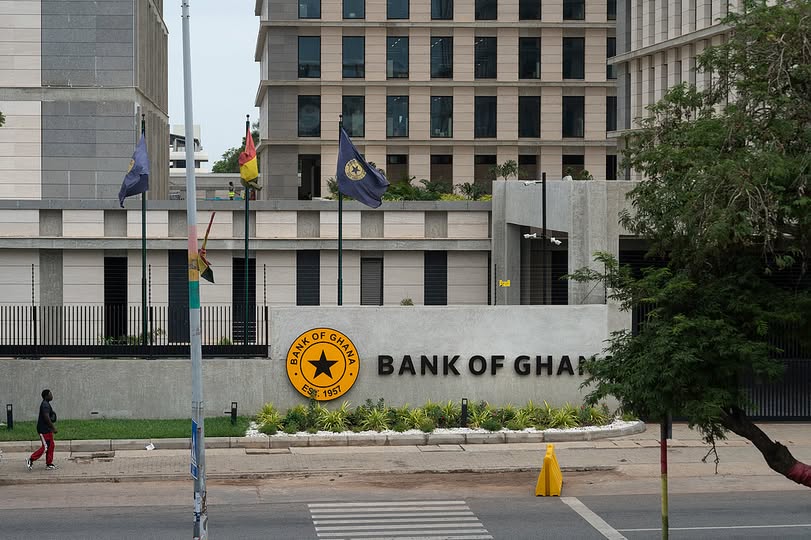
The Bank of Ghana has suspended its aggressive interest rate reduction campaign, opting to keep the Monetary Policy Rate (MPR) unchanged at 14 percent amid mounting global inflation risks linked to escalating tensions in the Middle East.
The decision was announced on May 20, 2026, following the Monetary Policy Committee’s 130th meeting in Accra. It comes after the central bank slashed the benchmark rate by a cumulative 1,400 basis points since July 2025 in response to easing inflation and improving macroeconomic conditions.
Governor Dr. Johnson Pandit Asiama said the committee considered risks to inflation and growth to be relatively balanced but noted that geopolitical instability and rising crude oil prices had become major concerns.
“The elephant in the room is the Middle East crisis,” Dr. Asiama said during the post-meeting briefing. “At this stage, it is difficult to determine whether the situation will be temporary or prolonged.”

The central bank’s latest stance marks a pause in one of Ghana’s sharpest monetary easing cycles in recent years. Since peaking at 28 percent in mid-2025, the policy rate has steadily declined as inflation moderated, the cedi stabilised and investor confidence improved under Ghana’s IMF-supported economic programme.
The most recent cut occurred in March 2026, when the MPC reduced the benchmark rate from 15.5 percent to 14 percent. At the time, policymakers argued that lower inflation and positive real interest rates created room to stimulate private sector credit growth.
However, new inflationary risks have since emerged.
Headline inflation edged up to 3.4 percent in April from 3.2 percent in March, marking the first increase since late 2024. The rise was attributed partly to higher non-food prices and exchange rate-related effects.
At the same time, renewed instability in the Middle East and disruptions to global trade routes — including the blockade of the Strait of Hormuz — have pushed international crude oil prices sharply higher, raising fears of imported inflation.
According to the central bank, sustained increases in fuel prices could spill over into transport costs, utility tariffs and overall production expenses, potentially reversing recent gains in price stability.
“The disruption to trade flows following the blockade of the Strait of Hormuz has reignited inflationary pressures,” Dr. Asiama warned.
The MPC’s decision is expected to influence Ghana’s broader interest rate environment.
Commercial banks, which had gradually begun lowering lending rates after successive policy cuts, are now expected to maintain current pricing levels in the near term. Analysts say uncertainty surrounding inflation and credit risks could prevent further significant declines in borrowing costs.
Dr. Asiama acknowledged that lower policy rates do not immediately translate into cheaper loans.
“When interest rates are falling, banks do not simply rush into lending. They still require credible projects and must maintain proper credit standards,” he explained.
As a result, prime corporate borrowers are likely to continue accessing cedi loans at rates between 18 and 24 percent, while medium-sized businesses could face borrowing costs ranging from 25 to 35 percent depending on risk profiles and collateral requirements.
Consumer loans are also expected to remain relatively expensive, with many unsecured facilities still priced above 30 percent annually despite the sharp decline in the benchmark rate over the past year.
Non-bank financial institutions, including savings and loans firms, are similarly expected to keep rates elevated because of higher funding costs.
In the fixed-income market, the decision is expected to support the recent stabilisation in Treasury bill yields after months of significant declines.
Although yields have dropped sharply since late 2025 due to improving economic conditions and strong liquidity, investors have become more cautious amid rising global inflation risks and oil price volatility.
Market analysts believe the decision to maintain the policy rate at 14 percent could keep short-term Treasury bill rates near current levels ahead of the MPC’s next meeting in July.
Investors are also expected to favour shorter-dated securities such as the 91-day and 182-day Treasury bills while remaining cautious about longer-term bonds because of uncertainty over future inflation trends.
Meanwhile, the government may face slower-than-expected declines in domestic borrowing costs, although financing conditions remain far improved from the crisis-era highs recorded in 2023 and early 2024.
Financial market participants broadly welcomed the MPC’s cautious approach, arguing that safeguarding macroeconomic stability remains more important than pursuing rapid monetary easing.
The Bank of Ghana also announced additional liquidity-tightening measures, including a revised cash reserve ratio framework that will require banks to maintain a uniform 20 percent reserve requirement in domestic currency beginning June 4.
Analysts say the move is intended to strengthen monetary policy transmission and absorb excess liquidity that could otherwise fuel speculative activity in the foreign exchange and government securities markets.
Despite pausing rate cuts, the central bank maintained an optimistic outlook on Ghana’s economy, citing continued improvements in private sector activity, industrial output and trade.
The Bank’s Composite Index of Economic Activity expanded by 12.6 percent year-on-year in March 2026, compared with 2.3 percent during the same period last year.
Still, with geopolitical tensions continuing to threaten global commodity markets and inflation expectations, the Bank of Ghana appears determined to prioritise economic stability until clearer signals emerge ahead of its next policy review in July.
By: Toma Imirhe / businesspostonline