

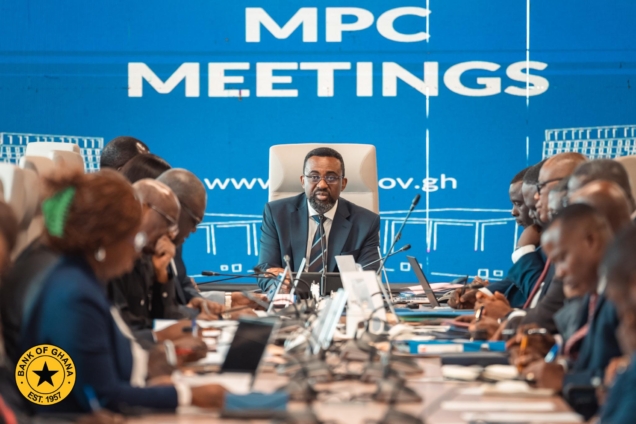
Governor of the Bank of Ghana (BoG), Dr Johnson Asiama, has warned that while Ghana’s macroeconomic conditions have improved significantly in recent months, a worsening global environment—driven largely by the prolonged Middle East conflict—is creating fresh risks that could complicate policy decisions.
Speaking at the opening of the Monetary Policy Committee (MPC) meeting, Dr Asiama said the central bank is navigating a delicate balance between preserving hard-won domestic gains and responding to mounting external shocks.
“We are meeting at a time of heightened policy complexity,” he stated, noting that the Ghanaian economy has strengthened meaningfully since the committee’s last meeting in March 2026.
“This reflects the sustained reform efforts undertaken in recent years.”

However, the Governor highlighted that the global outlook has deteriorated sharply since then. The ongoing conflict in the Middle East—initially assessed as a potential short-term disruption during the 129th MPC meeting—has evolved into a prolonged crisis with visible economic consequences.
At the earlier meeting, policymakers had outlined scenarios ranging from a swift resolution, with Brent crude prices easing toward US$75 per barrel to a prolonged conflict pushing prices to around US$100 per barrel through the end of 2026.
“Today, a clearer picture is emerging,” Dr Asiama said. “The conflict has not abated, and its economic consequences are now evident in global data.”
He pointed to the closure of the Strait of Hormuz as a major trigger for sustained increases in global energy prices.
In response, the International Monetary Fund (IMF) has revised its global growth forecast downward to 3.1 percent from 3.3 percent, citing adverse supply and demand effects.
The energy price shock has already led to a resurgence of inflation in several advanced and emerging economies, prompting central banks to pause or reverse earlier easing measures.
For Ghana, an energy-importing yet commodity-exporting economy, the transmission of these shocks is multifaceted.
“These pressures are coming through fuel prices, transport costs, rising import bills, and ultimately consumer inflation,” Dr Asiama explained.
Domestically, early signs of strain are beginning to show. Headline inflation has recorded its first uptick, interrupting a downward trend that had supported recent policy optimism.
At the same time, government financing strategies are evolving. Authorities have announced plans to raise US$1 billion through local currency bonds to fund cocoa purchases for the 2026/27 season—a move officials say will reduce reliance on foreign borrowing.
“This represents a significant shift,” the Governor noted, “and underscores efforts to deepen domestic financing while easing external vulnerabilities.”
The MPC faces a complex set of policy choices over the coming days. Central among them is whether to adjust the interest rate structure in response to emerging inflation risks, while ensuring expectations remain anchored.
Despite inflation having declined in recent months, Dr Asiama cautioned that a combination of domestic energy supply disruptions and external price pressures could trigger renewed inflationary momentum.
“There is a real risk of inflation expectations becoming dislodged if these pressures persist,” he warned.
The effectiveness of monetary policy transmission also remains under scrutiny. The committee is expected to assess whether current policy tools are sufficiently influencing lending rates, supporting credit growth, and sustaining economic activity.
Beyond immediate monetary considerations, the Governor stressed the importance of a resilient banking sector to support recovery and growth.
“The economy will require a strong financial system capable of delivering credit expansion,” he said, adding that financial stability concerns remain a priority.
Key risks highlighted include:
- The prolonged Middle East conflict and sustained energy price increases
- Domestic energy supply disruptions
- Current account and reserve vulnerabilities
- Fiscal pressures stemming from potential external revenue declines
- Elevated business costs linked to Ghana’s recent power challenges
Although the domestic power situation is showing signs of improvement, its impact on production costs and inflation expectations remains significant.
Dr Asiama also provided an update on Ghana’s post-Extended Credit Facility (ECF) engagement with the IMF, indicating that the country is transitioning to a 36-month Policy Coordination Instrument (PCI).
The PCI will serve as a framework to strengthen policy discipline and reform implementation across six key pillars, including fiscal consolidation, debt sustainability, and financial sector stability.
For the Bank of Ghana, the programme will place particular emphasis on refining the monetary policy framework, improving liquidity forecasting, and reinforcing the inflation-targeting regime.
Additionally, the central bank will be expected to strengthen its balance sheet by limiting quasi-fiscal operations and enhancing transparency around initiatives such as the domestic gold purchase programme.
Despite the growing risks, Dr Asiama struck a cautiously optimistic tone, describing Ghana’s current position as one of resilience amid turbulence.
“The domestic economy is holding up,” he said, “but it is operating in an increasingly difficult external environment.”
The MPC’s decisions this week are expected to signal how policymakers intend to navigate this delicate phase—balancing growth, inflation control, and financial stability against a backdrop of global uncertainty.
By: Christian Akorlie / businesspostonline