

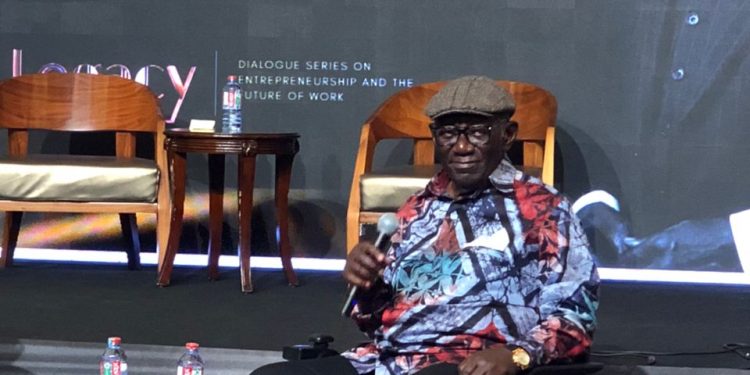
Former President John Agyekum Kufuor has renewed his call for a decisive shift toward private sector–led growth, stressing that Ghana’s long-term prosperity depends on entrepreneurship, innovation and strong public–private partnerships.
He said sustainable development could not be achieved through State dominance but through empowering individuals to take risks and create wealth within a clear and fair regulatory framework.
Mr Kufuor was speaking at the inaugural Design and Technology Institute (DTI) Legacy Dialogue Series on Entrepreneurship and the Future of Work, held in Accra under the theme “Within Our Lifetime: Building Ghana’s Industrial Future.”
“The State by itself cannot enrich society,” the former President said. “Wealth creation happens when individuals are allowed to venture, take risks and pursue profit within a regulated environment. That is how jobs are created and societies advance.”

Reflecting on Ghana’s pre‑independence economic trajectory, Mr Kufuor traced his convictions to the era of the Gold Coast, when private initiative drove national success.
“In the 1940s, this country became the world’s leading cocoa producer not because government farmed cocoa, but because ordinary men and women, working small plots of land, responded to market incentives and profitability,” he said.
He noted that following independence, Ghana adopted statist economic models that crowded out private enterprise, resulting in decades of economic underperformance.
“We removed the risk‑taker from the development equation. The State wanted to do everything – state farms, state industries – and the results are well known,” he said, citing countries such as Malaysia, South Korea and Singapore, which embraced enterprise and industrial policy more successfully.
The former President said these historical lessons shaped his administration’s policy direction, encapsulated in the vision of ushering Ghana into “the golden age of business.”
“Why should we be afraid of people becoming wealthy?” he asked. “If entrepreneurs succeed, government benefits through taxes, employment and economic expansion.”
Mr Kufuor emphasised that entrepreneurship must be treated not merely as an individual ambition but as a national development strategy, supported by consistent policies and bipartisan commitment.
“This must go beyond partisan politics. Who does not want Ghana to be far richer than it is today?” he said.
He identified public–private partnerships as the most practical route to tackling youth unemployment, weak industrial growth and Ghana’s limited value addition to natural resources.
“With nearly 60 per cent of our population under 35, job creation cannot depend on the State alone. Without a vibrant private sector, frustration will continue to grow,” he warned.
The event brought together policymakers, development partners, traditional leaders, industry players, academics, students and the media to
examine the future of work and skills development.
Earlier, delivering the welcome address, Founder and President of DTI, Ms Constance Elizabeth Swaniker, said Ghana’s industrial future demanded deliberate investments in practical skills, youth entrepreneurship and policy continuity.
She recalled that Ghana’s industrial ambition, articulated by Osagyefo Dr Kwame Nkrumah at independence, required the country to achieve in a generation what others had taken centuries to build.
Despite decades of policy statements, she said, Ghana continued to face structural unemployment, particularly among young people.
Citing World Bank data, Ms Swaniker said about 1.34 million Ghanaians aged 15–24, representing more than 21 per cent, were not in employment, education or training, while the economy needed to create at least 300,000 new jobs annually to absorb new entrants.
“This is not just a gap; it is a structural failure, and it weighs heavily on our youth,” she said.
Ms Swaniker explained that her decision to establish DTI in 2016 stemmed from her experience in manufacturing, where she observed a disconnect between formal education and industry needs.
DTI, she said, addressed this gap through hands‑on, character‑driven technical training, with many learners financing their education through enterprise‑based learning.
She welcomed recent government commitments announced in the 2026 State of the Nation Address, including the establishment of six Regional TVET Centres of Excellence, plans to raise TVET enrolment to 20 per cent, curriculum review efforts and the rollout of the Adwumawura Programme to support youth‑owned businesses.
Ms Swaniker also praised the National Development Planning Commission’s Ghana@100 (Vision 2057) initiative, which seeks to ensure continuity in national development beyond electoral cycles.
“The inability to sustain momentum across political transitions has cost us dearly,” she said, urging the adoption of a national compact on development priorities.
Ms Swaniker announced that DTI had broken ground for an 11‑acre Multi‑Skills Campus at Berekuso, supported by a €3 million African Union grant through AUDA‑NEPAD, with financing from KfW.
When completed, the campus will train about 3,500 learners annually, host an industrial park and serve as a Pan‑African Centre of Excellence for TVET and workforce development.
Programmes will include industrial plumbing, industrial electricals, agricultural mechanisation and cleaning sciences, alongside DTI’s core strengths in welding, fabrication, design and entrepreneurship.
She noted that DTI is the first institution in Africa to receive international accreditation from the American Welding Society under the SENSE programme, and is also accredited by Pearson BTEC.
Ms Swaniker announced that DTI’s new entrepreneurship hub at Berekuso would be named the J. A. Kufuor Centre for Entrepreneurship, in honour of the former President’s lifelong advocacy for enterprise and value addition.
“This is not a ceremonial gesture,” Ms Swaniker said. “It is a legacy measured by the businesses built, jobs created and industries transformed.”
Renewed Optimism
Concluding the dialogue, Mr Kufuor expressed confidence that Ghana’s youthful population could reclaim the country’s entrepreneurial heritage if properly trained and supported.
“We must not lose hope. If we do, we are preparing for decline,” he said. “It is not too late to rebuild the venturing spirit that once defined us.”
Velda Sosah, seasoned Chartered Accountant and a Non-Executive Director for the Design and Technology Institute highlighted the organisation’s contribution to workforce development, noting that more than 49,000 young people had passed through DTI programmes since its establishment, with female participation rising from 21 per cent to over 50 per cent.
Many graduates, she said, had gone on to establish businesses or secure employment locally and across global markets.
Mr. Martyn Mensah, a management professional and strategy expert, described the Dialogue Series as a practical vehicle for youth empowerment and mentorship, emphasising the need for deliberate collaboration to bridge the gap between education and employment.
Another major highlight was the high-level session on “Unlocking Ghana’s Golden Age of Business”, featuring Dr. Tony Oteng-Gyasi and Paa Kwesi Yankey.
The discussion explored actionable strategies for strengthening industry-aligned skills systems, scaling human capital development, and unlocking the vast potential of Ghana’s informal sector through coordinated action.
In a distinct rallying call, Mrs. Linda Larbi, a marketing and business development leader, urged stakeholders to move beyond discussion to action by investing in long-term partnerships.
She emphasised the importance of “placing bold bets” on Ghana’s youth, building belief in local capability, and joining a collective movement to create sustainable opportunities through entrepreneurship and innovation.
Participants also underscored persistent structural challenges within Ghana’s education and training system, particularly the misalignment between academic output and industry needs, calling for renewed focus on technical and vocational education and training (TVET).
The DTI Legacy Dialogue Series is expected to become a regular national platform for intergenerational conversations on Ghana’s industrialisation, entrepreneurship and the future of work.
By: Christian Akorlie / businesspostonline