

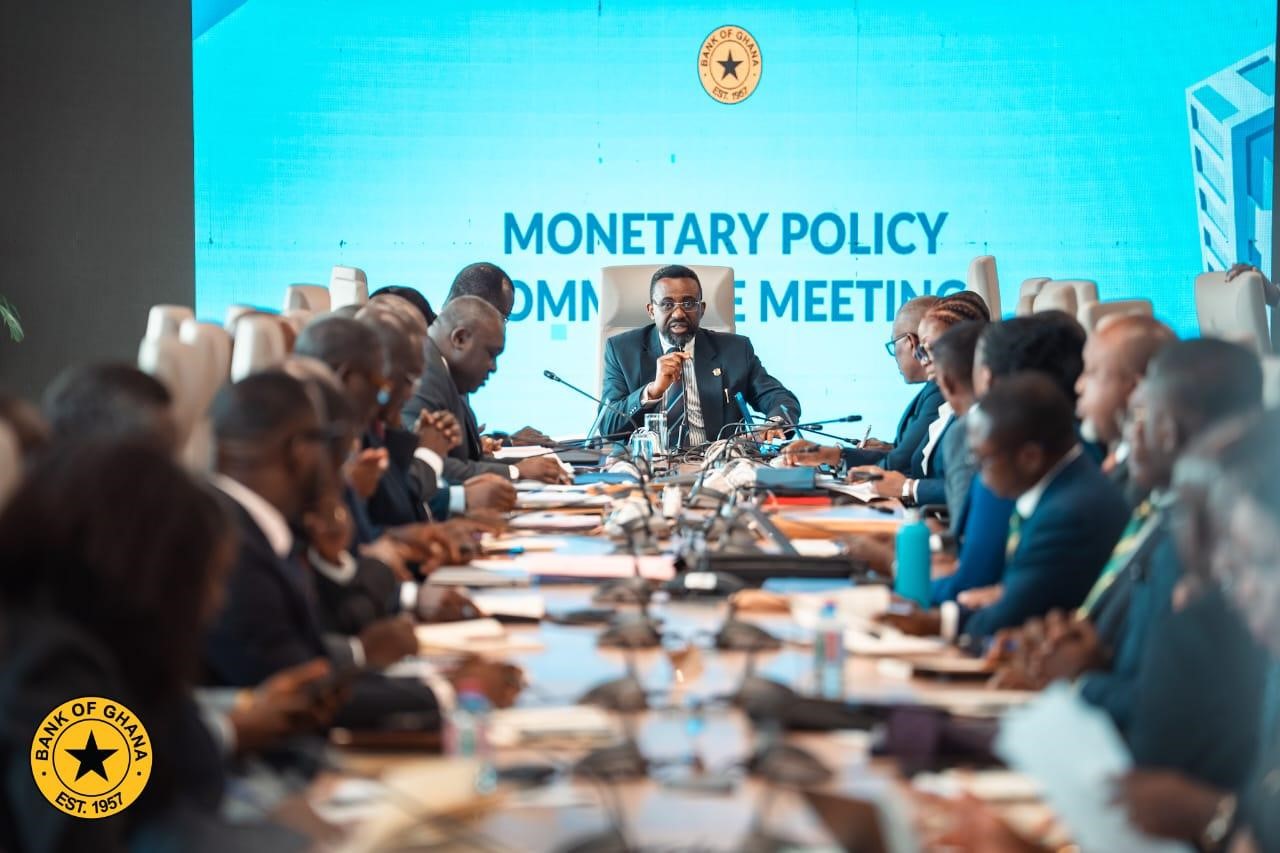
Ahead of a crucial announcement this week by the Governor of the Bank of Ghana, Dr Johnson Pandit Asiama, on where the Monetary Policy Committee (MPC) – which he chairs – will set the Monetary Policy Rate (MPR), financial market operators and economists have narrowed down the options to either a small cut in the benchmark rate by a maximum of 200 basis points or a retention of the current rate of 14.00 percent at which it has been held since March this year. Economic and financial pundits have reached a consensus that despite pressures on both domestic price levels and the cedi’s exchange rate against the United States dollar, the MPC will be comfortable enough with the current circumstances to dismiss any temptation to tighten monetary policy for now by increasing interest rates.
Therefore, at the BoG’s 132nd MPC meeting, scheduled for September 23–24, 2026, the Committee will have to decide whether the substantial improvement in Ghana’s macroeconomic fundamentals since 2025 has created sufficient room to resume interest-rate easing, or whether renewed inflationary, exchange-rate and external pressures warrant another pause.
The two-day meeting will conclude with the MPC’s policy announcement and press conference on Thursday, September 24 and lenders, borrowers, as well as both institutional and individual depositors and portfolio investors are awaiting the decision anxiously.
The immediate objective remains the preservation of price stability while supporting sustainable economic growth and financial stability. Under Ghana’s inflation-targeting framework, the medium-term target is 8 per cent, with a symmetric band of ±2 percentage points. The MPR) is the principal instrument through which the MPC influences short-term interest rates and, ultimately, credit, spending and inflation.

The Committee therefore enters this week’s meeting with a significant degree of policy space. Headline inflation was only 5.0 percent in August, despite rising from 4.6 per cent in July, and remains comfortably below the lower boundary of the target band.
However, the composition of inflation is becoming less reassuring. Non-food inflation increased from 6.3 percent to 6.8 percent, while services inflation rose to 8.6 percent. Locally produced goods and services recorded inflation of 6.1 percent, compared with just 2.2 percent for imported items. This suggests that domestic cost pressures, rather than merely imported inflation, are becoming increasingly important.
Producer-price data reinforce that concern. Producer inflation accelerated from 4.0 percent in July to 4.4 percent in August, with a particularly sharp 2.5 percent month-on-month increase. Energy, mining and oil-related costs were prominent sources of pressure.
The argument for cutting rates
The strongest case for another reduction is that inflation remains substantially below the MPC’s target and the underlying macroeconomic stabilization process remains intact.
Ghana’s economy expanded by 6.0 percent year-on-year in the second quarter, taking first-half growth to 6.2 per cent. Services grew by 8.0 percent, while non-oil GDP increased by 5.4 percent.
The IMF, which is now providing policy guidance for both government and its central bank through a Policy Co-ordination Instrument, describes Ghana’s stabilization as substantial. Ghana reported 6.0 per cent GDP growth in 2025 and 6.4 per cent growth in the first quarter of 2026, alongside substantially improved reserves, fiscal consolidation and declining debt vulnerabilities. It projects 2026 inflation to remain around the Bank of Ghana’s target range.
Credit conditions provide another reason for easing. Databank Research says private-sector credit growth has reached 41.2 per cent year-on-year in nominal terms and 34.1 per cent in real terms, while banks’ capital adequacy remains strong. It consequently argues that the economy can absorb lower policy rates without creating an immediate financial-stability problem.
The argument for caution
The principal complication is that the inflation decline appears to have bottomed out temporarily. Inflation has risen from 3.2 percent in March to 5.0 percent in August. The IMF attributes part of the reversal to higher oil prices associated with the Middle East conflict.
The external environment has subsequently become more challenging. Brent crude has remained above US$100 per barrel for much of September, although it fell towards US$101 on September 21 amid hopes of greater Saudi supply and renewed US-Iran diplomacy.
At the same time, the US Federal Reserve raised its policy rate to 3.75–4.00 per cent on September 16, its first increase in more than three years, while signaling that further tightening could follow.
That matters for Ghana because a wider interest-rate differential in favour of the US could encourage portfolio outflows and complicate cedi management. The cedi has already experienced renewed pressure: Databank attributes recent weakness to corporate and offshore FX demand, including import payments and coupon repatriation.
What analysts expect
The clearest published forecast ahead of the meeting comes from Databank Research, which expects the MPC to cut the MPR by 150 basis points, from 14 percent to 12.5 per cent. Databank argues that the continued correction in inflation, stronger credit transmission and improving bank asset quality justify resuming the easing cycle.
IC Insights, while not publishing an MPR forecast in the material available before the meeting, expects September inflation to remain broadly stable with a slight upside bias, forecasting 5.1 percent ±0.5 percentage points. It identifies Middle East-related energy costs as the principal upside risk.
On balance, a cut appears the most likely outcome, but the size is less certain. A 100–150 basis-point reduction would reconcile the two competing considerations: inflation remains well below the 6–10 percent target band, but energy prices, producer inflation, the cedi and the unexpectedly hawkish US monetary-policy environment argue against an aggressive easing cycle.
The strongest possibility is therefore a reduction to 12.5 percent, as Databank predicts, although a smaller cut to 13 percent would provide the MPC with greater protection against renewed inflation and exchange-rate pressures.
The unusual two-day duration is worth noting. The Bank’s published framework says MPC meetings normally run for three days, with members assessing current economic conditions and the inflation outlook before voting.
There is a widespread suspicion that the Committee may have deliberately compressed the meeting because much of the macroeconomic direction is already clear: inflation is substantially below target, growth is robust, fiscal consolidation is continuing and the banking system has strengthened. The principal debate may therefore concern the magnitude and pace of easing rather than its broad direction.
The two-day format could consequently reflect a relatively focused decision-making process rather than a predetermined outcome.
By: Toma Imirhe / businesspostonline