

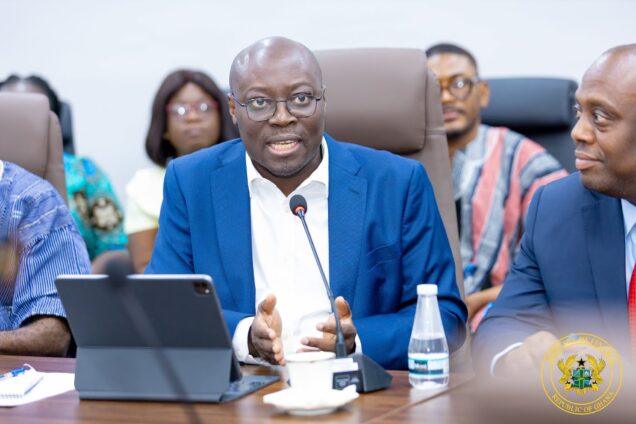
Finance Minister Dr Cassiel Ato Forson has begun consultations with key government ministries as preparations gather pace for the rollout of the government’s proposed New Economy transformational programme, which is expected to leverage an estimated US$10 billion in investments.
The programme is intended to move Ghana beyond macroeconomic stabilisation towards a new phase of growth focused on expanding domestic production, creating jobs and generating greater wealth.
As part of the preparatory process, Dr Ato Forson, together with his deputy, the Chief Director of the Ministry of Finance and other senior officials, has held discussions with the Minister for Trade, Agribusiness and Industry, Elizabeth Ofosu-Adjare, and officials of her ministry.
The engagements are expected to help government identify priority sectors, policies and investment opportunities capable of driving the next phase of Ghana’s economic development.

The consultations come as government seeks to build on gains made under its macroeconomic stabilisation programme and shift attention towards long-term transformation of the productive sectors of the economy.
Dr Ato Forson has consistently maintained that restoring macroeconomic stability was not the ultimate objective of government’s economic programme but rather a foundation for a broader transformation agenda.
“Stabilisation was never the destination. It was the price of entry. Ghana has paid that price. What comes next is the work that changes lives at scale—the work of transformation,” he said.
Speaking during the presentation of the 2026 Mid-Year Fiscal Policy Review, the Finance Minister said the proposed New Economy agenda would focus on reducing Ghana’s vulnerability to external shocks by strengthening domestic production and expanding economic opportunities.
“Through the New Economy agenda that we will unveil, we will build an economy that does not merely withstand shocks but creates jobs, generates wealth and grows on the strength of what Ghana produces,” he said.
The government’s focus on the productive sectors is expected to place greater emphasis on areas such as industry, trade, agribusiness and value addition, as Ghana seeks to generate more economic value from domestic resources and reduce its dependence on imports.
President John Dramani Mahama has indicated that the full details of the New Economy programme will be presented in the 2027 Budget in November.
The budget is expected to provide greater clarity on the sectors, projects and investment framework that will underpin the proposed transformation agenda.
Government is seeking to use the estimated US$10 billion investment pipeline to support projects capable of expanding production, strengthening industrial capacity and creating sustainable employment opportunities.
The ministerial engagements are therefore expected to play an important role in shaping the programme before its formal unveiling.
The consultations will enable the government to align priorities across ministries and identify areas where public policy, private investment and government-led initiatives can be combined to accelerate economic transformation.
The New Economy agenda represents the next stage of government’s economic strategy following efforts to restore macroeconomic stability, control inflation, strengthen the currency and improve fiscal and debt sustainability.
With the groundwork now underway, government faces the task of translating the stabilisation gains into investments and projects that deliver tangible improvements in production, employment and incomes.
The outcome of the ongoing consultations is expected to feed into the government’s broader preparations ahead of the presentation of the 2027 Budget, when the New Economy programme is expected to be formally unveiled.
Source: businesspostonline