

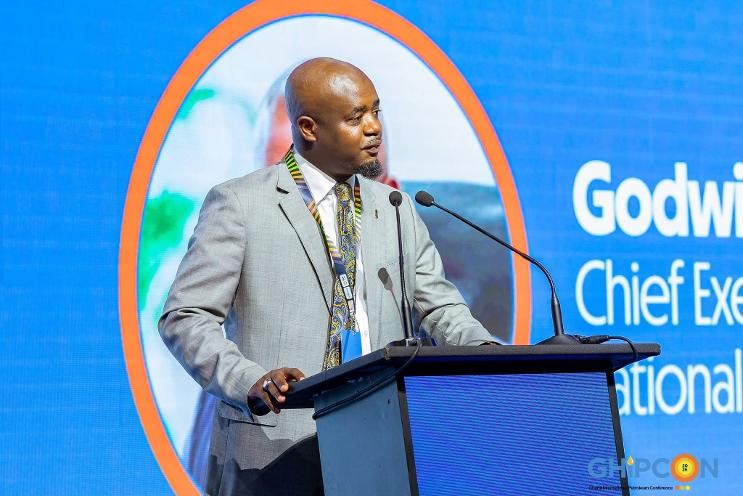
The National Petroleum Authority (NPA) has outlined an ambitious agenda to transform Ghana into a leading regional petroleum hub by strengthening the resilience, competitiveness and investment appeal of the country’s downstream petroleum sector.
Speaking at the opening of the 7th Ghana International Petroleum Conference (GhIPCon 2026) in Accra, NPA Chief Executive Godwin Edudzi Tamakloe said Ghana must build a downstream industry capable of withstanding global energy shocks while leveraging opportunities presented by regional integration under the African Continental Free Trade Area (AfCFTA).
Addressing regulators, policymakers, investors and industry leaders from more than 25 countries, Mr. Tamakloe said the sector’s long-term success would depend on sound policies, innovation and sustained investment.
He noted that recent geopolitical tensions and supply chain disruptions have underscored the importance of developing a robust petroleum industry that guarantees energy security while remaining competitive in an evolving global energy landscape.

“The future of our downstream petroleum industry will not be determined by chance. It will be shaped by the quality of the policies we formulate, the innovations we embrace, the investments we attract and the partnerships we build,” he said.
Building resilience
According to Mr. Tamakloe, Ghana’s downstream petroleum sector has demonstrated its resilience by maintaining uninterrupted fuel supplies despite recent global market uncertainties.
He attributed part of this stability to government interventions, including the removal of selected petroleum price margins, which helped cushion consumers from sharp increases in fuel prices.
However, he stressed that resilience extends beyond ensuring fuel availability and must include stronger infrastructure, improved operational efficiency, enhanced energy security and institutions capable of responding swiftly to market disruptions.
Innovation and investment
The NPA Chief Executive identified innovation as a key pillar of the industry’s future, calling for wider adoption of digital technologies, automation, smart logistics, data-driven regulation and cleaner fuel solutions.
He also emphasised the need for increased public and private investment to modernise infrastructure, strengthen human capital and improve the sector’s overall competitiveness.
“Without sustained investment, it will be difficult to build the infrastructure, technology and skilled workforce needed to support Ghana’s long-term energy aspirations,” he said.
Mr. Tamakloe noted that the downstream petroleum industry contributes about **10 percent of Ghana’s Gross Domestic Product (GDP), underscoring its strategic importance to the national economy.
Strengthening regulation
He reaffirmed the NPA’s commitment to maintaining a transparent and predictable regulatory environment that protects consumers while encouraging investment, fair competition and high product quality.
According to him, the Authority is deploying technology-driven regulatory systems to improve compliance, strengthen oversight and support sustainable industry growth.
He urged petroleum service providers to continue investing in research, safety, digital transformation and workforce development to remain competitive in an increasingly dynamic energy market.
AfCFTA presents new opportunities
Mr. Tamakloe said Ghana is well-positioned to become a regional centre for petroleum trading, storage, transportation and distribution under the AfCFTA framework.
He noted that achieving this objective would require stronger regional collaboration, harmonised industry standards, modern infrastructure and continuous investment in technical skills.
“Our greatest resource is not only the petroleum products we regulate but the human capital that drives the industry. We must continue to equip young professionals with the knowledge and skills needed to lead Africa’s next generation of energy development,” he said.
He expressed confidence that discussions at GhIPCon 2026 would produce practical recommendations to strengthen the downstream petroleum value chain and deepen partnerships that support sustainable growth.
The conference will conclude with the Downstream Awards and Gala Night, recognising organisations and individuals for excellence in innovation, compliance, operational efficiency and contributions to Ghana’s downstream petroleum industry.
Source: businesspostonline