

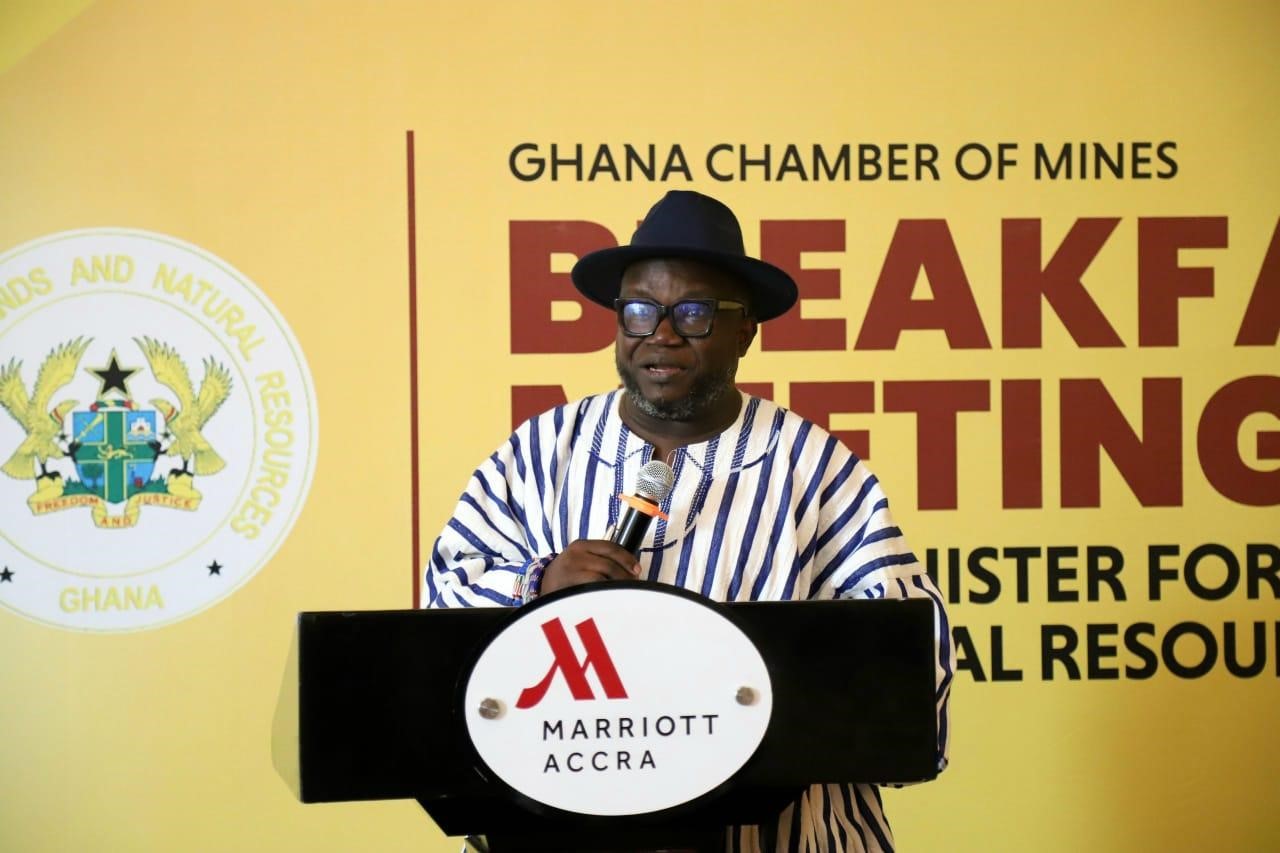
The Ghana Chamber of Mines has welcomed recent assurances by the Minister for Lands and Natural Resources, Mr. Armah Kofi Buah, that government has no intention of nationalising mining assets, describing the stance as critical to sustaining investor confidence and long-term sector growth.
Speaking after a meeting of stakeholders with the Minister, Dr Kenneth Ashigbey, CEO of the Chamber of Mines, noted that the Minister’s remarks help “cut through the noise” surrounding recent public debate on mining sector reforms.
“It is reassuring to hear the Minister clearly state that government policy is not about nationalisation, but about attracting investment while ensuring value is created locally,” he said.
The Chamber indicated that its own position aligned closely with government’s vision of a balanced partnership between investors and Ghana, where both parties benefit from resource extraction.

Industry stakeholders emphasised that investors should earn competitive returns on investment, Ghana should gain through capacity-building and knowledge transfer and mining operations should leave lasting economic legacies.
“The private sector — both foreign and indigenous — must work together to ensure Ghana gets the maximum benefit from its natural resources,” the official stated.
Dr Ashigbey also highlighted the importance of nurturing local mining champions, arguing that today’s indigenous companies could evolve into global players if properly supported.
“The Ghanaian companies we are building today are the multinationals of tomorrow,” he noted.
“If we undermine partnerships today, we risk limiting opportunities for these future champions on the global stage.”
He added that successful mining jurisdictions such as Canada and Australia demonstrated how local firms could coexist productively with international investors.
Despite the positive outlook, the Chamber raised concerns about significant disparities in tax contributions between large-scale and small-scale mining operations.
According to the Chamber large-scale miners, responsible for about 48 percent of gold output, paid approximately GH¢19 billion in taxes while small-scale miners, producing around 52 percent of output, contributed only about GH¢0.5 million in taxes
“This imbalance shows that as a country, we are losing significant value from the small-scale mining segment,” he said.
To address the disparity, the Chamber urged the government to fast-track efforts to formalise the small-scale mining sector.
Proposed measures include simplifying regulatory processes, enhancing compliance mechanisms and supporting small-scale miners to operate within the formal tax system.
The Chamber revealed it has already engaged consultants to develop strategies that will support government’s push for responsible and cooperative mining.
Another major proposal from the Chamber is for 30 percent of mining royalties to be returned directly to host communities.
The move, it argues, would ensure mining revenues deliver tangible development outcomes in affected areas.
“The question is not just how much is paid in taxes, but how much returns to the communities where the mining actually occurs,” the official said.
The Chamber is advocating for a structured framework similar to Ghana’s Petroleum Revenue Management Act, which clearly outlines how oil revenues are allocated.
Beyond taxation, the Chamber stressed the need to expand local participation across the mining value chain, particularly in equipment maintenance and reconditioning, supply of mining inputs, manufacturing of industrial materials such as activated carbon.
The latter, which can be produced from coconut and palm kernel shells, was cited as a key opportunity for rural industrialisation.
“We should not just mine gold; we should build industries around mining — right in the communities where these resources are extracted,” he said.
The Chamber also proposed that mining-support industries be strategically located in mining areas such as Tarkwa, Ahafo and others, rather than concentrated in urban centres.
This would create jobs locally, stimulate regional economic development and educe reliance on imports
“If we structure this well, mining communities can become industrial hubs, not just extraction points,” Dr Ashigbey added.
Source: businesspostonline