

The Ministry of Fisheries and Aquaculture Development (MoFAD), in collaboration with key industry stakeholders, has exempted canoe fishing operators from the 2026 Marine Fisheries Closed Season, citing their critical contribution to national food security and livelihoods.
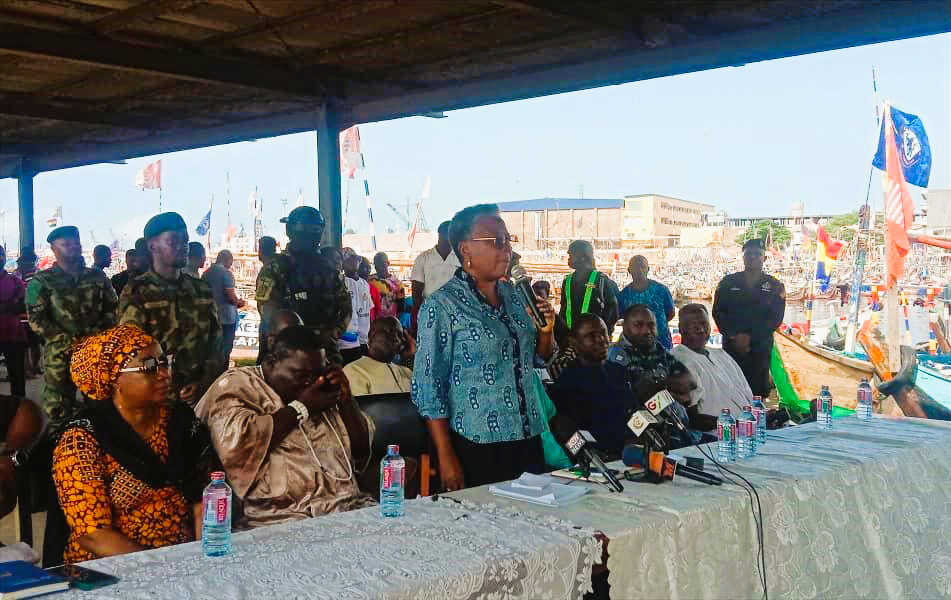
The decision was announced by the Minister for Fisheries and Aquaculture Development, Emelia Arthur, during a stakeholder engagement at the Tema Canoe Basin, where the ministry formally outlined Ghana’s 2026 marine fisheries closed season calendar.
The announcement forms part of the government’s commitment to sustainable, human‑centred and science‑based fisheries management aimed at restoring depleted fish stocks.
According to the minister, canoe fisheries account for about 80 per cent of fish consumed locally and provide approximately 60 per cent of the country’s animal protein intake, making their inclusion in the 2026 closure economically and nutritionally unsustainable.

“The exemption of canoe fishing vessels in the 2026 closed season programme is to avoid undue economic hardship and unintended post‑closure fishing pressure that could undermine conservation gains,” Ms. Arthur explained.
She noted that the decision was also influenced by the sector’s role in safeguarding livelihoods and preventing excessive fishing effort following the reopening of the season, which could negate stock rebuilding efforts.
Outlining the timelines for the 2026 marine fisheries closed season, the minister said:
- Industrial tuna vessels began observing their closed season on March 17, which will end on April 30, 2026.
- Industrial trawl vessels will observe a two‑month closure from July 1 to August 31, 2026.
- Semi‑industrial vessels will observe a one‑month closure from July 1 to July 31, 2026.
- Canoe fishing vessels will not observe a closed season in 2026.
Despite the exemption, Ms. Arthur cautioned that canoe fishing operators will be subject to enhanced monitoring, control and surveillance measures.
These include the introduction of tracking and communication systems to improve safety at sea and ensure regulatory compliance.
She stressed that canoe fishers are expected to strictly comply with fisheries laws, particularly provisions relating to illegal, unreported and unregulated (IUU) fishing.
“Let me be clear—light fishing, dynamite fishing and the use of all unapproved fishing methods will attract sanctions under the Fisheries and Aquaculture Act, 2025. We are not joking,” the minister warned.
She added that government enforcement agencies would intensify patrols and prosecutions to ensure full compliance with the law.
Ms. Arthur said government had recognised the role of artisanal fishers in sustainable fisheries management through the establishment of Ghana’s first Marine Protected Area, where traditional fishing grounds have been redesignated as regulated fishing zones.
“This initiative acknowledges the contribution of canoe fishers to sustainability while ensuring that fish stocks are given the chance to rebuild,” she noted.
The ministry, the minister revealed, is working closely with stakeholders to roll out a comprehensive Fishers’ Protection Package, which will cover vessel registration and licensing, insurance for fishing assets, social security arrangements for fishers and fair and transparent access to fisheries subsidies, including premix fuel.
The package is intended to enhance welfare, promote compliance, and improve accountability across the sector.
The Member of Parliament for Tema East, Isaac Ashai Odamtten, welcomed the initiative, describing it as a balanced approach to halting marine resource depletion while securing long‑term fish stock recovery.
He added that the measures would also strengthen the distribution and sale of premix fuel, in line with government policy.
An open forum allowed stakeholders to raise concerns, with most issues coming from industrial trawler operators and artisanal fishers.
Premix fuel dealers were reminded to operate transparently, with authorities directing dealers to submit required bank statements within 24 hours or risk suspension.
The 2026 closed season programme, the minister concluded, is guided by scientific evidence, human development principles, and the urgent need to rebuild fish stocks to secure the future of Ghana’s marine fisheries.
By: Christian Akorlie / businesspostonline