

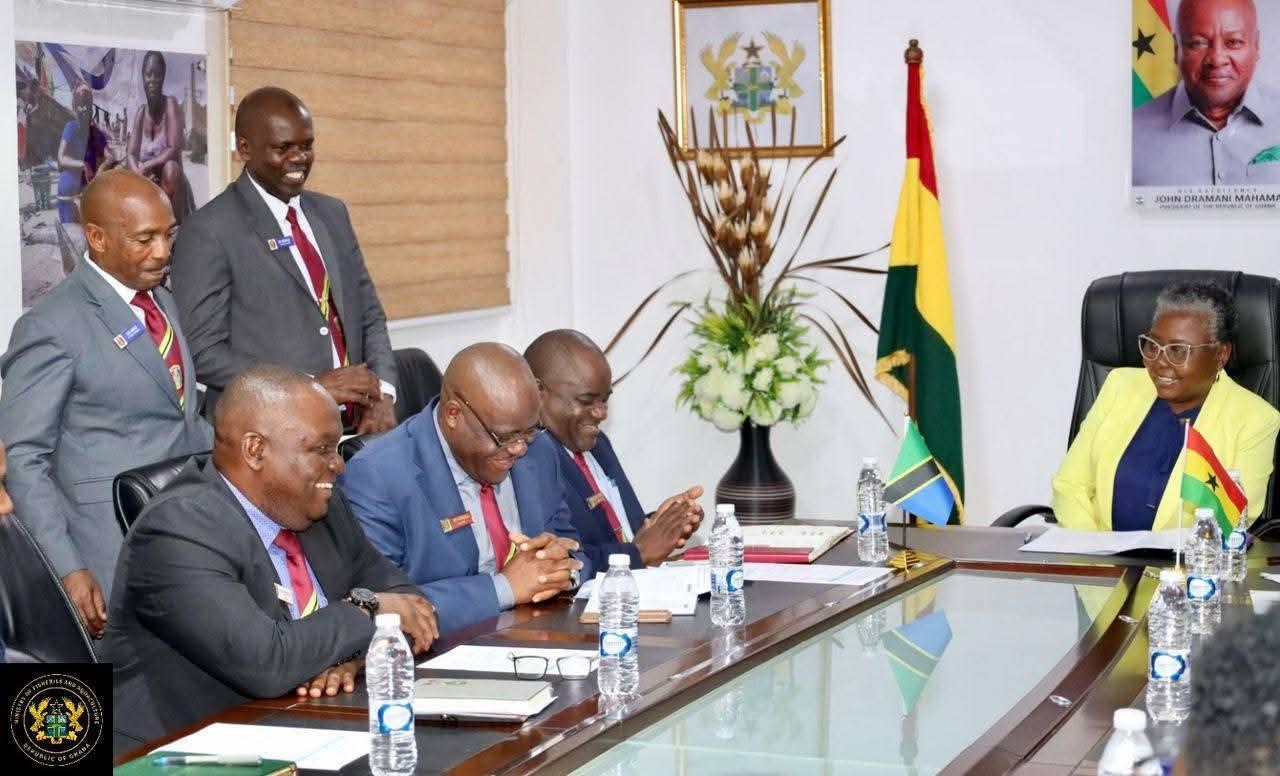
Ghana has reaffirmed its commitment to strengthening regional collaboration on ocean governance and maritime security as it hosted a high-level delegation from Tanzania’s National Defence College for a strategic neighborhood study tour.
Welcoming the delegation, Hon. Emelia Arthur, Minister for Fisheries and Aquaculture, underscored the growing importance of safeguarding Africa’s marine resources, describing it as central to national stability, economic growth, and sovereignty.
The delegation, led by Wilbert Augustin Ibuge, engaged Ghanaian officials, the Fisheries Commission, and representatives of the Ghana Armed Forces in discussions focused on sustainable fisheries governance, maritime security, and the blue economy transition.
In her opening remarks, the Minister emphasized that Ghana’s fisheries and aquaculture sector supports over three million livelihoods and remains a critical source of protein for the population. However, she cautioned that the sector’s significance extends beyond food security to include job creation, economic resilience, and national stability.

She noted that Ghana is undertaking a deliberate shift toward a structured blue economy framework, backed by strengthened policies, legal reforms, and institutional coordination aimed at transforming the sector into a driver of sustainable economic growth.
A key highlight of the engagement was the shared concern over illegal, unreported, and unregulated (IUU) fishing, which the Minister described as not only a fisheries challenge but also an economic crime and a threat to national sovereignty.
She further pointed to climate change and increasing competition over marine resources as pressing transboundary issues requiring coordinated regional action.
“National efforts alone will not be sufficient,” she stressed. “Our waters are connected, and our responses must be equally connected.”
The study tour featured technical presentations delivered by Fred Antwi, Coordinator for the Blue Economy, who spoke on Ghana’s blue economy transition, and Angela Lamptey, a Doctor and Chair of the Scientific and Technical Committee of the Fisheries Commission, who presented on harnessing the blue economy through sustainable fisheries governance and its role in natural resource management and economic transformation.
Discussions also explored opportunities in offshore energy, marine transport, and coastal tourism as part of a broader economic transformation agenda.
Ghana further highlighted ongoing measures such as enhanced enforcement systems, vessel monitoring, the implementation of closed fishing seasons, and investments in aquaculture to restore fish stocks and protect marine ecosystems.
The engagement forms part of broader efforts to deepen bilateral cooperation between Ghana and Tanzania, particularly in areas of maritime security, resource governance, and institutional strengthening.
Both sides expressed optimism that the study tour would move beyond dialogue to tangible outcomes, reinforcing Africa’s collective capacity to manage its ocean resources sustainably and strategically.
The meeting concluded with a call for stronger continental collaboration, with Ghana urging African nations to lead the transformation of the blue economy through unified action and shared expertise.
Source: businesspostonline