

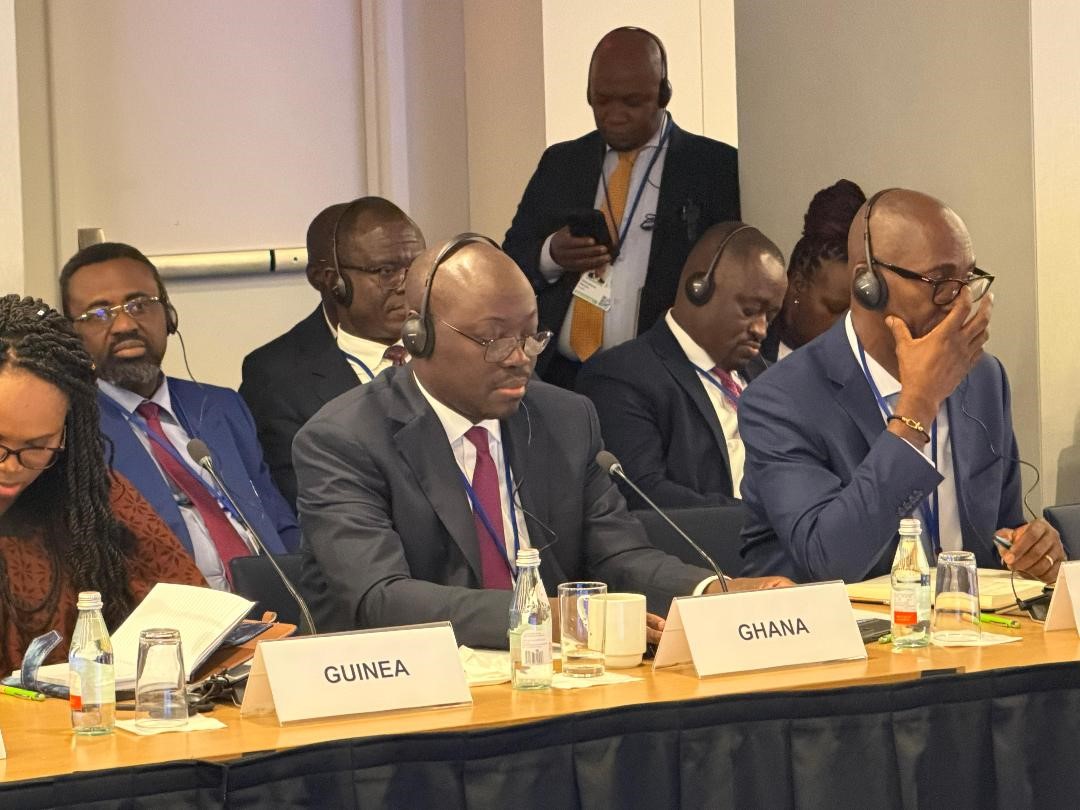
Ghana’s participation in the ongoing 2026 Spring Meetings of the International Monetary Fund and World Bank Group in Washington DC is coming at a pivotal moment as the country is transitioning from macroeconomic stabilisation under a three-year Extended Credit Facility (ECF) programme supervised by the IMF to a home-grown, economic growth-focused policy phase.
The high-level meetings, running from April 13-18 2026, have drawn finance ministers, central bankers and investors from all around the globe to deliberate on growth, debt sustainability and financial stability amid renewed global shocks, including rising energy prices and tightening financial conditions.
Leading Ghana’s delegation, Finance Minister Dr Cassiel Ato Forson has framed the country’s agenda around deepening partnerships with multilateral institutions while leveraging renewed investor confidence in Ghana’s reform trajectory. According to him, Ghana has stabilised its economy and is firmly on the path to debt sustainability, marking a shift from stabilisation to growth.
This shift underpins four key areas of collaboration agreed with the World Bank at a meeting between Dr Forson and Ousmane Diagana, its Regional Vice President for Western and Central Africa. These are: agriculture and agribusiness; energy—particularly gas-to-power and fertiliser production; education and human capital development; and infrastructure to facilitate trade. Together, these pillars reflect both and inclusive growth.

Agriculture and agribusiness to unlock employment potential
Agriculture remains Ghana’s largest employer, historically accounting for more than half of total employment and underpinning rural livelihoods. Yet its contribution to GDP has lagged, reflecting low productivity and limited value addition.
The World Bank collaboration aims to address this imbalance by shifting the focus from primary production to agribusiness and agro-processing. This aligns with Ghana’s need to create jobs at scale, particularly for its youthful population.
Finance Minister Dr Forson has emphasised job creation as central to the partnership, noting that agriculture offers the fastest route to absorbing labour while supporting import substitution. The World Bank’s involvement is expected to mobilise financing for irrigation, logistics and processing infrastructure—key bottlenecks that have constrained the sector.
The potential impact is significant. Ghana is already a leading global producer of cocoa, cassava and yam, but much of its output is exported raw or consumed domestically with minimal processing. Expanding agro-processing should boost export earnings, reduce post-harvest losses and stabilise rural incomes.
However, risks remain. Structural constraints—such as land tenure issues, climate vulnerability and limited access to credit—could dampen the effectiveness of new investments unless accompanied by policy reforms. The success of this pillar will therefore depend on integrating financial support with institutional changes.
Leveraging gas to power industrial growth
Energy sector reforms are another focal point, particularly the utilisation of Ghana’s natural gas resources for power generation and fertiliser production. Ghana produces oil and gas from offshore fields, yet inefficiencies in the energy value chain have resulted in high costs and periodic supply challenges.
The gas-to-power initiative seeks to reduce reliance on expensive liquid fuels, lower electricity tariffs and improve industrial competitiveness. In parallel, fertiliser production using natural gas could support agricultural productivity while reducing import dependence.
These initiatives are consistent with broader IMF and World Bank priorities of improving energy efficiency and fiscal sustainability. Ghana’s energy sector has been a major source of fiscal pressure, with legacy debts and subsidies contributing to public debt accumulation.
At the Spring Meetings, discussions are expected to focus on restructuring energy sector liabilities and attracting private investment into gas infrastructure. The IMF has consistently highlighted the need to address structural weaknesses in public financial management, including energy sector inefficiencies.
If successfully implemented, the gas-to-power strategy could deliver dual benefits: easing fiscal pressures and supporting industrial growth. But execution risks—particularly around financing and governance—remain high.
Enhancing human capital for long-term growth
The third pillar—education and human capital development—reflects a recognition that macroeconomic stability alone is insufficient for sustained growth. Ghana’s post-ECF strategy aims to build a more skilled workforce capable of driving productivity and innovation.
World Bank support in this area is expected to focus on technical and vocational education, digital skills and improved access to quality schooling. These investments are critical given Ghana’s demographic profile and the need to transition from a commodity-dependent economy to a more diversified one.
Global discussions at the Spring Meetings are emphasising the role of human capital in enhancing resilience, particularly in emerging markets facing external shocks. For Ghana, improving educational outcomes could also enhance its attractiveness to foreign investors seeking skilled labour.
Nonetheless, challenges persist. Public spending constraints under the IMF programme have limited fiscal space for social investments. As Ghana exits the ECF, balancing fiscal discipline with increased spending on education will be a key policy challenge.
Infrastructure for facilitating trade and regional integration
Infrastructure development—particularly transport and logistics—is the fourth area of collaboration that has been agreed. Ghana’s ambition to position itself as a regional trade hub depends on efficient movement of goods within the country and across borders.
The focus is expected to include roads, ports and trade corridors that support the African Continental Free Trade Area (AfCFTA), whose secretariat is based in Accra. Improved infrastructure could reduce transaction costs, enhance export competitiveness and stimulate private sector activity.
At the Spring Meetings, Ghana is likely to engage development partners on financing models that leverage public-private partnerships. Given constrained fiscal space, innovative financing will be essential to deliver large-scale infrastructure projects, including those under the President John Dramani Mahama administration’s ambitious US$10 billion Big Push initiative, without exacerbating debt vulnerabilities.
The IMF programme’s final stretch and policy recalibration
Ghana’s engagement with the IMF at the Spring Meetings is equally significant as its three-year US$3 billion ECF programme approaches its scheduled conclusion in August 2026. The programme has already delivered substantial financial support, with about US$2.8 billion disbursed so far.
The IMF programme has played a central role in stabilising Ghana’s economy following the 2022 debt crisis, helping to reduce inflation from peak levels above 50 percent in 2023 to 3.2 percent as at March this year, and restore a measure of macroeconomic stability.
As the programme winds down, discussions in Washington are expected to focus on three key areas.
One is programme completion and final reviews. Ghana will seek to successfully complete the remaining programme review to unlock the final disbursement of some US$200 million and cement its reform credentials.
The second is post-programme engagement. Attention is shifting to the policy framework that will succeed the ECF. The IMF is likely to emphasise continued fiscal discipline, revenue mobilisation and structural reforms to ensure debt sustainability.
The third is a growth-oriented policy recalibration. Ghana’s government has signalled its intention to adjust the policy mix towards growth, including potential tax reforms and increased investment in priority sectors. As President John Mahama has noted, while the IMF programme has stabilised the economy, “more work is needed” to address structural challenges.
The IMF, for its part, has indicated readiness to support Ghana’s transition, emphasising the importance of maintaining reform momentum while fostering inclusive growth.
Ghana’s participation in the Spring Meetings also reflects broader global concerns. Policymakers are grappling with rising borrowing costs, inflationary pressures and geopolitical risks that disproportionately affect emerging economies.
Within this context, Ghana is positioning itself as a reform success story—one that has navigated a severe debt crisis and is now pivoting towards growth. Its engagements in Washington aim to consolidate this narrative, attract investment and secure partnerships that will sustain its recovery.
The 2026 Spring Meetings therefore marks a transitional moment for Ghana. The country’s economic strategy is evolving from crisis management to long-term development, anchored on agriculture, energy, human capital and infrastructure.
The potential of these collaborations with the World Bank is substantial, offering pathways to job creation, industrialisation and improved living standards. However, realising these gains will require disciplined implementation, institutional reforms and sustained policy coherence.
As Ghana prepares to exit its IMF programme, the challenge will be to maintain macroeconomic stability while accelerating growth—a delicate balance that will define the next phase of its economic journey.
By: Toma Imirhe / businesspostonline