

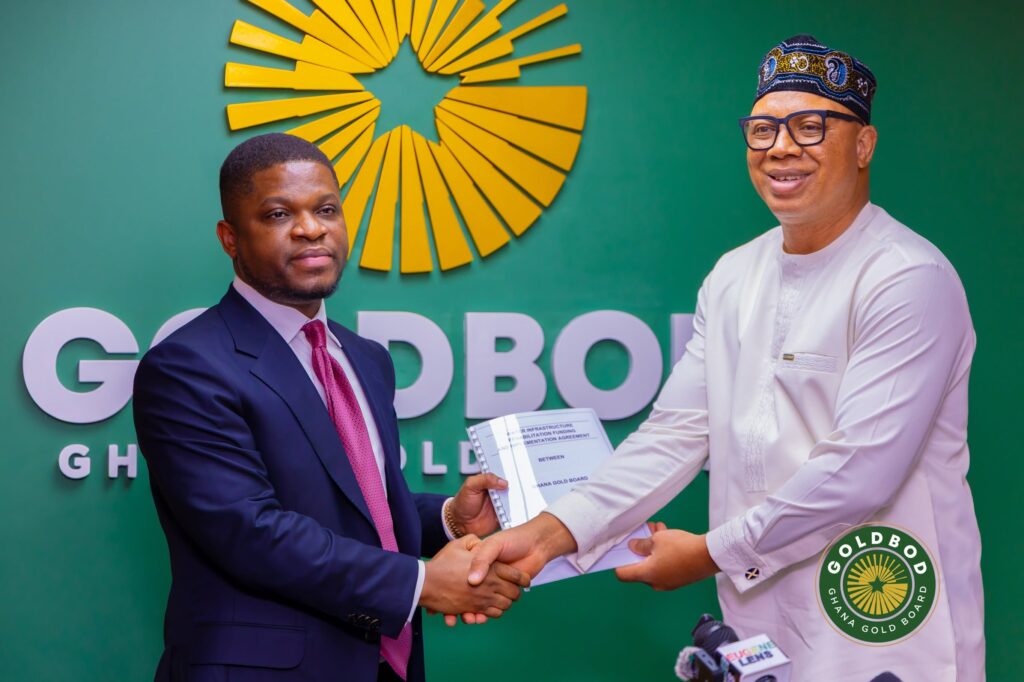
The Ghana Gold Board (GoldBod) has committed GH¢8.4 million towards the rehabilitation of three critical water supply systems affected by years of illegal mining and environmental degradation, as part of its environmental, social and governance (ESG) and corporate social responsibility initiatives.
The funding will support rehabilitation works on water supply systems in Bonsa, Abuasi and Trehmang in Ghana’s mining communities, following the signing of a Water Infrastructure Rehabilitation and Implementation Agreement with Ghana Water Limited (GWL).
Speaking at the signing ceremony, Chief Executive Officer of GoldBod, Sammy Gyamfi, said the intervention aligns with the broader mandate of the Ghana Gold Board under the Ghana Gold Board Act, 2025 (Act 1140), which goes beyond gold trading to include initiatives aimed at environmental restoration and sustainability.
According to him, illegal mining activities have significantly degraded several water bodies and water infrastructure, particularly in the Western and Central regions, affecting the ability of treatment plants to produce potable water for surrounding communities.

“As the Minerals Commission rightly stated, the Ghana Gold Board was not established solely to undertake and regulate gold trading. Parliament also assigned us responsibilities related to sustainability initiatives, including reclamation and environmental restoration,” he said.
Mr. Gyamfi noted that discussions with Ghana Water Limited began several months ago after concerns were raised about severe siltation and sediment accumulation in critical water treatment facilities.
“Technical assessments conducted by our ESG officers and Ghana Water Limited confirmed extreme levels of siltation, visible channel instability and frequent intake blockages, rendering some of these systems unable to efficiently process water for drinking purposes,” he explained.
Ghana Water Limited initially sought support for the rehabilitation of six affected systems: Bonsa, Aboasi, Trehmang, Prestea, Mankessim and Daboase.
However, due to budgetary limitations, GoldBod has opted for a phased approach, beginning with three systems located in mining-affected communities.
Mr. Gyamfi stressed that the deterioration of the infrastructure predates the establishment of GoldBod and reflects the cumulative impact of years of illegal mining, sand winning and other environmentally harmful activities.
“The degradation is an age-old problem. GoldBod did not create it. This is about Ghana and how we collectively solve a challenge that affects access to safe drinking water,” he said.
Under the agreement, Ghana Water Limited will lead the implementation of the project while GoldBod provides funding and monitoring support.
The rehabilitation programme will include:
- Hydrographic surveys;
- Dredging works;
- Sediment volume assessments;
- Sediment removal and safe disposal;
- Reservoir capacity assessments;
- Emergency restoration works;
- Intake infrastructure stabilisation;
- Water quality monitoring and restoration;
- Engineering inspections and certification; and
- Post-intervention technical verification.
GoldBod will also appoint representatives to participate in project monitoring to ensure accountability and effective implementation.
Managing Director of Ghana Water Limited, Adam Mutawakilu, welcomed the support, describing it as a critical intervention in addressing a challenge that has persisted for several years.
He said rising turbidity and sedimentation levels in water bodies had placed enormous pressure on treatment plants, making it increasingly difficult for Ghana Water to maintain reliable supplies of potable water in affected areas.
“Ghana Water alone cannot handle this challenge. That is why we approached GoldBod, and I am grateful that after extensive technical assessments, they recognised the urgency of the situation and responded positively,” he said.
Mr. Mutawakilu assured GoldBod that the funds would be managed responsibly and used strictly for the purposes outlined in the agreement.
“I want to assure you that whatever support you give us, we will be accountable. Together, we will ensure that the objectives captured in the agreement are fully achieved,” he stated.
He added that residents in the affected communities across the Western and Central regions stand to benefit significantly once the rehabilitation works are completed.
The latest intervention follows GoldBod’s recent partnership with the Ministry of Defence and the Forestry Commission on land reclamation projects aimed at restoring degraded areas affected by illegal mining.
The Board says its commitment to environmental restoration forms an integral part of its ESG strategy and reflects its determination to contribute to sustainable development beyond the gold trading sector.
“With water being essential to life, every institution that has the capacity to support efforts to restore these critical systems must do its part,” Mr. Gyamfi said. “This is only the first phase, and we hope it will pave the way for further interventions in the future.”
Source: businesspostonline