

Ghana is stepping up efforts to expand its domestic crude oil refining and natural gas processing capacity as continuing supply disruptions and geopolitical tensions in the Persian Gulf expose the vulnerability of countries heavily dependent on imported refined petroleum products.
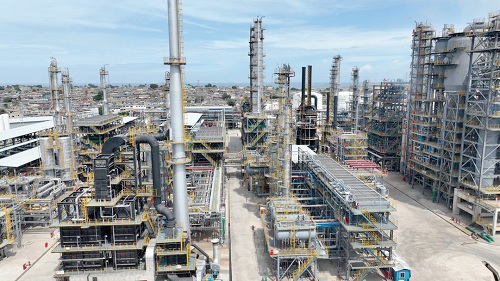
The latest indication of that strategy is a US$200 million medium-term financing facility arranged by Ecobank Ghana and announced last week, to support the expansion of the privately-owned Sentuo Oil Refinery in Tema, a move expected to significantly increase the country’s local refining capacity and reduce its exposure to external supply shocks.
The financing package, led by Ecobank Ghana in collaboration with other financial institutions, is expected to fund additional refining units, storage infrastructure and associated logistics facilities at Sentuo. Industry sources indicate the investment will support the refinery’s planned capacity expansion from its current level of approximately 40,000 barrels per day to a significantly higher throughput over the medium term.
The facility comes at a time when disruptions to crude oil and petroleum product supply chains from the Persian Gulf have contributed to increased volatility in international fuel prices, raising concerns among policymakers about Ghana’s long-term energy security.

Ecobank executives have described the transaction as a strategic investment in Ghana’s industrialisation agenda and energy resilience, emphasizing that domestic refining capacity is becoming increasingly important as global energy markets face recurring geopolitical risks.
Sentuo’s refinery, commissioned in 2024, represents Ghana’s first major new refining investment in decades. The refinery processes a range of crude oil grades sourced from international markets, including supplies from West Africa and other producing regions, providing flexibility in feedstock sourcing and reducing dependence on any single supplier.
Industry analysts note that the refinery’s ability to source crude from multiple jurisdictions is particularly important at a time when Middle East supply routes are facing heightened risks.
“The key lesson from the current disruptions is that countries that refine more of their own fuel requirements are better insulated from international market shocks,” said an Accra-based petroleum analyst. “Domestic refining does not eliminate exposure to global prices, but it substantially improves security of supply and reduces logistics vulnerabilities.”
The Sentuo expansion complements broader government efforts to revive and expand the state-owned Tema Oil Refinery (TOR), which remains central to Ghana’s long-term downstream petroleum strategy.
President John Dramani Mahama recently announced that TOR will begin processing Ghanaian crude oil from June 2026, marking a major policy shift towards local value addition. According to the President, crude oil produced from Ghana’s offshore fields will be supplied directly to the refinery rather than being exported entirely in raw form.
The initiative is intended to enable Ghana to capture more value from its hydrocarbon resources, reduce imports of refined products and strengthen energy security.
TOR resumed refining operations in late 2025 after several years of inactivity following the successful completion of major turnaround maintenance works on its crude distillation unit. The rehabilitation programme restored operational capability and paved the way for a broader expansion programme.
Management has since embarked on the integration of a second processing unit, known as the F-61 furnace, which is expected to raise the refinery’s operational capacity from approximately 28,000 barrels per stream day to about 45,000 barrels per stream day. The refinery is also pursuing a medium-term plan to increase capacity further to about 60,000 barrels per stream day.
TOR officials have indicated that processing locally produced crude oil will help reduce foreign exchange outflows associated with importing refined products while creating additional opportunities for local employment and industrial development. The refinery’s re-engineering programme is also designed to improve flexibility in handling crude produced from Ghana’s offshore oil fields.
Government officials view the combined expansion of Sentuo and TOR as critical components of a broader strategy to transform Ghana from a net importer of refined petroleum products into a regional refining and trading hub.
Beyond Tema, attention is also focused on the ambitious Petroleum Hub project at Jomoro in the Western Region. The project’s first phase includes plans for a 300,000-barrel-per-day refinery, a petrochemical complex, storage facilities and export infrastructure. The first phase alone carries an estimated investment value of US$12 billion.
The Petroleum Hub Development Corporation says preparatory work is progressing, with government continuing to engage investors and stakeholders to advance implementation. Chief Executive Officer Dr. Toni Aubynn recently expressed confidence that the project would move into its next stages as financing and regulatory processes advance.
When completed, the Jomoro project is expected to serve both domestic and regional markets, positioning Ghana as a major refining centre for West Africa. The development is intended to capitalize on a regional market that currently imports most of its refined petroleum products despite substantial crude oil production across the sub-region.
Taken together, the Sentuo expansion, TOR rehabilitation and the long-term Petroleum Hub initiative underscore Ghana’s determination to build a more self-sufficient downstream petroleum industry. With uncertainty in global energy markets showing little sign of easing, policymakers increasingly view domestic refining and gas processing capacity not merely as industrial projects but as strategic national assets capable of protecting the economy from external energy shocks.
By: Toma Imirhe / businesspostonline