

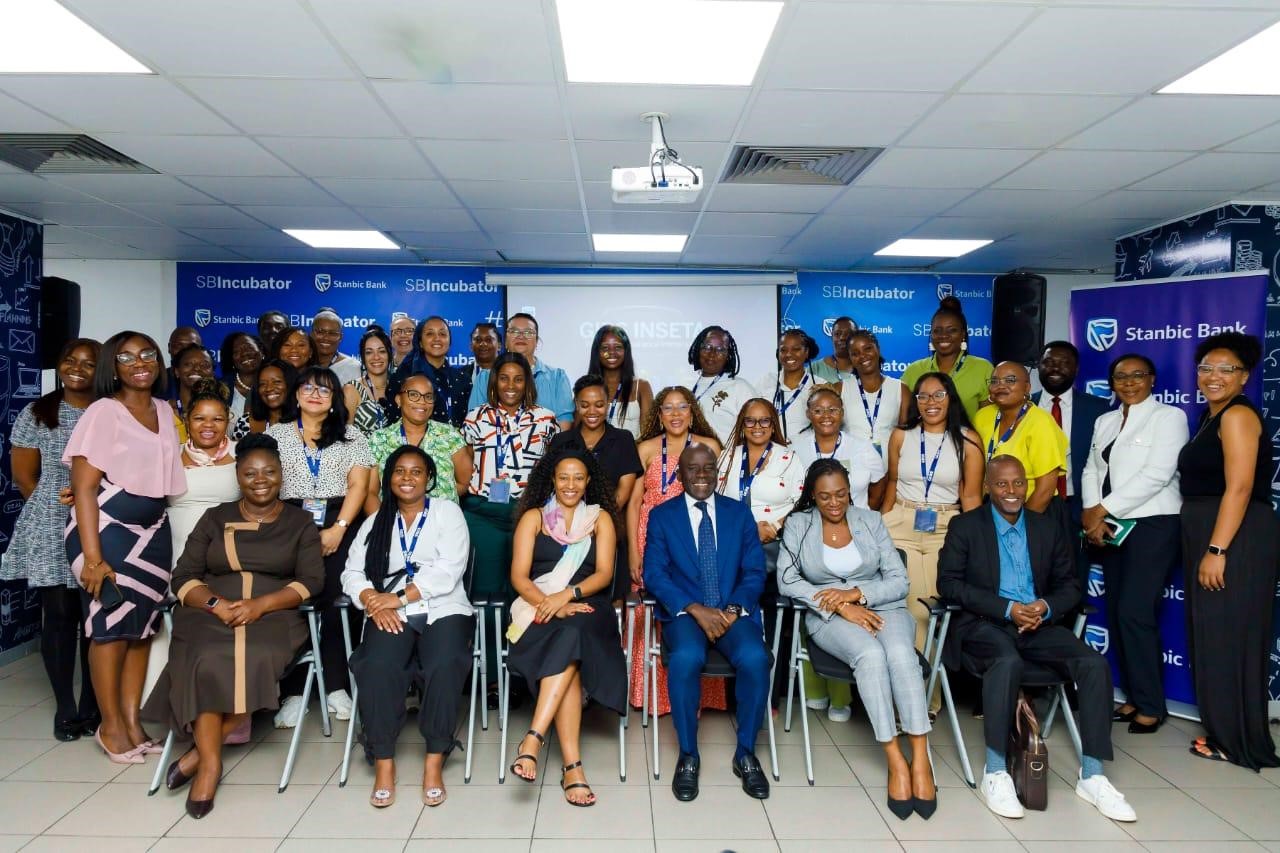
Senior executives of Stanbic Bank Ghana have outlined key developments shaping Ghana’s evolving financial ecosystem, underscoring the growing influence of digital innovation, capital markets and inclusive banking in driving economic growth across emerging markets.
The insights were shared during an interactive session with participants of the GIBS–INSETA IMPD Women Immersion Programme, a year-long leadership initiative organised by South Africa’s Insurance Sector Education and Training Authority (INSETA) in partnership with the Gordon Institute of Business Science (GIBS). The programme brings together women leaders from the insurance sector for a blend of academic learning and international exposure.
Leading the discussion, Kobby Bentsi-Enchill, Head of Investment Banking at Stanbic Bank Ghana, offered participants an overview of Ghana’s financial infrastructure and its evolution within a predominantly informal economy.
He noted that digital financial services—particularly mobile money—have transformed the country’s payments landscape, expanding access to financial services for millions of individuals and micro-enterprises previously excluded from the formal banking system.

“Ghana’s financial architecture sits at the intersection of formal banking, capital markets and a vibrant informal economy,” he said. “Mobile money has played a transformative role by integrating everyday transactions, small traders and micro-businesses into a more structured financial environment.”
Mr. Bentsi-Enchill added that beyond digital innovation, government securities continue to play a critical role in maintaining financial stability and supporting capital formation.
“Public debt instruments such as treasury bills and bonds remain central to Ghana’s financial markets,” he explained. “They provide stable investment options for individuals and institutions, while serving as pricing benchmarks that support broader development objectives.”
According to him, the coexistence of digital finance, informal economic activity and established public finance instruments demonstrates how emerging markets are developing hybrid systems that balance innovation with long-standing economic realities.
Building on this perspective, Akua Oppong provided participants with insights into Ghana’s broader banking and insurance ecosystem, emphasising the complementary roles the two sectors play in promoting economic resilience.
She explained that while banks provide financing for growth and investment, insurance institutions are essential in managing risk and protecting businesses and households from unexpected shocks.
“When banking and insurance work together effectively, they create a more resilient financial system,” she said. “Access to credit must be complemented by risk protection, financial education and strong partnerships to support sustainable growth.”
Ms. Oppong added that closer collaboration between banks and insurers could deepen financial inclusion, particularly for small and medium-sized enterprises (SMEs) operating in agriculture, trade and manufacturing.
“These sectors form the backbone of Ghana’s economy. Supporting them holistically has multiplier effects that go well beyond individual enterprises,” she noted.
The final session focused on gender-focused banking solutions and their role in inclusive economic development. Sarfoa Appietu-Ankra, representing Women’s Banking within Business and Commercial Banking at Stanbic Bank Ghana, walked participants through the bank’s women-focused financial proposition and the importance of tailored support for women entrepreneurs.
She highlighted persistent structural barriers limiting women-led businesses’ access to finance, mentorship and market opportunities, despite their growing contribution to economic activity.
“Women entrepreneurs are active across agriculture, retail, manufacturing and services,” she said. “But access to appropriate financial tools, guidance and networks often determines whether these businesses merely survive or achieve sustained growth.”
Overall, the sessions provided participants with a practical appreciation of how Ghana’s financial institutions operate within an emerging market context, offering lessons on capital flows, digital innovation and inclusive financial policy.
For the visiting delegation, the engagement formed a key part of the programme’s broader objective to develop a new generation of women leaders capable of driving transformation within Africa’s financial services sector.
Source: businesspostonline