

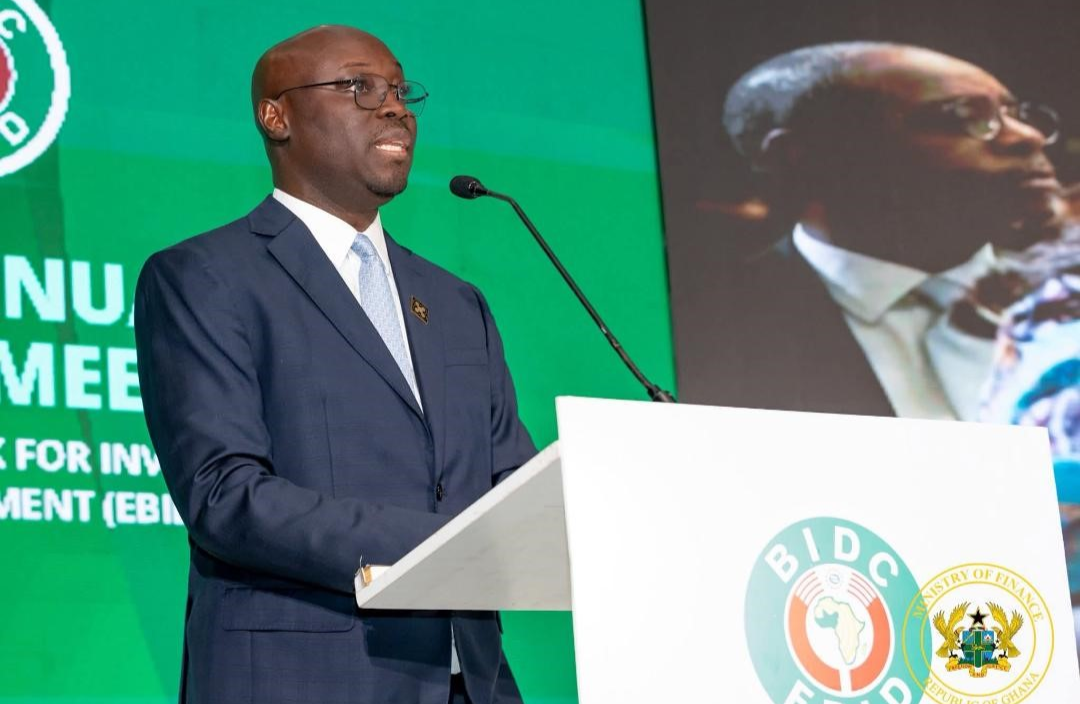
Ghana’s Minister for Finance, Dr. Cassiel Ato Forson, has called on ECOWAS Member States to urgently fulfil outstanding capital subscription obligations to the ECOWAS Bank for Investment and Development (EBID), warning that delayed payments could constrain the Bank’s ability to finance transformative regional projects.
Speaking at the 24th Ordinary Session of the Board of Governors of EBID in Accra, Dr. Forson said the Bank stood at a critical moment in its growth trajectory and required strong collective commitment from Member States to sustain its expanding development impact.
“It is our capital base that strengthens EBID’s leverage, sustains its growth and determines how boldly we can finance regional transformation,” he stated. “The future of EBID will be defined by what we commit to and what we actually do after we leave Accra.”
The high-level meeting brought together Governors, colleague Ministers, EBID President Dr. George Agyekum Donkor, senior management, heads of departments, captains of industry and members of the media.

The Finance Minister expressed concern over slow compliance with a 2022 Board decision to raise EBID’s authorised capital to US$3.4 billion and to call a third tranche of subscriptions amounting to US$411.4 million, with a deadline of December 2025.
“To date, only four Member States – Ghana, Côte d’Ivoire, Guinea and Togo – have fully met their obligations,” Dr. Forson disclosed.
Although US$102.5 million was paid in 2025, outstanding arrears still stand at approximately US$256 million, well past the agreed deadline.
He urged Member States to act with renewed urgency, stressing that expanding the Bank’s capital base remained vital to financing inclusive growth across West Africa.
Dr. Forson, who served as Chair of the EBID Board of Governors over the past year, commended the Bank for delivering strong financial and operational results in 2025 despite challenging global economic conditions.
He noted that the global economy had navigated what analysts described as the “Great Wedge” – a sharp divergence in growth driven by significant artificial intelligence investments in some regions, coupled with trade policy uncertainty and heightened geopolitical tensions elsewhere.
“This created a steady but narrow global growth path, the benefits of which were unevenly distributed,” Dr. Forson said, adding that EBID had to operate in an environment marked by inflation divergence, commodity price realignments and persistent fiscal and debt pressures across Member States.
Despite these challenges, EBID recorded significant growth. The Bank’s balance sheet expanded from US$1.97 billion in 2024 to US$2.39 billion at end-2025, reflecting increased scale of operations.
Profitability improved as well, with net profit rising from US$8.55 million in 2024 to US$9.75 million in 2025, representing a 13.3 per cent increase.
Project approvals increased by 50 per cent, while total commitments surged by more than 83 per cent to US$813.77 million, largely focused on energy and transport infrastructure, sectors considered critical to regional integration and economic transformation.
The Bank also reinforced its catalytic role, mobilising over US$510 million and €310 million for priority projects, alongside an additional US$100 million in capital mobilisation.
Dr. Forson highlighted several institutional milestones that strengthened EBID’s credibility and resilience during the year.
International ratings agencies Moody’s and Fitch reaffirmed EBID’s ratings at B2-Stable and B-Stable, respectively, validating the Bank’s governance framework, risk management and financial discipline.
Additionally, EBID secured accreditation with the Green Climate Fund, unlocking new opportunities to mobilise climate finance and support Member States in building resilient, low-carbon economies.
The opening of the Abidjan Regional Office was also cited as a strategic move to deepen regional presence, accelerate project delivery and strengthen engagement with Member States.
However, Dr. Forson assured participants that discussions at the Accra meeting would be rigorous and forward-looking, given the high expectations of citizens across the region.
“Our people look to us for results,” he said. “Let us be bold in our thinking, decisive in our actions and united in our purpose.”
By: Christian Akorlie / businesspostonline