

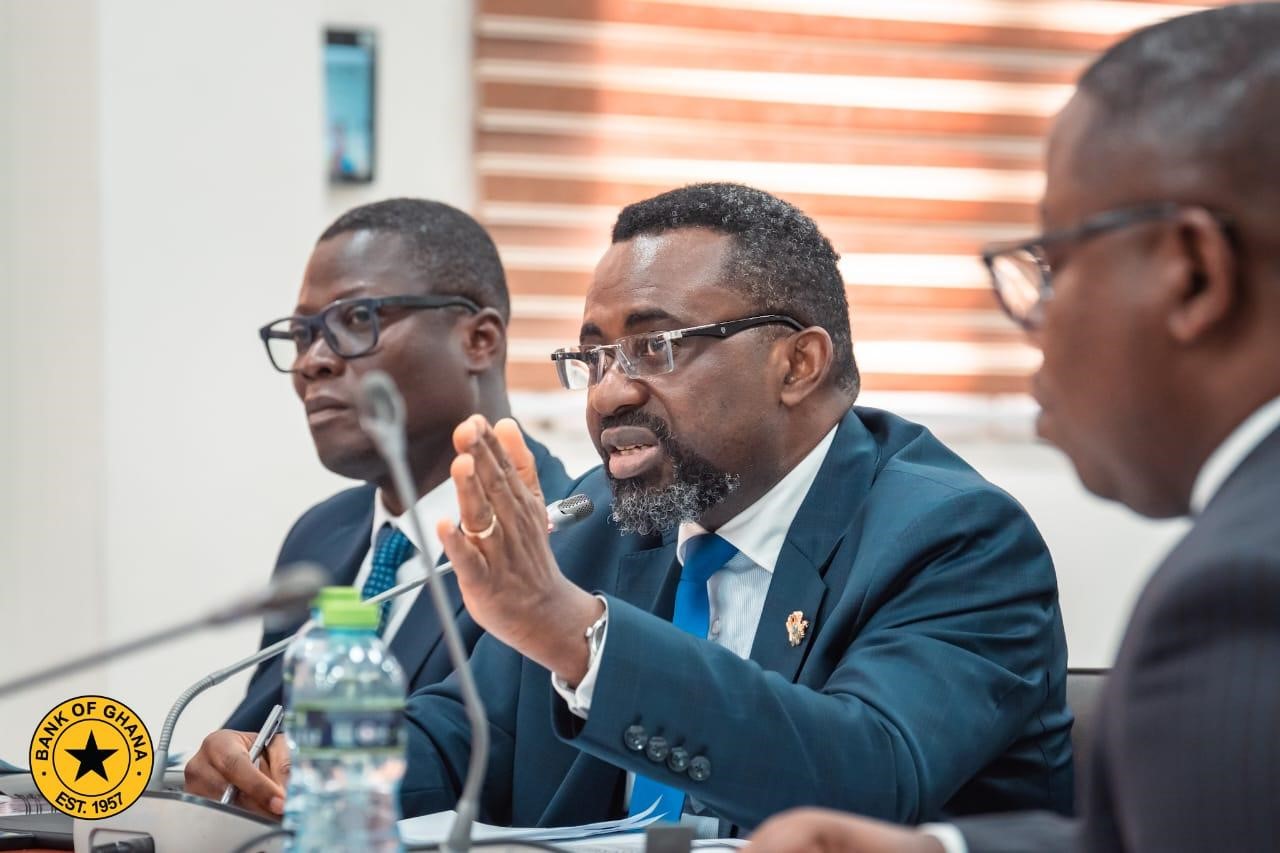
Ghana’s economic outlook remains increasingly optimistic as the Bank of Ghana projects sustained price stability, stronger external buffers, a resilient financial sector, and continued recovery in credit conditions.
This was the central message delivered by Governor Dr. Johnson Pandit Asiama when he appeared before Parliament’s Committee on Economy and Development, emphasising that the foundations for durable economic recovery are now firmly in place.
Dr. Asiama said the Bank expects inflation to remain low, the cedi to stay stable, and banking‑sector conditions to strengthen further through 2026, provided that global risks—particularly shifts in financial markets and commodity price volatility—are managed prudently. He stressed that the central bank will maintain a disciplined, data‑driven policy stance to safeguard the gains achieved so far.
The Governor noted that the macroeconomic gains recorded over the past year form the basis for the improved outlook. Inflation has dropped dramatically from 23.8% at the end of 2024 to 3.3% in February 2026, marking one of the lowest readings in recent history. The cedi has stabilised and appreciated through 2025, reflecting bolstered market confidence, while the Bank’s Monetary Policy Rate was reduced by 900 basis points during the year to 18%, easing financing conditions across the economy.

Ghana’s external buffers have also strengthened markedly, with gross international reserves rising to US$13.8 billion, equivalent to 5.7 months of import cover. Dr. Asiama said these indicators confirm that stability has returned and provide a solid platform for sustained growth.
Recounting the state of the economy at the beginning of 2025, the Governor said Ghana had been navigating a fragile post‑crisis environment. Inflation was significantly above target, the cedi had weakened by 24.8% in 2024, and the Domestic Debt Exchange Programme had placed pressure on bank balance sheets. The Bank of Ghana itself had suffered a 50% haircut on its holdings of government securities and had incurred large valuation losses due to rising yields and structural liquidity overhang.
With these challenges, the central bank entered 2025 with a clear but demanding mandate: reduce inflation, restore confidence, stabilise the exchange rate and rebuild the financial system.
To bring inflation under control, the Bank maintained a tight monetary policy stance throughout 2025. However, restoring policy transmission required more than rate hikes. Structural excess liquidity in the banking system meant the policy rate was not fully affecting market conditions.
To correct this, the Bank intensified its open‑market operations—issuing more short‑term instruments, sterilising foreign‑exchange‑related inflows and coordinating closely with the Ministry of Finance to minimise unintended liquidity injections. These measures aligned market liquidity with monetary policy objectives and played a crucial role in reducing inflation.
Dr. Asiama also highlighted key external‑sector measures that reinforced the stabilisation drive. In November 2025, the Bank introduced a new Foreign Exchange Operations Framework to improve transparency and predictability in FX market interventions.
Alongside this, the Domestic Gold Purchase Programme significantly increased Ghana’s gold holdings—from 8.7 tonnes in 2021 to more than 40 tonnes by October 2025. However, because gold had grown to represent 42% of total reserves, the Bank executed a strategic portfolio rebalancing by converting a portion of gold into foreign‑exchange assets. This move, he emphasised, did not reduce national assets but restored diversification and enhanced the liquidity of Ghana’s reserve portfolio.
The financial system’s recovery has been another pillar supporting Ghana’s positive economic outlook.
Capital adequacy improved to 17.5%, above the regulatory minimum of 13%, while non‑performing loans declined from 21.8% to 18.9%, with a target of 10% by end‑2026.
Banks also expanded their balance sheets with total assets rising from GH₵368bn to GH₵447bn, and Deposits increased nearly 18% to GH₵325bn. Gross loans grew from GH₵95bn to GH₵111bn while New loan disbursements climbed from GH₵80.95bn in October 2025 to GH₵104.17bn by year‑end.
Real private‑sector credit growth accelerated to 13%, a major improvement from 2% the previous year. Liquidity remains strong, with liquid assets covering 96% of deposits.
“These indicators show a banking system that is liquid, solvent and increasingly positioned to support Ghana’s economic recovery,” the Governor said.
Dr. Asiama addressed Parliament’s concerns about the Bank’s financial position, noting that central banks often incur costs when executing stabilisation policies.
These costs include reduced income due to the DDEP, higher interest expenses from absorbing excess liquidity, operational costs associated with the Gold Purchase Programme and valuation losses arising from the cedi’s appreciation.
He stressed that these are standard effects of stabilisation processes and do not undermine the Bank’s ability to conduct monetary policy.
Looking ahead, he said the Bank’s financial position is expected to improve through portfolio repricing, enhanced reserve management, reduced liquidity‑absorption costs and tighter alignment between market and reference exchange rates.
Dr. Asiama concluded by reaffirming that Ghana’s economic prospects are now stronger than they have been in years, underpinned by lower inflation, a stable currency, rising reserves and a banking system on firmer footing. However, he warned that external risks—including global financial tightening and commodity price shocks—must be monitored carefully.
“The Bank of Ghana will continue to pursue a prudent, disciplined and data‑driven approach to monetary policy to safeguard these gains and support sustained economic recovery,” he told the Committee.
Source: businesspostonline