

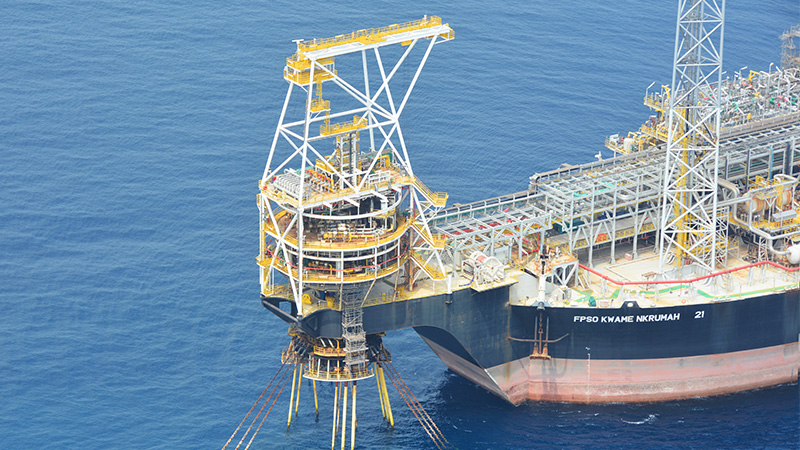
Ghana’s crude oil production has fallen for six consecutive years, cutting output by almost half since 2019 and costing the country an estimated US$16.5 billion in potential gross oil revenue, according to a new report by the Institute for Energy Security (IES).
The report warns that the prolonged decline reflects a structural crisis in Ghana’s upstream petroleum industry rather than a temporary cyclical downturn, citing ageing oil fields, declining investment and the absence of new petroleum agreements since 2018 as the principal causes.
Prepared by energy analysts Smith Prosper Boahene and Prince Lumor, the study shows that crude oil production dropped from 71.44 million barrels in 2019 to 37.30 million barrels in 2025, representing a decline of nearly 48 percent.
The Energy Commission projects output will fall further to 34.83 million barrels in 2026, extending the decline into a seventh consecutive year.

“The decline is not attributable to one shock, but to several structural, operational, and policy failures compounding over an unusually long period,” the report stated.
Petroleum revenues under pressure
The sustained fall in production has significantly reduced government earnings from the petroleum sector.
According to the report, total petroleum receipts declined by 43.27 percent from US$1.36 billion in 2024 to US$770.27 million in 2025, reflecting both lower production volumes and weaker crude oil prices.
The average realised crude oil price fell from US$86.12 per barrel in 2024 to US$74.93 per barrel in 2025.
During the first half of 2025 alone, crude production fell by 26 percent year-on-year to 18.42 million barrels, while petroleum receipts dropped sharply from US$840 million to US$370 million.
IES estimates that had Ghana sustained a modest annual production growth rate of three percent through continuous drilling, improved reservoir management and the signing of new petroleum agreements, cumulative production between 2019 and 2025 would have been approximately 221 million barrels higher than actual output.
Ageing fields and policy gaps
The report attributes the decline primarily to natural depletion in Ghana’s mature offshore fields, inadequate replacement reserves and delays in attracting fresh upstream investment.
Ghana’s crude oil production remains concentrated in the Jubilee, TEN and Sankofa Gye Nyame fields.
Although Jubilee remained the country’s largest producing field in 2025 with 22.2 million barrels, it also recorded the steepest annual decline—more than 30 percent—partly due to a planned production shutdown between March 26 and April 8.
According to the report, production gains recorded in 2024 following drilling activities under the Jubilee South East project demonstrate that targeted investment can slow the rate of decline.
It also noted that while the COVID-19 pandemic disrupted operations in 2021, Ghana’s production decline had already begun before the pandemic.
“COVID-19 aggravated an already-declining trend rather than starting it,” the report observed.
Broader economic implications
Beyond lower export earnings, IES warned that declining crude production poses significant risks to Ghana’s broader energy security and public finances.
The report said revenues accruing to the Ghana National Petroleum Corporation (GNPC) have fallen by more than 61 percent, a situation worsened by a policy decision that reduced GNPC’s share of petroleum revenues from 30 percent to 15 percent.
It also referenced findings contained in the Public Interest and Accountability Committee’s 2025 Annual Report, which highlighted rising cash-call obligations associated with the TEN field as well as US$561.65 million in petroleum revenue linked to GNPC subsidiary Explorco that remains unresolved.
IES cautioned that declining crude output could also reduce domestic natural gas supplies used to fuel thermal power plants, increasing Ghana’s dependence on imported fuels and exposing the economy to greater exchange rate volatility and fluctuations in international energy prices.
Petroleum revenues currently account for roughly 10 percent of total government revenue and finance several infrastructure and development programmes.
Government outlines recovery strategy
Government has acknowledged the challenges confronting the upstream petroleum sector.
In the 2026 Budget Statement, the Ministry of Finance noted that average daily crude oil production has fallen from approximately 200,000 barrels per day in 2019 to around 150,000 barrels per day in 2025.
To reverse the trend, government says it has secured more than US$3.5 billion in investment commitments.
These include a US$2 billion investment framework to drill 20 additional wells in the Jubilee and TEN fields and a US$1.5 billion Memorandum of Intent covering the Offshore Cape Three Points block.
The Ghana National Petroleum Corporation is also expected to commence exploratory drilling in the Voltaian Basin from October 2026.
Government is simultaneously reviewing upstream fiscal and regulatory policies to attract new international oil companies, including Shell, while Parliament has approved extensions to Tullow Oil’s petroleum agreements covering the West Cape Three Points and Deep Water Tano blocks until December 31, 2040.
The revised agreements will also allow GNPC to increase its equity stake in the Jubilee and TEN fields by 10 percent from July 2036.
In addition, the administration says it is working to restore investor confidence through the settlement of legacy energy-sector debts and renewed efforts to stimulate upstream petroleum investment.
Think tank calls for urgent reforms
IES is urging government to accelerate petroleum licensing rounds, fast-track implementation of the planned drilling programme and strengthen institutional oversight of the sector.
The institute also called on Parliament and the Public Interest and Accountability Committee (PIAC) to closely monitor implementation of the planned US$2 billion investment programme while urging reforms to strengthen GNPC’s financial position, including resolving the outstanding Explorco revenue issues and reviewing the reduction in GNPC’s petroleum revenue allocation.
Meanwhile, the Africa Sustainable Energy Centre has cautioned against proposals to finance domestic gas and electricity infrastructure with petroleum revenues, warning that such a move could weaken the country’s foreign exchange buffers and worsen the energy sector’s estimated US$14 billion debt burden.
Financial economist Professor Lord Mensah has also called for more consistent fiscal and investment policies, arguing that petroleum revenues should increasingly be channelled into infrastructure, agriculture and export diversification to reduce Ghana’s long-term dependence on crude oil.
IES concluded that reversing Ghana’s production decline will require decisive policy action and sustained investment.
“Ghana’s six consecutive years of crude oil production decline are far more than a cyclical fluctuation. The data show a structural crisis. Reversing it will require new licensing, accelerated investment, improved operational efficiency, strengthened institutional capacity and diversified revenue management, implemented with the urgency the data clearly demonstrate is overdue,” the report said.
Source: businesspostonline