

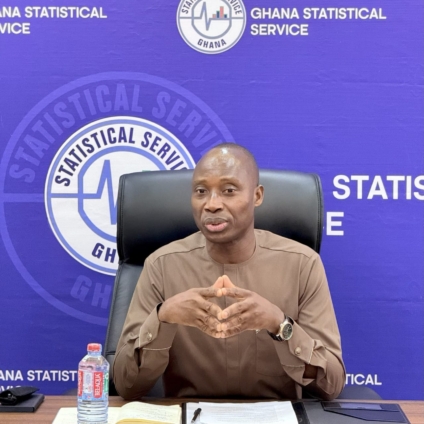
Ghana’s economy grew by 6.0 percnt year-on-year in real terms in the second quarter of 2026, with the information and communication technology (ICT) sector emerging as the single biggest engine of growth, contributing more than two-fifths of the expansion, Government Statistician Dr. Alhassan Iddrisu has announced.
Presenting the Ghana Statistical Service’s (GSS) Q2 2026 Gross Domestic Product (GDP) estimates and the June 2026 Monthly Indicator of Economic Growth (MIEG), Dr. Iddrisu said the economy continued to demonstrate resilience despite a slight moderation from the 6.6 percent growth recorded in the corresponding period of 2025.
“In the second quarter of 2026, Ghana’s economy grew by 6 percent in real terms. One striking number is that four out of every ten cedis of new growth came from a single sub-sector, and that sub-sector is information and communication technology,” he said.
Real GDP increased to GH¢51.3 billion from GH¢48.4 billion in Q2 2025, while nominal GDP rose by 11.4 percent to GH¢372.1 billion, compared with GH¢334.1 billion a year earlier.

The ICT sector recorded a remarkable 30.9 percent growth, up from 21.3 percent in the same period last year, and accounted for 41.5 percent of total GDP growth, making it the largest contributor across all sectors.
Dr. Iddrisu noted that the sector has maintained double-digit growth for the past three years, underscoring the increasing importance of digital services, mobile connectivity and technology-driven economic activity in Ghana’s growth trajectory.
“Ghana’s growth story today is, in real terms, substantially an ICT story,” he said.
The services sector, which remains the largest component of the economy with a 45.9 percent share of GDP, grew by 8.0 percent and contributed 57.6 percent of overall growth during the quarter.
Beyond ICT, strong performances were recorded in transport and storage, which expanded by 14.9 percent, as well as manufacturing, which grew by 6.6 percent.
Industry, accounting for 33.1 percent of GDP, expanded by 4.3 percent, up from 2.4 percent a year earlier. The sector’s performance was largely driven by a dramatic rebound in the oil and gas industry, which swung from a 29.0 percent contraction in Q2 2025 to 22.4 percent growth in Q2 2026.
The oil and gas subsector alone contributed 4.8 percentage points to overall GDP growth.
Agriculture, which constitutes 21.0 percent of GDP, grew by 3.9 percent, down from 7.1 percent recorded a year earlier. Growth in forestry and logging accelerated to 10.7 percent, while crops expanded by 5.2 percent.
However, the sector was weighed down by a sharp contraction in fishing, which declined by 24.7 percent, making it one of the weakest-performing subsectors in the economy.
The GSS data also showed significant disparities across sectors. While ICT, transport, forestry, manufacturing and livestock posted the fastest growth rates, fishing, accommodation and food services, education, public administration and real estate all recorded contractions.
On the expenditure side of the economy, domestic demand increased by 11.2 percent, supported by a surge in investment. Gross capital formation jumped by 53 percent, indicating strong business and government investment activity.
Exports grew by 14.2 percent, while imports expanded by 29.9 percent, reflecting rising domestic demand and investment-related imports.
One of the most notable developments was the easing of inflationary pressures. The GDP deflator, a broad measure of price changes across the economy, declined from 18.6 percnet in Q2 2025 to 5.5 percent in Q2 2026.
According to Dr. Iddrisu, the combination of strong economic growth and significantly lower inflation represents an uncommon but positive outcome for households and businesses.
“Strong growth on one side and calmer prices on the other is a combination that is very rare. It represents real relief for families and businesses,” he said.
For the first half of 2026, Ghana’s economy grew by 6.2 percent, slightly below the 6.4 percent recorded during the same period in 2025.
Non-oil GDP growth stood at 5.9 percnt, while services generated more than half of total growth during the six-month period.
Meanwhile, the Monthly Indicator of Economic Growth showed economic activity accelerating steadily throughout the second quarter, rising from 5.5 percent in April to 6.0 percent in May and 6.5 percent in June.
The MIEG index reached 116.7 in June, with services leading monthly growth at 10.8 percent.
Dr. Iddrisu urged policymakers to sustain macroeconomic stability, deepen investment in digital infrastructure and address declining sectors such as fishing, education, public administration and real estate.
“The central message of this release is that growth remains strong, but it is concentrated in a handful of sectors. The challenge now is to broaden that growth and ensure it translates into jobs, incomes and improved living standards for all Ghanaians,” he said.
Source: businesspostonline