

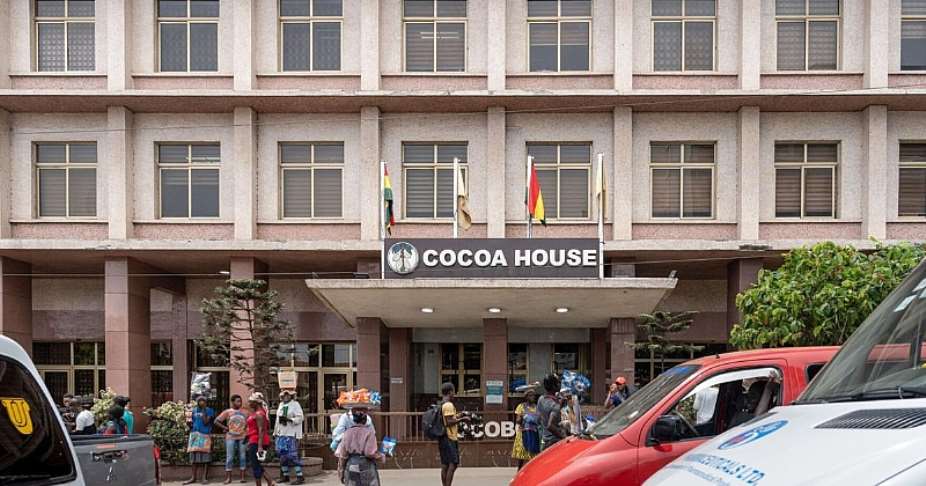
A high powered delegation from COCOBOD is scheduled to represent Ghana at a four nation Cocoa Value Addition Summit 2026 which will take place in Abuja, Nigeria’s capital on Tuesday, July 14. The Summit, which has been convened by the Federal Government of Nigeria, will comprise participation from Cote d’Ivoire and Ghana, which between them account for well over half of the world’s cocoa production, as well as from Nigeria and Cameroun which both produce much smaller – but growing –proportions of global production. Between them the four countries account for some two-thirds of global cocoa production.
The Summit is being convened for the four African nations to sign the “Abuja Declaration” establishing a Cocoa Value Addition Alliance through which they will negotiate, set standards and engage world markets as one bloc. The agreement will commit its members to collaborate towards increasing their respective national production, commit them to a joint position on recognition of national traceability systems – and the principle that compliance costs must not be pushed onto smallholder farmers – and most importantly, commit them to a collective path towards gradually replacing the export of raw cocoa beans with domestic processing of the beans before export to add value to the commodity locally.
Nigeria’s Minister of State for Industry, Trade and Investment, John Owan Enoh, has noted ahead of the upcoming summit that the four participating countries will declare that the century of exporting raw beans is over. Indeed the theme for the summit is: “From Bean to Brand.”
He laments that: “For a hundred years, Africa has sent its cocoa to the world in sacks and received it back in wrappers, paying at both ends of the transaction.”

To this end, at the summit, Nigeria intends to sign a national compact on processing what it grows, which will bind its Federal Government, the Governors of its cocoa-producing states, farmer and industry associations, researchers and development financiers, to measurable commitments on processing, farmer incomes and investment, with a delivery council chaired by the Minister of State for Industry, Trade and Investment.
This is following the lead set by Ghana, whose President John Dramani Mahama administration has announced a sweeping policy reset requiring at least 50% of Ghana’s cocoa beans to be processed locally starting from the 2026/2027 crop season.
To break away from exporting raw cocoa and retain more value within the domestic economy, the administration has introduced several critical steps
Ghana is transitioning away from the historical annual offshore syndicated loan model used to finance cocoa purchases, replacing it with a model whereby COCOBOD will now raise funds domestically through local bond issuances and domestic currency to buy cocoa from farmers. Purchasing beans with domestic funds removes the requirement to collateralize and ship raw beans directly to foreign creditors, keeping up to 400,000 tonnes available inside the country for local processors.
Under the new financing framework, COCOBOD has been given the flexibility to sell cocoa beans of any volume directly to local private and state-owned factories. The Cabinet issued an immediate directive to restrict the export of raw beans beyond the 50% limit and allocate remaining stocks primarily to local processors like the West Africa Mills Company (WAMCO).
The administration has also prioritized the revival and retooling of the state-owned Cocoa Processing Company (CPC) with modern machinery to double its daily output even as the Ministry of Trade, Agribusiness and Industry is collaborating with the Association of Ghana Industries (AGI) to set up decentralized processing plants directly within cocoa-growing communities to turn beans into cocoa powder, butter, and consumer spreads.
The policy shifts tertiary and secondary production focus toward exporting finished chocolates and drinks to the wider continent using the African Continental Free Trade Area (AfCFTA) framework.
A new bill is being drafted for Parliament that legally mandates the 50 percent local processing requirement while simultaneously guaranteeing cocoa farmers at least 70% of the world market price. The government is working to absorb the Western Rail Line under its “Big Push” infrastructure agenda to lower transport costs from plantations directly to local processing factories and ports.
Ghana’s participation in the summit comes at a decisive moment for the global cocoa economy. Global market prices have swung away from historic highs of above US$11,000 per tonne to near US$3,000 and back towards US$5,000 within 18 months, a volatility absorbed most brutally at the farm gate. At the same time, the European Union’s Deforestation Regulation begins to apply to large and medium sized operators on December30, 2026, requiring plot-level traceability for all cocoa entering the EU, which purchases 60 percent of global cocoa exports.
The Cocoa Value Addition Summit 2026 is convened by Nigeria’s Federal Ministry of Industry, Trade and Investment – with that country’s Bank of Industry as co-convener – with a view to advance the processing, manufacturing and branding of African cocoa at origin.
By: Toma Imirhe / businesspostonline