

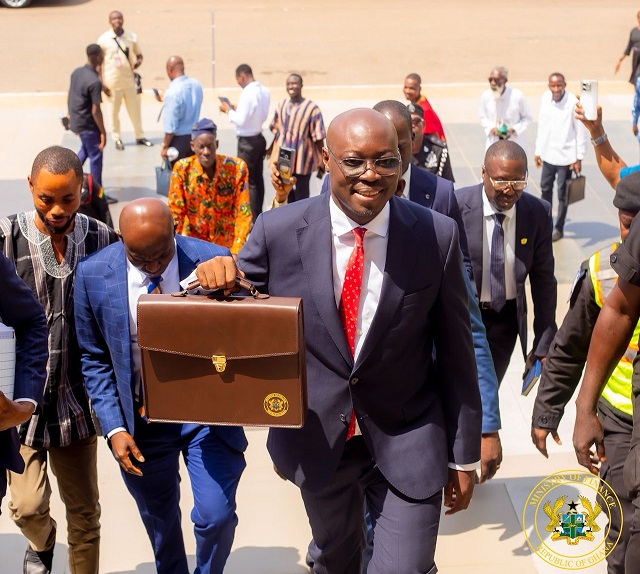
With Ghana’s 2026 Mid-Year Budget Review now just a few weeks away, the organized private sector, represented by the various key business associations, has begun concerted lobbying of government’s economic managers with their respective wish lists as to what they want the budget review to address.
Although Parliament had not officially announced the precise presentation date at the time of writing, government planning documents and parliamentary scheduling suggest that the review will be delivered during the second half of July 2026, broadly in line with the traditional timing of previous mid-year reviews.
The review is expected to assess fiscal performance during the first six months of the year while updating revenue, expenditure, borrowing and macroeconomic projections for the remainder of 2026.
Unlike previous years, however, the review comes against the backdrop of an economy that has recovered considerably from the severe macroeconomic stresses of 2022 and 2023.

For the private sector, however, improved macroeconomic indicators have not eliminated longstanding concerns over the cost of doing business. Business associations including the Association of Ghana Industries, the Ghana National Chamber of Commerce and Industry and the Ghana Union of Traders’ Associations are using the mid-year review as a pivotal opportunity to press government for targeted interventions rather than broad-based fiscal stimulus.
The AGI has consistently argued that manufacturers need lower production costs to become competitive and is using the run-up to the 2026 budget review to renew calls for reductions in electricity costs, faster VAT refund processing, accelerated implementation of industrial support programmes and increased public procurement from locally manufactured products. The association has welcomed macroeconomic stability but continues to maintain that businesses cannot fully benefit until financing costs fall more substantially and energy supply becomes cheaper and more reliable.
Similarly, the GNCCI is said to be advocating for measures that improve liquidity within the private sector. Chamber executives have repeatedly emphasized the need for prompt payment of government arrears owed to contractors and suppliers, easier access to credit for small and medium-sized enterprises, continued exchange-rate stability and predictable tax administration. The Chamber is also urging government to resist introducing any new taxes during the review while accelerating reforms that simplify customs procedures and reduce administrative bottlenecks.
GUTA, representing traders, is focusing its lobbying on pressing for lower lending rates, improved access to affordable trade finance, reductions in port handling charges and continued efforts to prevent exchange-rate volatility from returning.
These requests broadly reflect a consensus emerging across Ghana’s organized private sector. Businesses are no longer demanding emergency fiscal rescue measures; instead, ahead of the impending budget review they are seeking policies that convert macroeconomic stability into lower operating costs, more liquidity in the economy and higher private investment.
Government, however, on its own part remains committed to continue exercising considerable fiscal restraint. The administration has repeatedly indicated that preserving macroeconomic credibility remains its overriding priority. The original 2026 Budget committed government to maintaining fiscal discipline, achieving a primary fiscal surplus, continuing debt sustainability reforms and completing the IMF-supported programme, which it indeed successfully exited in May. Finance Ministry officials assert that those commitments will not be diluted during the mid-year review because they underpin both domestic investor confidence and Ghana’s improving international credit standing.
Finance Minister Dr. Cassiel Ato Forson insists that the gains already achieved—declining inflation, lower public debt ratios, stronger foreign reserves and renewed investor confidence—must not be jeopardized through expansionary fiscal policies. Government officials are therefore signaling that any additional expenditure commitments will be financed through stronger-than-expected revenue performance rather than increased borrowing.
Where changes are expected is in the composition rather than the overall size of expenditure. Stronger domestic revenue mobilization and improved economic performance could provide additional fiscal space for priority programmes such as infrastructure development under the “Big Push” initiative, implementation of the 24-Hour Economy policy, agriculture, education infrastructure, health programmes and support for small businesses without materially weakening the fiscal framework. Additional expenditure on drainage, especially in Accra, has become an urgent priority following the unprecedented flooding that occurred earlier this week.
Analysts also expect updated macroeconomic assumptions to reflect stronger growth, continued disinflation and a more favourable exchange-rate outlook than originally projected. Revenue projections could consequently be revised upward while debt servicing costs may be adjusted downward if domestic borrowing rates continue their declining trend.
Most economists therefore expect a relatively conservative mid-year review. Rather than unveiling dramatic policy reversals, government is likely to reaffirm its commitment to fiscal consolidation while making targeted adjustments that support productive sectors of the economy. Such an approach would satisfy international creditors and investors by preserving policy credibility while responding, at least partially, to private sector demands for improved competitiveness
Under Ghana’s Public Financial Management Act, the Minister for Finance, Dr. Cassiel Ato Forson, is required to present Parliament with a mid-year review of budget implementation and government’s proposals for adjustments to the original 2026 budget which are to be implemented during the second half of the year.
Inflation has remained in single digits, the cedi has stabilized, international reserves have strengthened, domestic interest rates have eased significantly and Ghana has successful completed its IMF-supported reform programme. These improvements have substantially altered the tone of policy discussions from crisis management to sustaining stability while accelerating growth.
By: Toma Imirhe / businesspostonline