

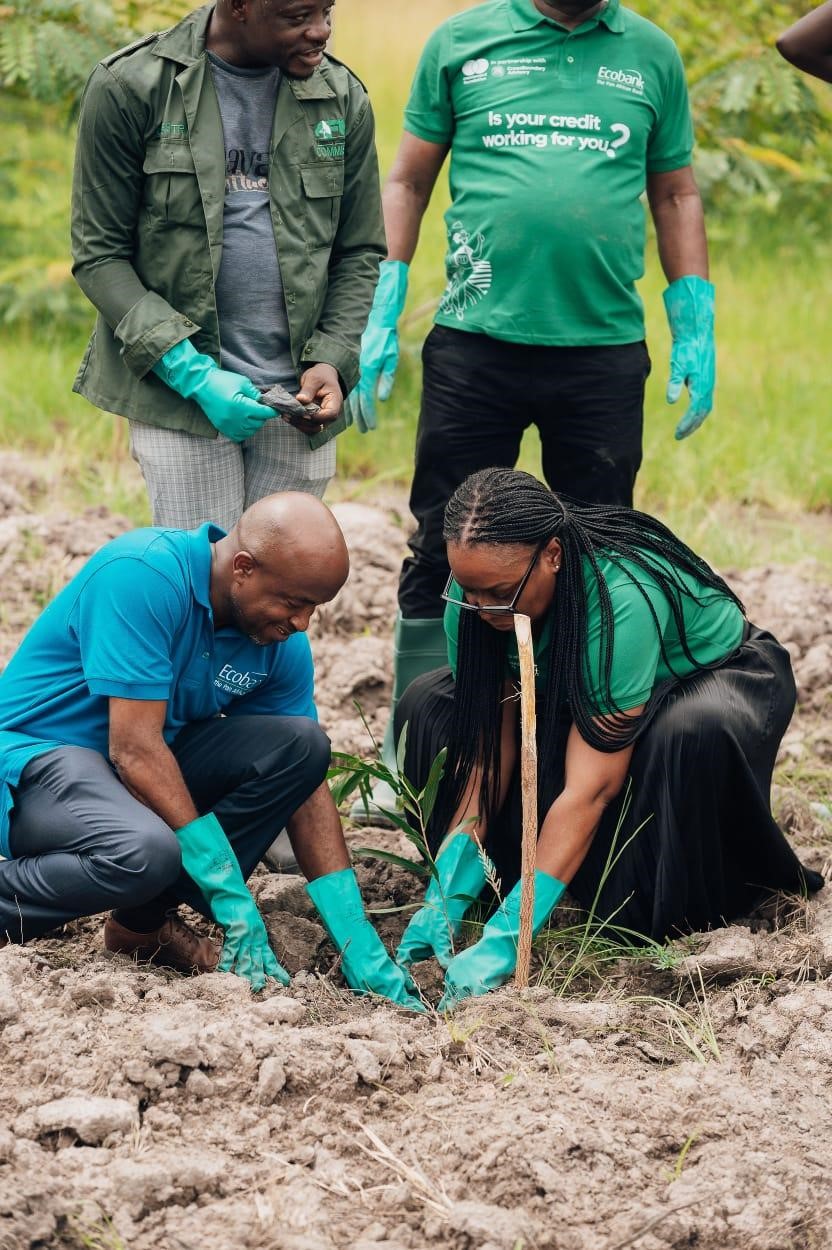
Ecobank Ghana has reaffirmed its commitment to environmental sustainability with a large-scale tree planting exercise at the Chipa Forest Reserve, as part of activities marking this year’s World Environment Day and “Tree for Life” initiative.
The exercise forms part of a broader national effort aimed at restoring degraded lands and mitigating the impacts of climate change, with a government target of planting 30 million trees across the country this year.
Speaking at the event, Dr. Daniel Kassa-Tee, Head of Corporate Communications at Ecobank Ghana, highlighted the bank’s long-standing involvement in environmental conservation, noting that Ecobank’s tree planting activities date back to 2012.
He recalled that on June 5 of that year, the bank planted over 1,200 trees at Prampram Secondary School as part of World Environment Day activities.

“We have been in this business of environmental consciousness and sustainability issues for a long time,” he said. “Last year, when His Excellency the President launched the Tree for Life initiative, we decided to scale up our efforts.”
According to him, Ecobank has since expanded its activities to cover multiple regions, working with schools, churches and hospitals. In 2025 alone, the bank supported tree planting efforts in five regions across 27 institutions, extending activities throughout the entire month of June.
This year, the bank has maintained its momentum, participating in the national launch of the initiative and rolling out tree planting exercises across Accra, Kumasi, Takoradi, Sunyani and Tamale. At Prampram Secondary School, Ecobank returned 14 years after its initial planting exercise.
Dr. Kassa-Tee expressed satisfaction at the survival of the earlier trees, describing it as evidence of the long-term impact of such initiatives. “We were very excited to see that the initial 1,200 trees were largely thriving,” he noted.
Simultaneously, tree planting exercises were carried out in Takoradi, Sunyani and Tamale, with 250 trees planted in each location. Kumasi’s exercise, initially delayed, has been rescheduled.
At the Chipa Forest Reserve, Ecobank is planting approximately 2,000 trees across a newly adopted two-hectare land. The bank is also revisiting areas planted last year to assess growth and replace any failed seedlings.
Dr. Kassa-Tee underscored the connection between environmental sustainability and the banking sector, stressing that Ecobank has embedded eco-friendly practices into its operations.
“Our head office building is designed to be environmentally friendly, and we have significantly reduced paper usage through digital transformation,” he explained. “Paper comes from trees, and reducing its use helps to protect the environment.”
He added that the bank remains committed not only to planting trees but also to nurturing them to ensure long-term survival and environmental impact.
Ecobank has pledged to continue monitoring all sites where it has planted trees, including the 27 institutions covered last year, to ensure sustainability and long-term environmental benefits.
“With sustained collaboration and proper nurturing, these trees will not only restore degraded lands but also contribute significantly to climate change mitigation,” Dr. Kassa-Tee said.
Officials from the Forestry Commission also commended Ecobank’s intervention, describing it as crucial to restoring the Chipa Forest Reserve, which has suffered extensive degradation due to illegal logging and sand winning.
District Manager for Tema Ada Forest District, Linda Ansah, explained that about 24 hectares of the forest reserve have been affected, requiring urgent restoration.
“The degradation is caused by illegal felling of firewood and illegal sand winning,” she said.
“With these reforestation efforts, we expect to achieve canopy closure within five years.”
She stressed that collaboration between government and corporate organisations is essential to achieving restoration targets.
“The government alone cannot do it. We need corporate institutions like Ecobank to partner with us to bring back our forests,” she added.
Sustaining the Gains
Forestry officials also outlined measures to ensure the survival of the newly planted trees, including regular weeding, watering during dry periods, and replacing dead seedlings—a process known as “beating up.”
Fire belts will also be constructed to protect the young trees from potential bushfires during the dry season.
Source: businesspostonline