

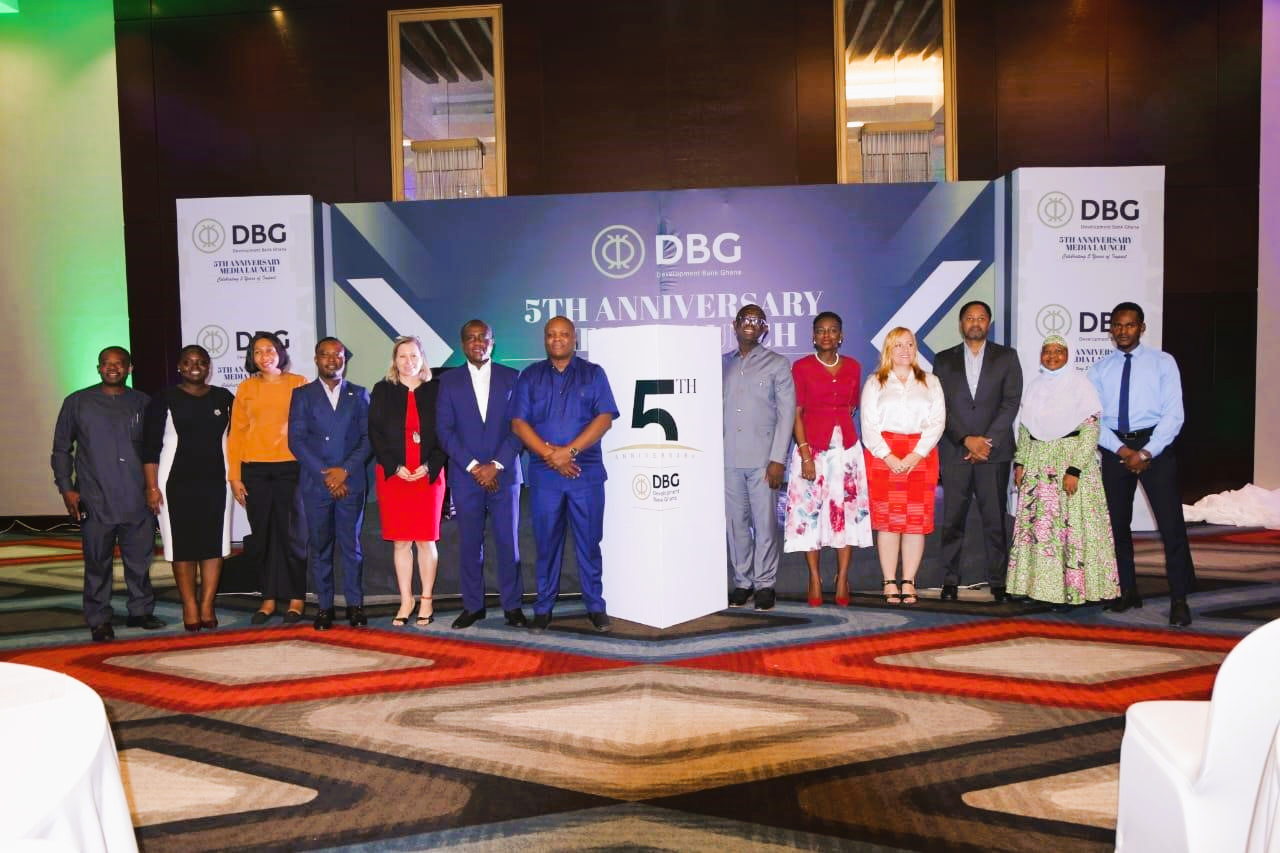
Development Bank Ghana (DBG) has launched its fifth anniversary with a bold agenda to deepen financial sector reform, expand credit access, and drive industrial transformation nationwide.
At a media launch in Accra on Tuesday, Chief Executive Officer Prof. Randolph Nsor-Ambala reflected on the bank’s journey since its establishment in November 2021, describing it as a response to a critical financing gap that once constrained business growth.
“Five years ago, long-term credit had all but disappeared from our financial system,” he said. “A Ghanaian entrepreneur with a viable business could walk into every bank and come out with a two-year loan at best – and often nothing at all.”
Ghana’s private sector credit remains low at about 9 percent of GDP, far below the Sub-Saharan Africa average of roughly 28 percent. Key sectors such as agriculture—despite contributing about 24 percent of GDP—receive less than 5 percent of bank lending, while only about 15 percent of loans exceed five-year tenors.

DBG was created to address that gap by providing patient, affordable capital to commercial banks for on-lending to businesses.
According to the CEO, the model has delivered significant results over the past five years with more than GH¢2.5 billion disbursed through 21 partner financial institutions into Ghanaian businesses.
The financing has supported 997 businesses nationwide and about 97 percent of beneficiaries MSMEs, with 63 percent comprising women-owned or women-led enterprises.
Notably, over half of the financing has supported women-led enterprises, while funded businesses continue to create thousands of jobs annually.
Unlike traditional lending models, DBG has focused on long-term financing, extending loans to sectors such as agriculture, manufacturing and services.
“A factory is built on patient money – or it is never built at all,” Prof. Nsor-Ambala emphasised.
He added that one of the bank’s most significant achievements is its repayment record, noting that all partner institutions had repaid loans in full and on time over the five-year period.
DBG also played a countercyclical role during periods of economic instability when borrowing costs surged to nearly 30 percent.
“At those levels, credit stops being fuel and becomes a burden,” the CEO said. “We were deliberately aggressive, pushing over GH¢1.5 billion into the system when businesses needed it most.”
With macroeconomic conditions improving—characterised by declining inflation and lending rates returning to single digits—Prof. Nsor-Ambala credited policy interventions led by Finance Minister Dr. Cassiel Ato Baah Forson for improving access to affordable capital.
He noted that the Ministry has also tasked DBG with helping to transform the financial sector – a challenge the bank has pledged to embrace.
As part of its next phase of operations, DBG is introducing credit guarantee schemes designed to reduce the collateral burden that prevents many viable businesses from accessing credit.
“From today, DBG will begin to share the risk that holds our banks back,” the CEO announced.
The bank also plans to expand partnerships with fintechs and financial institutions to digitise lending processes and extend access to underserved regions.
Additionally, DBG will scale up technical assistance programmes to strengthen financial institutions’ ability to lend to high-impact sectors while supporting business formalisation and growth.
“Capital starts a business. Capability keeps it alive,” Prof. Nsor-Ambala said.
Looking ahead, DBG outlined several priority areas:
- Oil palm industry transformation – supporting the entire value chain from smallholder production to processing and exports
- Women-focused financing – building tailored financial products for female entrepreneurs
- Regional expansion – ensuring financing reaches all 16 regions beyond Accra
- Green finance – backing clean energy, climate-smart agriculture and Ghana’s Nationally Determined Contributions (NDCs)
These initiatives will be pursued in partnership with development institutions including the World Bank, KfW, the European Investment Bank and the African Development Bank.
DBG currently works with 21 financial institutions and five partner agencies, strengthening Ghana’s financial ecosystem and expanding credit access to underserved segments.
The anniversary media launch forms part of a broader two-day celebration scheduled for November 16–17, 2026, where the bank will showcase its impact and future initiatives.
Prof. Nsor-Ambala compared DBG’s trajectory to global development banks such as Germany’s KfW and Singapore’s DBS, both of which evolved into major financial institutions after supporting national development.
“We do not intend to remain static,” he said. “Our ambition is to complete each assignment and take on a harder one until development financing becomes routine across the banking system.”
He concluded by reaffirming DBG’s mission: “Five years ago, this institution was a promise. Today it is proof. Tomorrow it must be more.”
Development Bank Ghana is a development finance institution focused on increasing access to long-term financing through partner financial institutions to support sustainable private sector growth and economic transformation.
By: Christian Akorlie / businesspostonline