

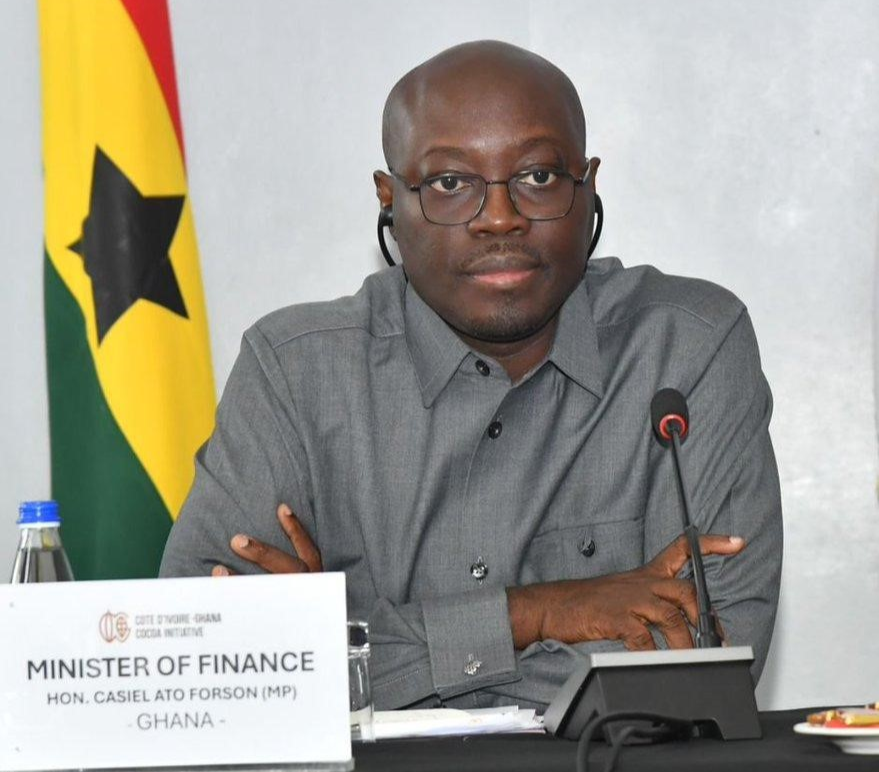
Minister for Finance, Dr. Cassiel Ato Forson, has called for renewed commitment and deeper collaboration between Ghana and Côte d’Ivoire to transform the cocoa sector into a resilient and profitable industry for farmers.
Speaking at the opening of the 7th Steering Committee Meeting of the Côte d’Ivoire-Ghana Cocoa Initiative in Abidjan, Dr. Forson emphasised the critical role of sustained cooperation between the world’s two largest cocoa-producing nations.
The high-level meeting brought together senior government officials, industry leaders, and key stakeholders from both countries, including the Chief Executive of the Ghana Cocoa Board (COCOBOD), Dr. Randy Abbey.
Participants are expected to deliberate on strategies to enhance cooperation, boost farmer incomes, and tackle emerging challenges confronting the cocoa sector.

Chairing the session, Dr. Forson underscored the importance of continuous dialogue and strategic alignment between Ghana and Côte d’Ivoire, noting that their partnership remains central to safeguarding the future of the industry.
“While we may not be able to resolve all our challenges here today, our collective determination to make a genuine and lasting positive impact on our farmers, our countries, and future generations should remain the driving force that guides our work,” he stated.
He stressed that the collaboration is not optional but essential, given the shared responsibilities of both countries in the global cocoa value chain.
“The relevance and necessity of this collaboration are undeniable, and we must ensure that it succeeds,” he added.
Dr. Forson further urged both countries to shift from reactive approaches to proactive and strategic engagement in handling global market dynamics.
According to him, Ghana and Côte d’Ivoire must leverage their position as market leaders to better anticipate shocks and shape industry outcomes.
“As the world’s two leading cocoa-producing countries, we must engage more consistently and strategically to protect our economies. By doing so, we can better anticipate challenges, mitigate shocks, and shape the future of the industry rather than merely reacting to its disruptions,” he said.
He also called on participants to focus on delivering practical, results-oriented solutions that will directly benefit cocoa farmers, stressing that the sector must evolve to deliver fair and sustainable livelihoods.
“The cocoa sector deserves to be transformed into one that is more resilient, prosperous, and profitable for the benefit of both our countries and our farmers,” Dr. Forson emphasised.
In his remarks, Côte d’Ivoire’s Minister of Agriculture, Rural Development and Food Production, Bruno Nabagné Koné, reinforced the need for collective action and shared responsibility in addressing the challenges facing the cocoa sector.
“We have gathered because we are combining our efforts. I do count on your spirit of responsibility,” he said, urging stakeholders to remain committed to the initiative’s goals.
Mr. Koné highlighted the importance of ensuring fair compensation for farmers, noting that harmonisation of cocoa pricing policies between the two countries is key to achieving sustainable incomes.
“Ensuring decent income and justice through harmonisation of prices is critical. Cocoa must first of all guarantee a worthy lifestyle for farmers,” he stated.
The Côte d’Ivoire-Ghana Cocoa Initiative, jointly established by the governments of the two countries, seeks to coordinate cocoa policies, strengthen their bargaining power on the global market, and improve the livelihoods of millions of farmers who depend on cocoa production.
The 7th Steering Committee Meeting is expected to conclude with concrete recommendations aimed at deepening bilateral cooperation and advancing efforts to build a more sustainable, resilient, and profitable cocoa industry.
Source: businesspostonline