

Domestic and international policy institutions broadly favour using Ghana’s economic stabilization gains to accelerate productive investment, employment and economic diversification. However, differences have emerged over the pace of fiscal expansion, revenue mobilization, inflation risks and the sustainability of the country’s recovery reports TOMA IMIRHE.
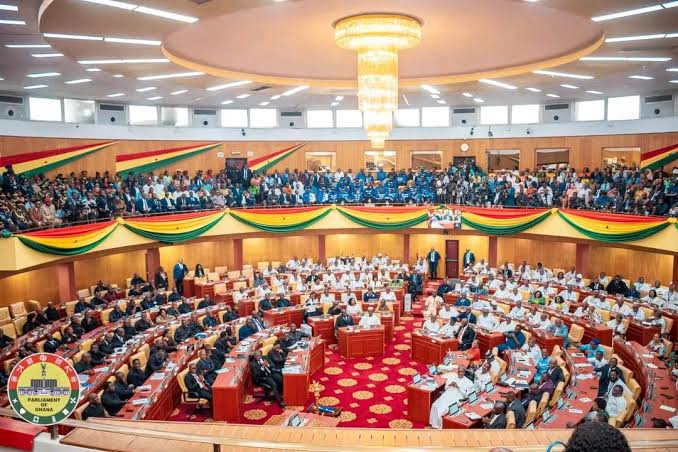
Ghana’s November 12 presentation of its 2027 Budget Statement and Economic Policy comes at an important turning point in the country’s economic management. Following the substantial macroeconomic stabilization achieved under the US$3 billion International Monetary Fund (IMF) Extended Credit Facility programme, the government intends to move towards a more ambitious programme of productive investment, industrial transformation and employment creation, under its proposed New Economy agenda.
The challenge is to accomplish this transition without reversing improvements in inflation, exchange-rate stability, public debt and investor confidence.
Assessments by Ghanaian policy institutions and international economic research organizations – between their specific 2027 budget previews and their wider considerations of the country’s economic circumstances – point to considerable agreement on the need to broaden domestic revenue mobilization, improve public expenditure efficiency, strengthen productive capacity and address structural constraints to private-sector development. Nevertheless, there are important differences in their emphases and economic expectations.

Areas of broad agreement
First of all is the obvious – they agree that fiscal discipline must be preserved, but investment cannot remain the casualty.
Perhaps the strongest area of convergence is that Ghana must not allow fiscal consolidation to become synonymous with suppressing development expenditure.
The IMF’s July 2026 approval of the 36-month, non-financing Policy Coordination Instrument (PCI) provides an important framework. It permits Ghana to reduce its primary budget surplus from 1.5 per cent of GDP in 2026 to 0.5 per cent in 2027, provided debt sustainability and accompanying structural reforms are maintained. Ghana’s legislated objective remains reducing public debt to 45 per cent of GDP by 2034.
The Institute of Statistical, Social and Economic Research ISSER has made perhaps the clearest domestic intervention on this question. Its Director, Professor Robert Darko Osei, has called for increased capital expenditure in the 2027 Budget, warning that capital spending missed its target by more than 40 per cent in the first half of 2026.
He argues that infrastructure investment must support the operating environment of businesses, rather than simply produce physical infrastructure. He also insists that increased allocations must be accompanied by project monitoring, accountability and value-for-money safeguards.
This position is consistent with the broader development priorities of the Africa Centre for Economic Transformation (ACET) and Brookings Institution’s Africa Growth Initiative, whose research agendas emphasize structural transformation, productive employment, industrial competitiveness and development financing.
The important qualification is that investment must be economically productive, rather than politically motivated or financed through unsustainable borrowing.
Another significant area of agreement concerns Ghana’s comparatively weak capacity to generate domestic revenue.
The Institute for Fiscal Studies (IFS), through its Executive Director, Dr Said Boakye, has made this a central pre-budget demand. At its November 6 press conference, the institute identified inadequate extractive-sector revenue, tax evasion, revenue leakages and excessive tax exemptions as major constraints.
IFS is advocating a review of tax exemptions, better returns from mineral resources and improved government participation in the extractive industries. It argues that Ghana should secure more meaningful fiscal benefits from its natural-resource wealth, drawing lessons from countries such as Botswana.
ISSER has similarly recommended broadening the tax base, strengthening compliance and reducing revenue leakages. Its October assessment of the 2025 fiscal adjustment observed that consolidation relied substantially on expenditure restraint rather than improved revenue mobilization.
The implications for the 2027 Budget include more effective taxation of the informal economy, digital transactions, extractive industries and high-income economic activities, without imposing disproportionate burdens on struggling businesses and households.
Development-oriented research by policy think tanks also reinforces the need to move beyond headline GDP growth as the principal measure of economic success.
Ghana’s economy expanded by approximately six per cent in 2025, yet employment creation and productivity remain substantial challenges.
The government itself has acknowledged the problem through its proposed US$10 billion New Economy transformation programme, which is intended to expand productive investment, value addition and employment.
ISSER’s position is that infrastructure, agriculture, agribusiness and industrial development must be connected to business productivity and employment opportunities.
ACET’s structural transformation agenda and Brookings’ Africa Growth Initiative similarly provide an analytical basis for prioritizing manufacturing, agricultural processing, technology adoption and regional trade.
The common policy implication is that the 2027 Budget should identify employment-intensive sectors, specify measurable targets and demonstrate how public expenditure will mobilize additional private investment.
The Institute for Energy Security (IES), the Natural Resource Governance Institute (NRGI) and the International Centre for Tax and Development (ICTD) represent important specialist perspectives on this issue.
Ghana’s dependence on gold, cocoa and petroleum revenues creates opportunities for fiscal expansion but also exposes public finances to international commodity-price fluctuations.
The IMF has specifically identified the energy and cocoa sectors as important sources of fiscal risk, alongside weaknesses in state-owned enterprises. Its recommendations include stronger oversight, improved financial management and more effective control of quasi-fiscal liabilities.
NRGI’s natural-resource governance perspective makes transparency, accountable licensing, revenue management and the equitable distribution of extractive-sector benefits particularly relevant.
For Ghana, the central question is whether rising mineral and petroleum earnings can be converted into sustainable infrastructure, local industrial capacity and employment rather than temporary improvements in foreign-exchange receipts.
Significant differences in forecasts and recommendations
International forecasters are less uniformly optimistic about growth and inflation
The clearest documented divergence comes from Fitch Solutions, operating through BMI.
Fitch expects Ghana’s economic growth to moderate from approximately 5.9 percent in 2026 to 4.7 percent in 2027. More significantly, it forecasts average inflation increasing from 4.7 percent to 11.3 percent over the same period.
Its concerns include rapid money-supply growth, unfavourable statistical base effects and higher international food prices associated with the El Niño weather phenomenon. It also anticipates renewed monetary tightening, which could constrain private-sector credit and consumption.
Nevertheless, Fitch expects Ghana’s current-account surplus to remain substantial, at approximately 5.3 percent of GDP in 2027, supported by elevated gold prices.
This presents a more cautious inflation and domestic-demand outlook than the government’s medium-term strategy, which anticipates inflation remaining within the Bank of Ghana’s 8±2 per cent target band.
As well as this, domestic institutions appear more concerned about the social and productive consequences of consolidation
Indeed, a notable difference between Ghanaian and foreign-based institutions is their relative emphasis.
ISSER and IFS have made specific interventions highlighting the domestic consequences of fiscal policy: insufficient infrastructure, inadequate revenue mobilization, limited employment opportunities and the failure to translate economic growth into improved living standards.
The Institute of Economic Affairs (IEA), IMANI Centre for Policy & Education and Ghana Centre for Democratic Development (CDD) have reinforced the importance of scrutinizing not only the budget’s headline allocations but also the transparency, implementation arrangements and accountability mechanisms governing expenditure.
For CUTS International, the consumer dimension is particularly important. Taxation, utility tariffs, fuel prices, competition, transport costs and the affordability of essential goods are important considerations in assessing whether economic reforms translate into tangible household welfare improvements.
The domestic policy debate therefore tends to place greater emphasis on the immediate distributional consequences of economic management, particularly the need to ensure that the benefits of stabilization reach businesses, workers and households.
Foreign-based institutions, by contrast, have tended to approach Ghana through the perspectives of sovereign creditworthiness, investment risk, macroeconomic sustainability, external-sector resilience and the international competitiveness of its economy.
This is a difference in emphasis rather than necessarily a fundamental disagreement about policy objectives.
The most important policy disagreement concerns how quickly Ghana should move from stabilization towards expansion.
ISSER’s call for increased capital expenditure illustrates the argument that excessive expenditure restraint can undermine the productive capacity required to sustain long-term growth.
Fitch’s inflation forecast, however, highlights the danger of assuming that the improved economic environment automatically permits rapid expansion without monetary and external-sector consequences.
An important intermediary position has emerged from IC Group’s November 5 assessment of Ghana’s first PCI review. The investment and financial-services group expects the 2027 primary surplus to fall to 0.5 per cent of GDP, consistent with the IMF framework, but warns that foreign-exchange reserves, energy-sector liabilities and expenditure-management weaknesses remain significant risks.
It expects the cedi to become more market-determined and forecasts a year-end 2026 exchange rate of GH¢11.60–11.80 to the US dollar.
The implication is that fiscal expansion should be gradual, properly financed and supported by stronger foreign-exchange buffers.
The foreign institutions’ specialist contributions offer another important dimension.
NRGI’s research focus suggests that Ghana’s natural-resource policies should be evaluated not simply by their immediate revenue yields but also by transparency, institutional accountability and the long-term management of mineral and petroleum wealth.
ICTD’s work on taxation offers a complementary perspective: revenue mobilization must be sustainable, equitable and administratively efficient.
What the 2027 Budget must demonstrate
The government’s 2027 Fiscal Strategy Document provides an important reference point for evaluating these recommendations.
It envisages real GDP growth of at least 5 per cent over the medium term, inflation within the 8±2 per cent target band, a primary surplus of 0.5 per cent of GDP and a reduction in public debt towards 45 per cent of GDP by 2034.
It also proposes dedicating the additional fiscal space created by the reduction in the primary surplus, together with additional revenue measures, to financing the New Economy programme.
There are, however, several implementation challenges.
First, government must demonstrate that its proposed investment programme has credible financing arrangements. The announcement of a US$10 billion New Economy agenda is not itself evidence that the requisite funding is available.
Second, capital expenditure must be properly appraised and prioritized. The IMF has specifically emphasized competitive procurement, strict expenditure controls and value-for-money assessments.
Third, the government must address persistent weaknesses in the energy and cocoa sectors, strengthen state-owned enterprise governance and prevent the accumulation of arrears.
Fourth, it must rebuild and protect foreign-exchange reserves while managing the implications of international oil, gold and food-price movements.
Finally, revenue mobilization must become less dependent on expenditure compression and more reliant on sustainable improvements in tax administration, compliance, extractive-sector returns and economic formalization.
The central message emerging from both domestic and international policy assessments is that Ghana has reached a point where maintaining macroeconomic stability must be accompanied by a demonstrable improvement in productive capacity, employment and household welfare.
The domestic institutions’ strongest stance is their insistence that economic growth must become more employment-intensive and that fiscal consolidation should not undermine infrastructure and development.
International forecasting and policy institutions provide an important counterweight by highlighting inflationary risks, external vulnerabilities, commodity-price exposure and the importance of predictable fiscal management.
The challenge for the government is not to choose between these positions but to reconcile them.
The November 12 Budget must therefore demonstrate that Ghana can finance an ambitious transformation programme without returning to the fiscal excesses, debt accumulation and macroeconomic instability that necessitated the recent IMF-supported recovery.
Ultimately, the success of the New Economy will be measured not by the size of its announced investment programme, but by how much additional productive capacity, competitive businesses, sustainable employment and improved living standards it actually delivers.
By: Toma Imirhe / businesspostonline