

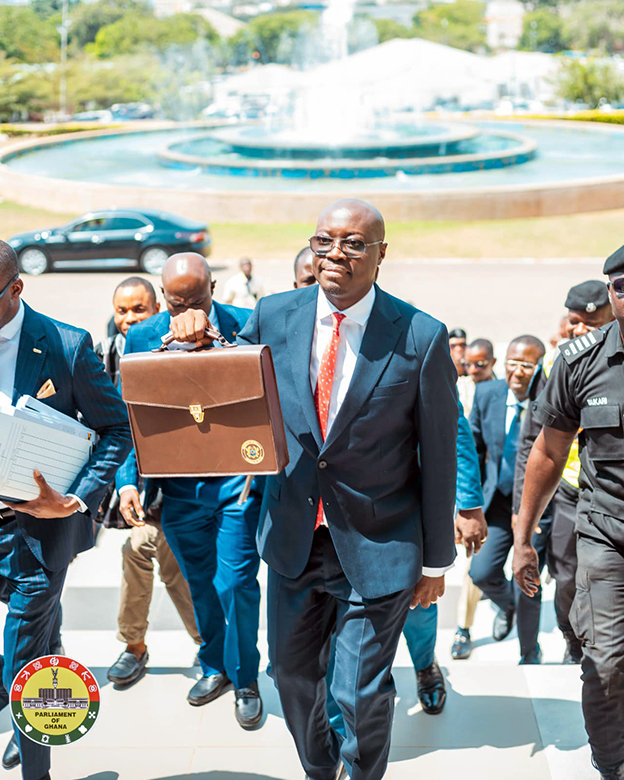
Investors and market dealers alike in Treasury securities, fixed-income, interbank, foreign-exchange and equity-market activity are pausing any major changes in their financial market positioning as they wait to assess the implications of the upcoming November 12 fiscal and economic policy statement.
Ghana’s financial markets are approaching the presentation of the 2027 Budget Statement and Economic Policy to Parliament on November 12 against a critical test of investor confidence: whether the Government will consolidate the gains from macroeconomic stabilization while pursuing its stated ambition of accelerating productive-sector investment and employment creation without compromising fiscal discipline.
The principal question for dealers, institutional investors, banks, fund managers and corporate issuers is how the proposed fiscal programme will affect government borrowing requirements, Treasury bill yields, domestic liquidity, the exchange rate, interest rates and equity valuations.
Government treasuries investors retreat to the short term

The clearest indication of investor positioning has emerged from the primary Treasury securities market, where demand strengthened considerably in the latest auction, suggesting that investors are not withdrawing from government debt despite uncertainty surrounding the forthcoming fiscal programme.
According to the Bank of Ghana’s latest auction results, published for the week ended November 6, investors submitted bids totaling GH¢5.01 billion, almost double the GH¢2.55 billion recorded at the preceding auction. The amount exceeded the Government’s GH¢3.54 billion target by 41.5 per cent.
The Treasury accepted GH¢4.11 billion, exceeding its target by approximately GH¢564 million.
However, the distribution of subscriptions is revealing. The 91-day bill attracted some 60% of all the bids, at GH¢3 billion, while the 182-day instrument received GH¢1.62 billion and the 364-day bill just GH¢388.45 million.
Yields remained relatively subdued. The 91-day rate settled at 4.56 per cent, the 182-day at 6.20 per cent and the 364-day at 9.48 per cent. The latter two declined by six and 12 basis points respectively, although the 91-day rate edged upwards by two basis points.
This combination of stronger demand and relatively low yields suggests that investors retain confidence in the Government’s immediate debt-servicing capacity and are prepared to maintain exposure to domestic securities. Nevertheless, the preference for shorter maturities indicates that some investors may be reluctant to commit funds for longer periods before the Budget clarifies the borrowing programme and fiscal outlook.
Secondary market investors holding what they have
The secondary fixed-income market presents a somewhat different picture.
GFIM recorded GH¢1.44 billion in transactions on November 4, GH¢958.30 million on November 5 and approximately GH¢1.20 billion on November 6.
The November 6 activity comprised GH¢682.01 million in Domestic Debt Exchange Programme bonds and GH¢503.25 million in Treasury bills. Corporate bonds accounted for just GH¢5.78 million, while commercial paper contributed GH¢2.02 million.
The three reported daily volumes therefore averaged approximately GH¢1.20 billion.
This compares with October’s GH¢48.13 billion in total GFIM trading volume, equivalent to an approximate daily average of GH¢2.1 billion, over about 23 trading sessions.
This suggests a substantial reduction in secondary-market turnover. Indeed, a separate Tesah Capital Research assessment also reported a 43.7 per cent contraction in secondary fixed-income trading over the latest comparison week.
The implication is that investors may be retaining government securities while becoming less active in buying and selling them pending greater clarity about the Government’s financing requirements, refinancing strategy and possible implications for future bond prices as will be revealed in the upcoming 2027 budget statement..
The interbank funds market provides another important indication of liquidity conditions.
The Bank of Ghana’s monetary-policy rate remains 14 per cent, following its September Monetary Policy Committee decision. Its October investor bulletin had earlier reported an interbank weighted-average rate of approximately 10 per cent, reflecting relatively comfortable banking-system liquidity.
However, sufficiently detailed daily interbank transaction volumes and comparable November-versus-October averages were not available to establish whether banks have materially reduced their willingness to lend to one another ahead of the Budget.
The foreign-exchange market, meanwhile, has exhibited some movement in the cedi.
Bank of Ghana data put the interbank dollar exchange rate at GH¢11.64 on November 6, compared with GH¢11.66 on November 5. Retail forex reporting indicated a considerably weaker selling rate of approximately GH¢12.25 on November 6.
The marginal interbank appreciation suggests that there has not yet been a pronounced exchange-market reaction to the impending fiscal announcement. Nevertheless, the divergence between interbank and retail quotations underlines the importance of monitoring market liquidity and foreign-currency supply.
Investors will particularly want assurances that the 2027 financing programme will not generate renewed pressure on the cedi through excessive domestic liquidity creation or increased foreign-exchange demand.
Equity markets correction amid continued trading
The Ghana Stock Exchange has experienced a more visibly cautious period.
The GSE Composite Index closed at 14,112.83 on November 4, before declining to 13,966.79 on November 5 and recovering to 14,000.37 on November 6.
Despite Friday’s recovery, the benchmark ended the week approximately 2.11 per cent below its October-end level of 14,302.27.
The Financial Stocks Index also declined, finishing November 6 at 7,269.22, against 7,388.15 at October-end.
Market capitalization fell to GH¢263.27 billion from GH¢268.15 billion at the end of October.
Trading turnover also warrants attention. November 4 recorded GH¢11.04 million, while November 5 saw GH¢6.96 million. Available November 6 market data put turnover at approximately GH¢6.32 million.
The three sessions consequently averaged approximately GH¢8.1 million, substantially below October’s average daily equity turnover of approximately GH¢15 million, based on 23 trading sessions.
However, the weekly picture is less uniformly negative: reported turnover for the week to November 6 rose 23 per cent to GH¢69.61 million. This suggests that the slowdown in individual sessions should not automatically be interpreted as a wholesale withdrawal of investors.
Budget expectations and investor positioning
Taken together, the evidence points to a market exhibiting caution, rather than any broad loss of confidence.
The strongest evidence of confidence remains the substantial oversubscription of the latest Treasury bill auction. Conversely, reduced secondary fixed-income turnover, a weakening equity benchmark and lower daily share-trading values suggest that some investors are postponing fresh commitments or adjusting portfolios.
Much will depend on the November 12 presentation by Finance Minister Dr Cassiel Ato Forson.
Investors will be examining the projected fiscal deficit, domestic borrowing requirements, expenditure allocations, revenue mobilization measures, debt-service commitments and the Government’s proposed balance between fiscal consolidation and productive-sector investment.
They will also be looking for consistency with Ghana’s IMF-supported Policy Coordination Instrument and assurances that increased economic activity will not undermine the gains achieved through macroeconomic stabilization.
Ultimately, the Budget’s credibility will be judged not simply by its growth and employment ambitions, but by whether its financing arrangements are sufficiently disciplined to preserve declining inflation, manageable interest rates, exchange-rate stability and confidence in Ghana’s domestic capital markets.
By: Toma Imirhe / businesspostonline