

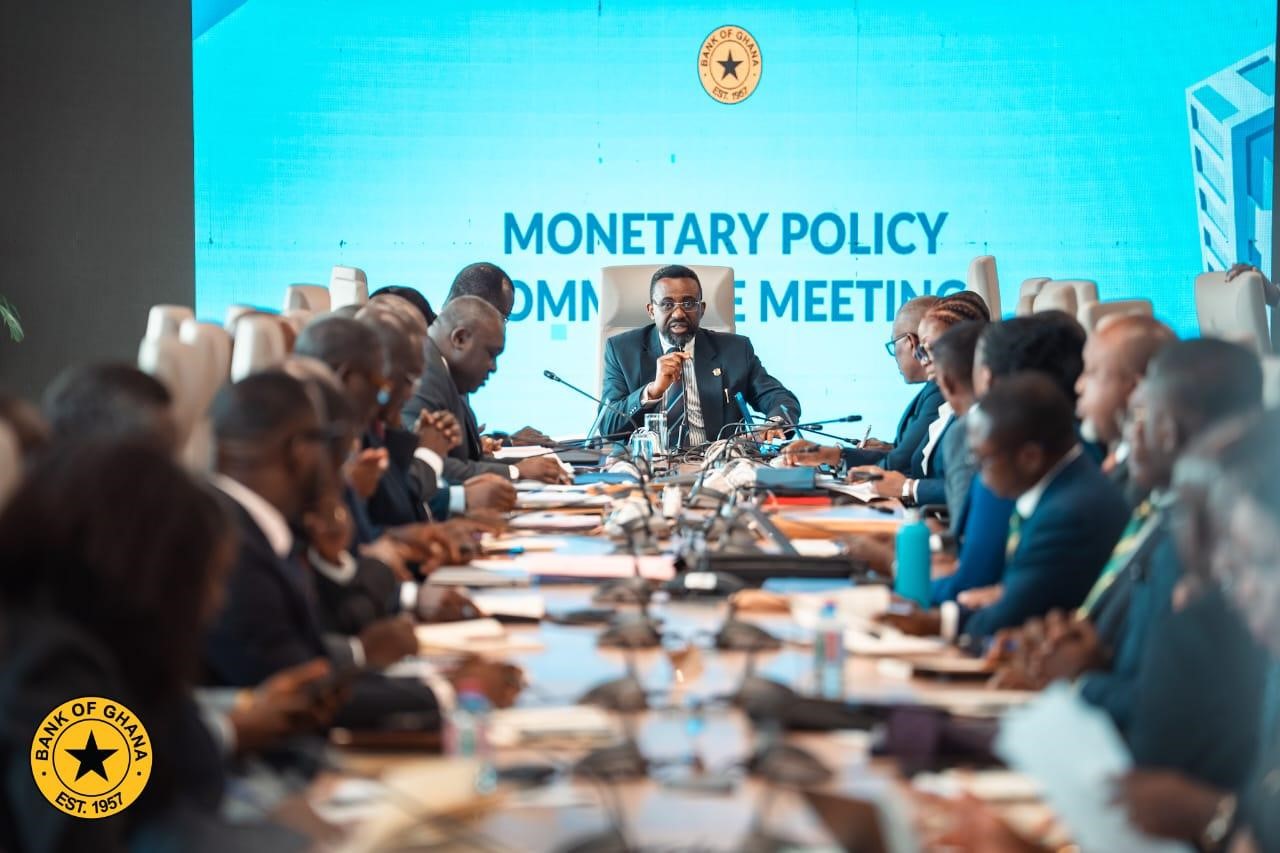
The Bank of Ghana (BoG) has maintained its Monetary Policy Rate (MPR) at 14 percent, citing renewed geopolitical tensions in the Middle East, rising crude oil prices and emerging inflation risks despite strong domestic economic performance.
Announcing the decision at the conclusion of the 131st Monetary Policy Committee (MPC) meeting, the Governor of the Bank of Ghana, Dr. Johnson Pandit Asiama, said the committee unanimously agreed to keep the policy rate unchanged to support price stability while assessing the implications of global developments on the domestic economy.
The MPC noted that escalating conflict in the Middle East, including disruptions to major trade routes and energy supplies, has reignited volatility in global energy markets and poses risks to the global growth outlook.
According to the central bank, crude oil prices have rebounded above US$85 per barrel, slowing disinflation efforts across several economies and prompting many central banks to pause monetary policy easing cycles.

Despite these challenges, the International Monetary Fund (IMF) has projected global growth at 3 percent in July 2026, broadly in line with its April forecast of 3.1 percent, supported by significant investments in artificial intelligence and measures to stabilize global energy supplies.
The MPC observed that Ghana’s economic activity remained resilient in the first quarter of 2026, with real GDP growth reaching 6.4 percent, compared to 6.2 percent recorded in the corresponding period of 2025.
The Bank’s Composite Index of Economic Activity (CIEA), which tracks high-frequency indicators, recorded annual growth of 13.4 percent in May 2026, a sharp increase from 4.4 percent a year earlier.
The expansion was driven by improvements in private sector credit, international trade, industrial production and tourist arrivals.
Consumer and business confidence surveys conducted in June also showed positive sentiment, underpinned by optimism about growth prospects, lower inflation and declining lending rates.
Headline inflation rose to 5.3 percent in June 2026, from 3.7 percent in May, driven by increases in both food and non-food prices.
Food inflation increased to 3.9 percent from 3.3 percent, while non-food inflation climbed to 6.3 percent from 4.1 percent over the same period.
The central bank attributed the increase largely to base effects and a temporary rise in transport fares following higher crude oil prices.
However, inflation remains below the lower limit of the Bank of Ghana’s medium-term target band of 8 percent ±2 percent.
Core inflation, which excludes energy and utility costs, also increased, while inflation expectations among businesses, consumers and banks remained broadly anchored within the target range.
Money supply and credit growth accelerate
Monetary aggregates expanded significantly during the period.
Reserve money grew by 31.7 percent in June 2026, compared with just 2 percent a year earlier, reflecting stronger net foreign asset positions and changes in reserve requirements.
Similarly, broad money supply (M2+) increased by 28.5 percent, up from 15.6 percent in June 2025.
Private sector credit growth accelerated sharply to 40.2 percent, compared with 8.6 percent a year earlier, while real credit growth reached 34.1 percent.
The increase followed lower borrowing costs and stronger demand for credit.
Meanwhile, interest rates continued their downward trend. The yield on the benchmark 91-day Treasury bill declined to 5.3 percent in June 2026, compared to 14.7 percent a year earlier.
The Ghana Reference Rate also eased to 10 percent from 23.8 percent, while average lending rates fell to 15.6 percent from 27 percent.
The MPC said fiscal performance during the first quarter broadly reflected strong expenditure restraint despite revenue shortfalls, resulting in better-than-targeted fiscal balances.
Public debt stood at GH¢720.8 billion, representing 45.1 percent of GDP at the end of May 2026, compared with GH¢613.4 billion, or 42.8 percent of GDP, at the end of December 2025.
The banking sector continued to show signs of recovery and resilience.
Total industry assets increased by 30.7 percent to GH¢502.4 billion, supported by growth in deposits, borrowings and shareholders’ funds.
Banks’ Capital Adequacy Ratio (CAR) improved significantly to 20.4 percent in June 2026 from 10.6 percent a year earlier.
Asset quality also strengthened, with the Non-Performing Loan (NPL) ratio declining to 16.1 percent, from 23.1 percent in June 2025.
Despite the improvement, the Bank of Ghana cautioned that elevated credit risks remain a vulnerability and called for continued adherence to prudential measures to further reduce NPL levels across the industry.
Ghana’s external sector recorded a strong performance in the first half of 2026, supported by increased export earnings from gold and cocoa.
The trade surplus widened to US$8.8 billion from US$5.8 billion during the same period in 2025.
Similarly, the current account surplus increased to US$5.1 billion, compared with US$4.1 billion a year earlier.
Gross International Reserves stood at US$12.9 billion at the end of June 2026, equivalent to five months of import cover, down from US$13.8 billion at the end of December 2025.
The decline reflected elevated energy-related payments linked to the Middle East crisis.
The cedi also experienced some pressure, depreciating cumulatively by 9.5 percent against the US dollar as of July 17, 2026, although the central bank noted that the currency has shown signs of recovery after coming under pressure in May.
Looking ahead, the MPC expects headline inflation to gradually return to the target band, although risks remain tilted to the upside.
The committee identified potential increases in utility tariffs, escalating geopolitical tensions and higher crude oil prices as key threats to the inflation outlook.
Nevertheless, the Bank believes continued fiscal consolidation and an appropriately calibrated monetary policy stance should help contain these risks.
“Given these considerations, the committee judged that the current policy stance remains appropriate to guide inflation into the medium-term target band while allowing time to assess evolving geopolitical developments and their potential impact on the domestic economy,” Dr. Asiama said.
Source: businesspostonline