

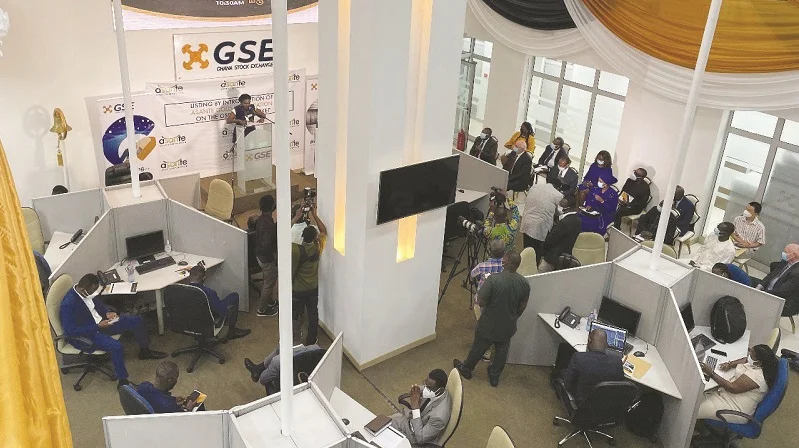
Equities listed on the Ghana Stock Exchange (GSE) have extended their positive momentum into the opening two weeks of July, with prices remaining resilient despite relatively moderate trading activity compared with the more active month of June. During the first two weeks of July 2026, the GSE Composite Index (GSE-CI) increased by 132.76 points (0.90%), although the GSE Financial Stocks Index (GSE-FSI) fell slightly by 11.15 points (-0.13%).
The indices moved from their June 2026 closing figures of 14,724.26 (GSE-CI) and 8,269.37 (GSE-FSI) to reach 14,857.02 and 8,258.22 respectively by mid-July.
The market experienced a brief correction in the first week before local investor sentiment drove a recovery during the second week. During the first week of the month the GSE-CI slipped by 0.53% to end at 14,689.01 points, and the GSE-FSI dropped 0.57% to 8,207.73 points. During the second week equities rebounded strongly, pushing the GSE-CI up to 14,857.02 points and expanding year-to-date (YTD) gains to 69.40%, from 14,577.13 points on July 1, 2026, which had translated to a year-to-date return of 66.21% as at that time.
The early July performance reinforces the view among many market analysts that Ghana’s equities market is on course to deliver an even stronger second half of 2026, supported by improving macroeconomic fundamentals, declining domestic interest rates relative to last year, sustained corporate earnings growth and renewed institutional investor participation.

The GSE Composite Index has continued to edge higher through mid-July, building on one of the strongest first-half performances recorded by the market in recent years, while the Financial Stocks Index has also maintained its upward trajectory on the back of continued investor demand for banking and insurance stocks.
Several blue-chip equities have continued to dominate trading activity. Banking stocks, particularly those with strong capital positions and improving profitability, remain among the most actively traded securities. Consumer goods, telecommunications-related companies and selected industrial stocks have also continued to attract institutional investors seeking earnings stability amid Ghana’s gradually improving economic environment.
The total equity trading volume for the first half of July 2026 reached approximately 41.52 million shares, a figure heavily influenced by massive blocks of institutional block trades like Access Bank Ghana. Cumulative equity trading for the first half of 2026 stood at a staggering 801.97 million shares valued at GH¢3.88 billion, marking a huge 431.35% increase in volume compared to the first half of 2025. The first half of July was heavily impacted by a massive, single-session institutional surge on Monday, July 13, where market turnover reached a colossal GH¢289.95 million due to heavy transactions in Access Bank shares before normalizing back to 3.79 million shares the following day. Net of these transactions, trading volumes moderated during the first two weeks of July compared with the previous period.
Market participants attribute the high trading volumes during the first half of this year primarily to profit-taking by investors following substantial capital gains during the period rather than any deterioration in investor confidence. With many listed companies having already guided investors on encouraging first-half year operating performance, some investors have now temporarily adopted a wait-and-see approach ahead of interim financial statements expected later in the quarter.
Analysts note that lower trading volumes are not unusual immediately after a sustained rally. Instead, they often represent a period during which investors reposition their portfolios before fresh corporate disclosures and macroeconomic developments provide new trading catalysts.
The broader economic environment continues to favour listed equities. Ghana’s inflation has moderated dramatically compared with the elevated levels experienced during the country’s recent economic crisis, while the relative stability of the cedi has reduced exchange-rate uncertainty for both domestic and foreign portfolio investors. Interest rates, although still relatively high by international standards, have eased sufficiently to encourage some institutional investors to diversify part of their portfolios away from fixed-income securities into equities offering stronger capital appreciation prospects.
Another important driver has been the continued recovery in corporate profitability. Commercial banks have reported stronger earnings as credit quality improves and loan growth gradually resumes. Insurance companies continue to benefit from stronger investment income and expanding premium collections, while several manufacturing companies have enjoyed lower imported input costs as exchange-rate volatility has diminished.
Research published by several Ghanaian brokerage firms, including SIC Brokerage, IC Securities and Databank Brokerage, has consistently argued throughout 2026 that Ghanaian equities remain attractively valued despite the impressive gains already recorded during the first half of the year. These firms have generally maintained ‘buy’ recommendations on fundamentally strong banking stocks, selected consumer companies and diversified financial services firms, citing healthy earnings growth, robust dividend prospects and attractive price-to-earnings multiples relative to comparable emerging equity markets.
Many analysts also believe foreign portfolio participation could strengthen further during the second half of the year if Ghana continues to meet its macroeconomic reform commitments under the IMF-endorsed programme. Continued fiscal consolidation, stronger international reserves and sustained exchange-rate stability would improve investor confidence while reducing the country-risk premium demanded by international investors.
The Government’s forthcoming mid-year budget review scheduled for July 23 is another event being closely monitored by equity investors. Markets will be looking for confirmation that fiscal discipline remains intact, that government borrowing requirements continue to moderate and that reforms supporting private-sector investment remain on course. Positive signals from the budget review could further strengthen investor appetite for listed equities.
Most equity analysts expect financial stocks to remain among the strongest performers during the remainder of 2026. Banks that have consistently delivered strong earnings growth, maintained healthy capital adequacy ratios and demonstrated prudent risk management – such as GCB Bank and Ecobank – are widely expected to continue outperforming the broader market. Enterprise Group is also frequently cited as an attractive long-term investment because of its diversified insurance operations and growing investment portfolio. MTN Ghana continues to feature prominently in many research recommendations because of its dominant market position, expanding mobile money business and consistent cash generation. Consumer-focused companies with improving margins are likewise expected to benefit from strengthening household purchasing power as inflation continues to ease.
Market strategists also identify dividend-paying stocks as likely outperformers during the second half. In an environment where investors continue to seek reliable income alongside capital appreciation, companies with established dividend records are expected to remain attractive to pension funds, insurance companies and collective investment schemes.
Overall, the consensus outlook remains positive. Although market volatility cannot be ruled out, particularly if global financial conditions become less supportive or domestic inflation unexpectedly accelerates, most analysts expect the Ghana Stock Exchange to record stronger overall performance during the second half of 2026 than during the first.
By: Toma Imirhe / businesspostonline