

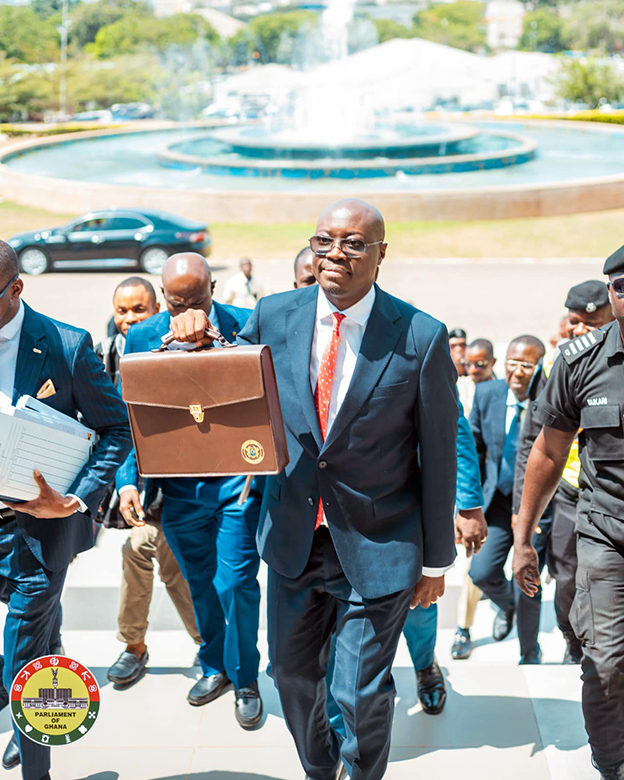
With barely a week until Ghana’s 2026 Mid-Year Budget Review, which Finance Minister Dr. Cassiel Ato Forson is scheduled to present to Parliament on Thursday, July 23, government officials have taken a tight-lipped stance to enquiries as to what it will contain, a position which is increasingly seen as emanating from the fact that it will not contain any major changes from the retention of the fiscal consolidation course announced in the original 2026 budget announced in November last year.
Business Post has learnt that quantitatively, the review will not introduce a fundamentally new fiscal framework. Instead, it will revise key macroeconomic assumptions to reflect developments during the first six months of 2026. Revenue projections are likely to be adjusted upwards modestly to reflect stronger-than-anticipated tax collections following improvements in compliance and digital tax administration, although first-quarter revenues reportedly fell slightly below projections. Expenditure estimates are also expected to be recalibrated to accommodate higher-than-budgeted allocations for infrastructure, agriculture, education and health while preserving the government’s primary surplus target under the recently exited IMF programme.
The review is expected to increase allocations to several priority sectors without significantly widening the fiscal deficit. Infrastructure spending is likely to receive additional resources, particularly for road rehabilitation, flood mitigation works, water supply projects and energy infrastructure. Additional funding may also be directed toward education infrastructure to support the government’s commitment to eliminating the double-track senior high school system, while health sector allocations could be enhanced to improve primary healthcare delivery and pharmaceutical supplies.
Government officials indicate that the review will represent a shift from stabilization to growth rather than a departure from prudent fiscal management as the government is now expected to use the review to outline measures aimed at accelerating economic growth, creating jobs and stimulating private sector investment while maintaining overall fiscal discipline.

This will involve directing funds into job creation, youth employment within digital and creative sectors, and local manufacturing to support the 24-Hour Economy initiative.
There will be a stronger emphasis on employment creation. Government has consistently indicated that macroeconomic stability alone is insufficient unless accompanied by tangible improvements in household incomes and employment opportunities. Consequently, the review is expected to announce expanded labour-intensive public works, youth entrepreneurship programmes, digital economy initiatives and targeted incentives for manufacturers capable of generating significant employment.
The government also plans to place greater emphasis on private sector-led growth by announcing measures aimed at improving access to credit for small and medium-sized enterprises, accelerating public-private partnerships, simplifying investment approval procedures and expanding industrial production.
It will also aim at boosting the agricultural sector through modernization, including investments in 50 farmer service centers for mechanization, irrigation networks, fertilizer/seed supplies, and poultry projects designed to improve domestic food production in order to contain food inflation and reduce import dependence.
The reviewed budget for the second half of the year will also address funding gaps for public schools, universal feeding programmes, health sector worker incentives, and Technical and Vocational Education Training (TVET) infrastructure.
Tax administration rather than new taxation is expected to dominate the revenue side of the review. Instead of introducing significant new taxes, government officials say they plan to focus on strengthening compliance, widening the tax net, expanding electronic invoicing systems, improving customs administration and intensifying efforts against tax evasion. Such measures would allow revenue mobilization to increase without imposing substantial additional burdens on compliant taxpayers.
The review is also expected to reaffirm government’s commitment to ongoing public financial management reforms. These include tighter expenditure controls, enhanced procurement transparency (through the establishment of a new, Value for money Office), improved debt management and continued implementation of fiscal responsibility legislation designed to prevent expenditure overruns that characterized previous fiscal years.
Government borrowing projections will also be revised. Domestic borrowing requirements have eased considerably following stronger Treasury bill demand, lower interest rates and improving investor confidence. Consequently, the revised budget is expected to reduce reliance on expensive short-term financing while increasing the use of longer-dated domestic securities where market conditions permit. In this regard government’s desires should be aided by increased demand for longer dated treasury bills at recent auctions although will come at a cost due to the steep yield curve currently in place for government securities. External borrowing estimates are expected to remain broadly unchanged though, with emphasis continuing to be placed on concessional financing and multilateral support rather than commercial borrowing.
Inflation assumptions may also be adjusted. The original budget anticipated a continued decline in inflation throughout the year. However, following the rise in June inflation rate to 5.3% and some renewed food price pressures, the revised projections may adopt a more cautious path while still forecasting single-digit inflation by year-end. Likewise, growth projections could be revised slightly upward if stronger-than-expected performances in mining, gold exports, construction and services continue during the second half of the year.
The adjustments are being made primarily because Ghana’s macroeconomic environment has improved considerably during the first half of 2026. Inflation has moderated substantially compared with previous years, the cedi has exhibited greater stability, interest rates have declined, international reserves have strengthened and investor confidence has improved. These developments provide government with greater fiscal flexibility than existed when the original budget was prepared.
At the same time, significant challenges remain. Businesses continue to complain about relatively high borrowing costs despite falling Treasury bill rates, unemployment remains elevated, infrastructure deficits persist and public expectations for improved living standards have increased. The government therefore faces the delicate task of using its improved fiscal position to stimulate economic activity without jeopardizing the hard-won gains in macroeconomic stability.
Overall, the July 23 Mid-Year Budget Review is expected to be evolutionary rather than revolutionary. It will maintain the broad fiscal framework established in the 2026 Budget while fine-tuning macroeconomic projections, reallocating expenditure towards priority sectors and signaling a gradual policy shift from stabilization to sustainable, private sector-led growth and employment creation
By: Toma Imirhe / businesspostonline