

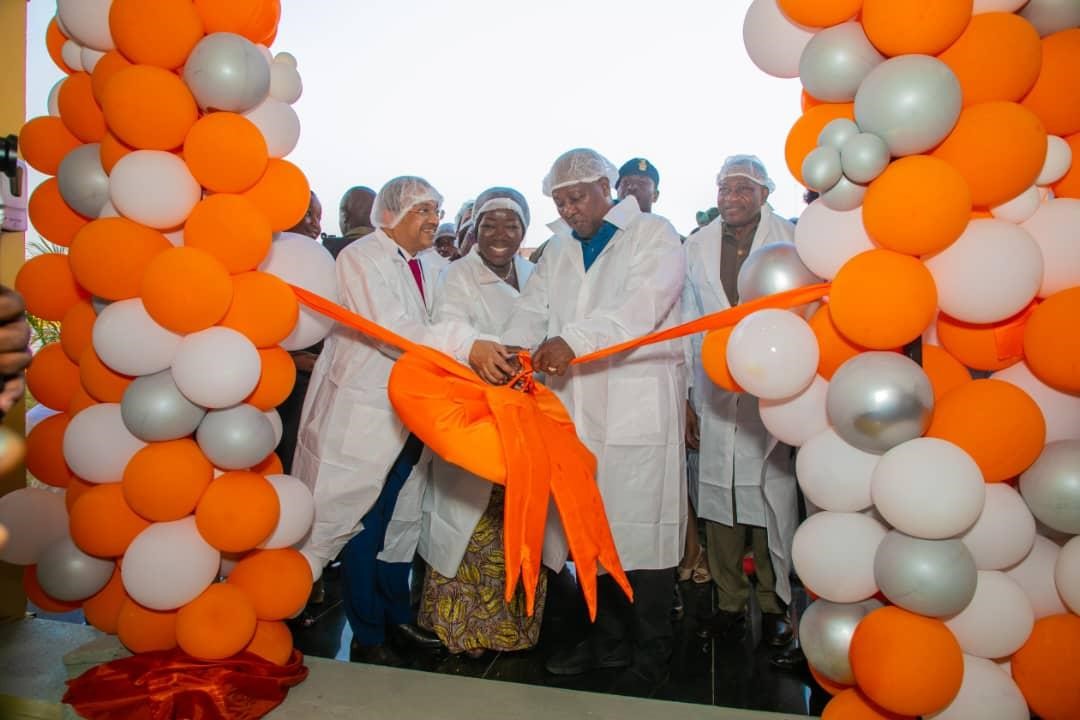
President John Dramani Mahama has commissioned Ghana’s first state‑of‑the‑art pasta manufacturing facility, describing the US$40 million investment by Olam Agri as a major step in the country’s transition from import dependence to strengthened domestic production and industrial expansion.
Speaking at the commissioning ceremony in Accra, the President said the new facility represents “a conscious shift—from reliance to production; from missed opportunities to targeted industrial growth,” adding that Ghana can no longer afford to outsource value creation by importing products it has the capacity to manufacture locally.
“When production occurs elsewhere, the economic cost is borne here at home,” he said. “Today, Olam Agri has demonstrated how partnership, technology and long‑term commitment can deliver real factories, real jobs and real transformation on the ground.”
The President emphasised that the investment aligns seamlessly with government’s Agriculture for Economic Transformation Agenda, which seeks to modernise agriculture, expand agro‑processing and create sustainable employment.

He highlighted ongoing industrial developments across the country—from poultry processing and steel production to new tile, sanitary ware and cement plants—all aimed at strengthening Ghana’s manufacturing base.
He announced that the new pasta facility qualified under the government’s 24‑Hour Economy Initiative, which offers incentives such as duty‑free importation of equipment for expansion.
“The 24‑Hour Economy Authority Bill has been passed, and implementation is underway,” the President said. “This facility will operate a shift system and stands among the first to benefit.”
The new pasta plant expands Olam Agri’s wheat milling and pasta manufacturing capabilities in West Africa and is designed with advanced processing technology to deliver premium, fortified products.
Beginning with spaghetti production, the factory will later introduce macaroni and other pasta varieties to meet growing consumer demand.
With an annual production capacity of up to 60,000 metric tonnes, the factory is expected to reduce Ghana’s rising pasta import bill.
Between 2021 and 2024, Ghana imported approximately US$140 million worth of pasta.
President Mahama announced a scientific breakthrough by the CSIR‑Crops Research Institute, which has developed a wheat variety suited to Ghana’s climate, with yields of five to six tonnes per hectare during trials.
“This discovery can significantly reshape our food production landscape,” he said, urging Olam Agri to collaborate with CSIR to gradually integrate locally grown wheat into its supply chain.
President Mahama reaffirmed government’s commitment to protecting domestic manufacturing, referencing recent import restrictions on vegetable oil, rice, tomato puree and mackerel. He noted that pasta may be considered for similar measures to curb smuggling and unfair competition.
“With this facility, Ghana takes another important step towards strengthening local production, creating jobs and building a more resilient national economy,” he said.
Mrs Elizabeth Ofosu‑Adjare, Minister for Trade and Industry, said the commissioning demonstrated that Ghana’s economic reset agenda was yielding results.
“This facility is projected to meet a substantial share of domestic demand, drastically reduce imports, and position Ghana as a net exporter of pasta within the sub‑region,” she said.
Olam Agri’s investment will generate about 300 direct and indirect jobs across operations, engineering, supply chain and distribution. Employees have undergone specialised training to operate advanced systems, ensuring high standards of quality, safety and efficiency.

Sustainability features prominently in the factory’s design, with high‑efficiency energy systems and resource‑optimised processes that reduce environmental impact.
Mr. Baibhav Biswas, Country Head of Olam Agri Ghana, said the company was proud to deepen its contribution to Ghana’s industrial landscape.
“From today, every packet of pasta consumed in Ghana can be produced locally—by Ghanaian talent, on Ghanaian soil,” he said. “This strengthens domestic manufacturing, builds technical capacity and ensures that value generated through consumer demand remains within the national economy.”
Olam Co‑Founder and CEO Sunny Verghese added:
“Olam was born in Africa, and Ghana has always been central to our growth. This investment reflects our confidence in Ghana’s role as a hub for trade, production and sustainable value creation.”
Olam Agri operates Ghana’s largest state‑of‑the‑art wheat mill in Tema. The new pasta plant expands its portfolio of wheat-based foods and reinforces its commitment to building resilient, competitive value chains in Ghana.
Source: businesspostonline